

SDS1000X-E Series
The oscilloscope that made 14 Mpts of memory and free serial decoding normal at this price. 100 or 200 MHz, 1 GSa/s, up to 400,000 waveforms per second, in two- and four-channel models — from €339.
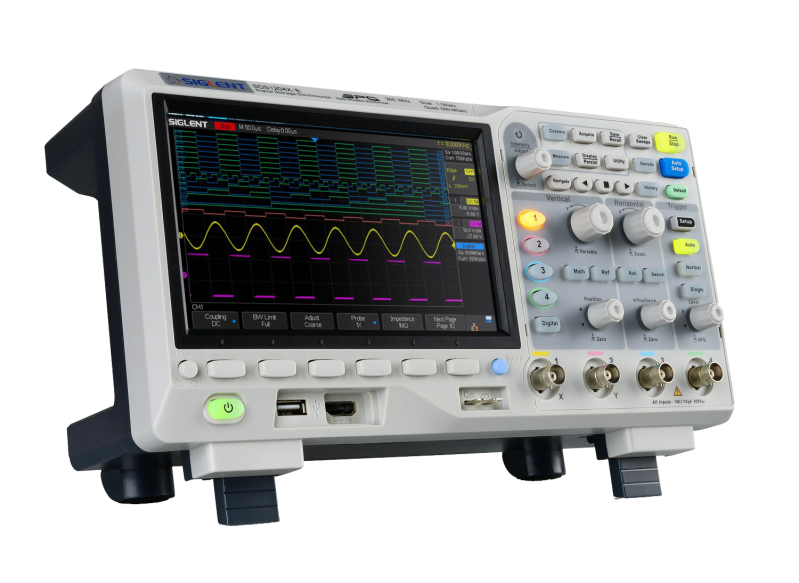
Still the reference point for a first serious oscilloscope
Most instruments in this price class are defined by what they leave out. The SDS1000X-E is defined by what it includes: 14 Mpts of record length as standard, serial triggering and decoding for I²C, SPI, UART/RS-232, CAN and LIN with nothing to license, a 1 Mpts FFT, 38 automatic measurements computed over every sampled point, and a display that grades 256 levels of intensity so infrequent events are visible instead of merely present.
The numbers behind it are honest ones. The two-channel model carries one 1 GSa/s converter and one 14 Mpts memory module; the four-channel models carry two of each, one per channel pair. That is why a four-channel X-E can run two channels at the full 1 GSa/s and 14 Mpts at the same time — use CH1 and CH3 — and why the four-channel models, not the two-channel one, carry every function that needs the second half of the hardware.
It is used in teaching laboratories, on embedded and power-electronics benches, in vehicle workshops and on production lines. The sections below set out where each model earns its place, what the four-channel models can do that the two-channel one cannot, and everything you can add to one.
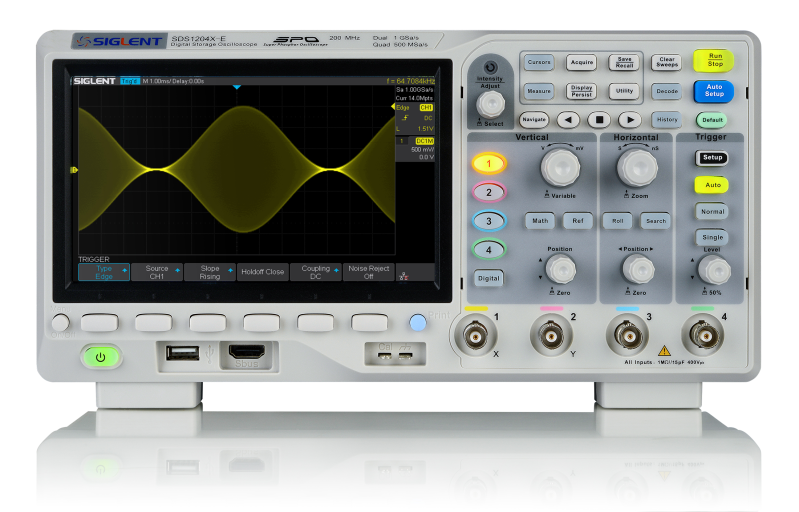
Three models
All three share the same acquisition engine, the same 7-inch display and the same standard serial decoding. Prices exclude VAT and include free shipping within the EU.
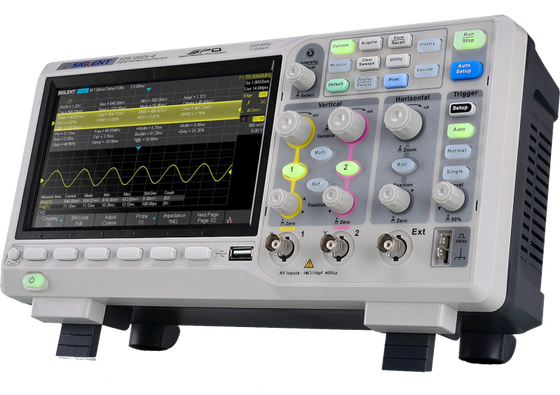
Two channels and an external trigger input at the full 200 MHz. One 1 GSa/s converter and one 14 Mpts memory module, so the headline numbers belong to whichever channel is on its own. The cheapest way into the series.
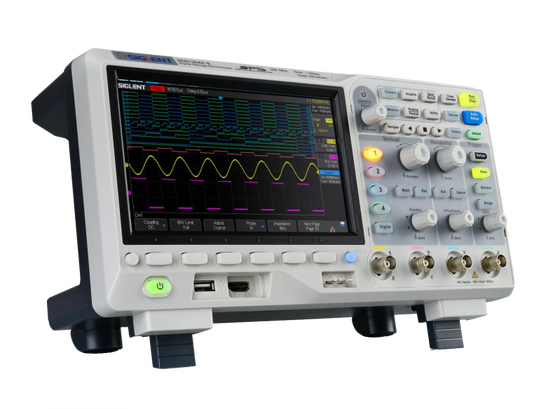
Four channels, two converters, two memory modules — and every four-channel-only function: MSO, the AWG module, Bode plot, web control, search and navigate, the counter and the data logger. 100 MHz is the only thing it gives up.
The complete instrument: four channels at 200 MHz, both converters, both memory modules, and 1.8 ns typical rise time instead of 3.5 ns. What you buy over the SDS1104X-E is edge resolution.
How to choose
Decide on channels first, not on bandwidth. If you will ever want mixed-signal, a Bode plot, web control or the data logger, you need a four-channel model — those functions do not exist on the SDS1202X-E and cannot be added to it. Then choose bandwidth: the SDS1104X-E resolves a 3.5 ns edge, the 200 MHz models 1.8 ns. If two channels at 200 MHz genuinely covers your work, the SDS1202X-E is the best value in the range.
Two channels or four — the full difference
This is the one comparison worth reading before you order, and it is on almost no product listing. Every row below comes from Siglent’s own data sheet, where these functions are marked “four channel series only”.
| SDS1202X-E | SDS1104X-E & SDS1204X-E | |
|---|---|---|
| Analogue channels | 2, plus an external trigger input | 4 |
| ADCs / memory modules | One 1 GSa/s ADC, one 14 Mpts module | Two 1 GSa/s ADCs, two 14 Mpts modules (CH1+CH2 share one, CH3+CH4 the other) |
| 1 GSa/s and 14 Mpts at the same time on | One channel | Two channels — one per pair, e.g. CH1 and CH3 |
| 16 digital channels (MSO) | — | Option: SLA1016 |
| Built-in AWG | — | Option: SAG1021I module + activation licence |
| Bode plot / control-loop response | — | Yes, including Vari-level for PSRR |
| Control from a web browser | — | Yes, embedded web server |
| Search and navigate | — | Yes |
| Channel labels | — | Yes |
| Hardware 6-digit counter | — | Yes |
| Data logger (sample + measurement) | — | Yes |
| FFT peaks and markers | — | Yes |
| NTP time synchronisation | — | Yes |
| USB host ports | 1 | 2 |
| Power / net weight | 25 W max · 2.5 kg | 50 W max · 2.6 kg |
Source: SDS1000X-E data sheet Rev. 04H, pages 1–2 and the specification tables on pages 7–15.
What every model does
Standard on the SDS1202X-E, the SDS1104X-E and the SDS1204X-E alike — no licences, no upgrades.
14 Mpts of record length
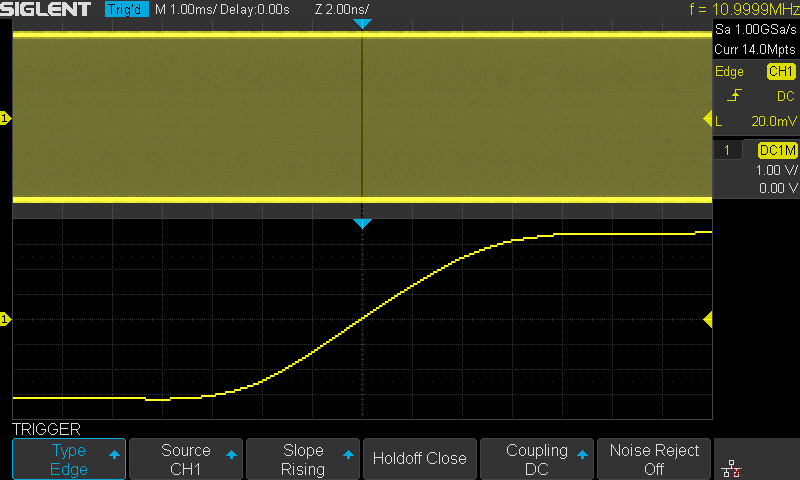
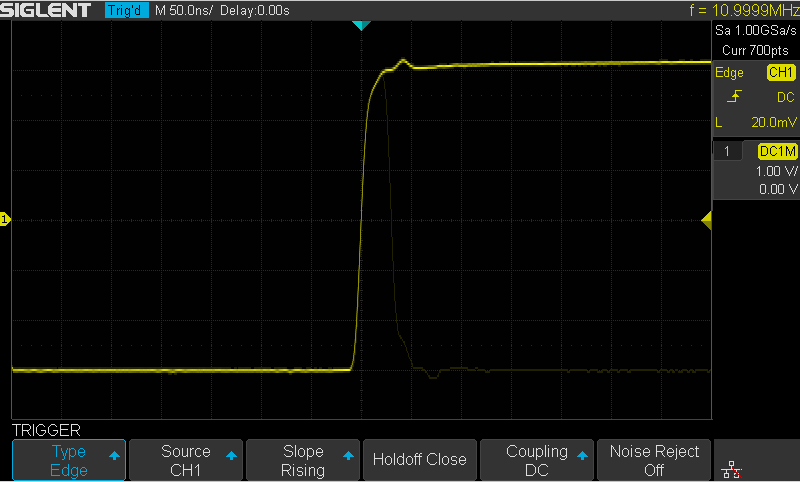
Standard, on every model — not an upgrade. Capture at a slow timebase and zoom in afterwards instead of guessing the right sweep speed before the event happens.
400,000 waveforms per second
100,000 wfm/s in normal mode and 400,000 wfm/s in sequence mode. A rare glitch is a statistics problem, and this is the number that decides how long you wait for it.
Serial decode included
I²C, SPI, UART/RS-232, CAN and LIN hardware triggering and decoding, with a tabular event list. No licence, on any model in the series.
256-level intensity grading
SPO display technology: frequent events are drawn brighter, infrequent ones dimmer, and colour-temperature mode maps occurrence to colour instead. Modulation and jitter become visible rather than inferred.
1 Mpts FFT
A hardware maths co-processor transforms up to a million points, so the spectrum has real frequency resolution and still refreshes quickly. Four-channel models add peaks and markers.
38 automatic measurements
With statistics, gating and history, computed over all 14 Mpts rather than the 700 points on screen — which is why the numbers agree with the waveform.
History and sequence
Up to 80,000 segments captured back-to-back with timestamps, and 80,000 frames of history to play back. Catch the intermittent fault once and then study it at leisure.
Hardware pass/fail
Up to 40,000 mask decisions per second against a user-defined template, with a 3.3 V TTL output on the rear — enough to gate a production fixture.
What 14 Mpts is actually for
Record length is the least intuitive number on an oscilloscope, so here it is as a picture. Both captures below show the same rising edge on the same instrument. The difference is whether you had to know in advance that you wanted to look at it.
And 400,000 waveforms per second is what finds the rare one
Deep memory decides how much of an event you keep. Capture rate decides how often you are looking. In sequence mode the SDS1000X-E writes up to 400,000 waveforms a second into as many as 80,000 timestamped segments, with only microseconds of dead time between them — so a fault that happens once every few thousand cycles is caught in seconds rather than left running overnight.
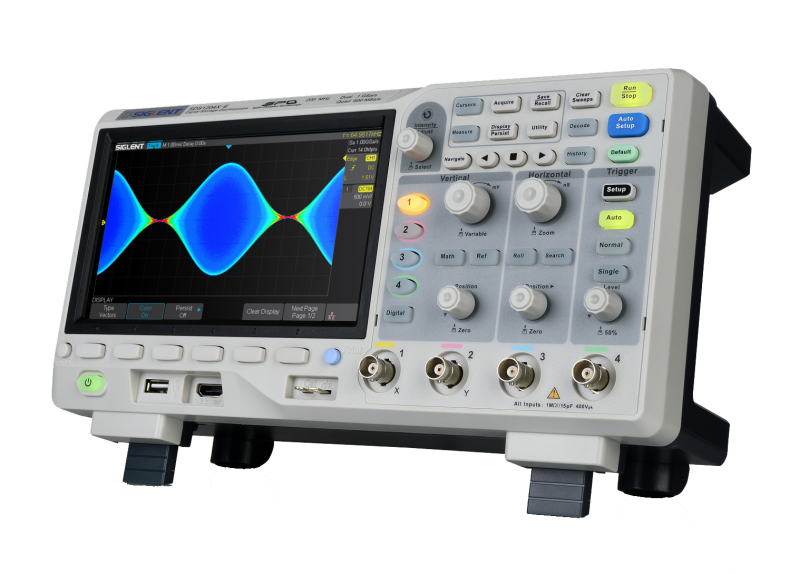
The 256-level intensity grading then does the interpretation for you. Frequent traces are drawn bright, rare ones dim; in colour-temperature mode occurrence becomes colour instead. Jitter, modulation and the one runt pulse in ten thousand stop being things you deduce and become things you see.
Where the SDS1000X-E is used
This series was designed as a general-purpose bench instrument, and that is how it is used — but the reasons differ by field, and so does the model you should buy. Functions described below as four-channel are not available on the SDS1202X-E.
Teaching and training laboratories
A 7-inch 800×480 screen readable from across a bench, ten one-button shortcuts, ten interface languages and embedded help. Cheap enough to equip a whole room, and the four-channel models can be watched from a browser on the instructor's machine. Pair one with the STB-3 demo board for known-good signals.
Embedded and IoT development
Four channels is exactly the shape of an embedded problem: clock, chip select, data and the reset or supply rail together. I²C, SPI, UART, CAN and LIN trigger and decode as standard, and the SLA1016 adds sixteen more digital channels when four analogue ones stop being enough.
Switch-mode power supply design
Ripple and switching-node work at 500 µV/div, differential probes across a floating gate drive, a current probe on the inductor — and on the four-channel models a full Bode plot of the control loop, with Vari-level mode for supply rejection.
Automotive and vehicle electronics
CAN and LIN triggering and decoding come with the instrument. Trigger on a specific identifier, or on an error frame, then use sequence mode and history to find the message that only goes wrong when the engine is hot.
Production test and end-of-line QA
Hardware pass/fail runs 40,000 mask decisions a second and drives a TTL line on the rear panel. LAN with VXI-11, Telnet and raw sockets means the whole instrument scripts over SCPI, and the price means every station can have one.
Service, repair and maintenance benches
38 automatic measurements with statistics for the routine checks, deep memory and zoom for the fault you cannot reproduce on demand, roll mode out to 100 s/div for slow drift. The rack kit builds it into a fixed test position; the BAG-S1 case makes it portable.
Analogue, audio and RF benches
500 µV/div minimum vertical scale with genuinely low front-end noise, a 1 Mpts FFT for spectrum work, and the maths set — add, subtract, multiply, divide, integrate, differentiate, square root — for the derived quantities.
Long-duration logging and monitoring
On the four-channel models the sample logger records from 1 Sa/s to 25 kSa/s straight to internal flash or a USB stick, and the measurement logger tracks up to four measured values at intervals from 0.1 s to 10 minutes. Environmental drift, battery discharge, thermal cycling.
Four jobs, start to finish
Feature lists are easy to write and hard to buy from. These are four real measurement problems, the way you would work through each one on this series, and exactly which capability — and which model — it depends on.
An I²C sensor that fails once an hour
A board reads a sensor every second and returns nonsense a few times a day. Nothing reproduces on demand, and watching the bus by eye is hopeless.
Trigger on the I²C condition itself — a missing acknowledge, or a specific address and data pattern — and leave the instrument in sequence mode. It fills up to 80,000 segments with timestamps and only microseconds of dead time between them. Come back later and walk the history frames until the decoded event list shows the bad transaction.
Standard I²C trigger and decode, sequence mode, 80,000 history frames. Nothing here is an option on any model in the series.
A power supply that rings when the load steps
A DC-DC converter is stable on the bench and overshoots badly in the product. The loop has too little phase margin, but nobody can say how much.
Fit the SAG1021I module to a four-channel X-E, break the feedback path with a small injection resistor and drive the injection transformer from the module's isolated output. The instrument sweeps from 10 Hz upward and plots gain and phase against frequency, at up to 500 points, with Vari-level mode keeping the drive sensible across the band.
Bode plot and Vari-level mode are four-channel models only, and need the SAG1021I hardware plus its activation licence. The module's ±42 Vpk isolation is what allows injection into a live loop.
A drive that trips on the factory floor
A motor drive throws an over-current fault intermittently. The DC bus is at several hundred volts, the fault lasts microseconds, and the machine cannot be taken away.
Take the instrument to the machine in its carry case. A DPB-series differential probe goes across the bus, a CP4000-series clamp round a phase, and the gate drive on a third channel. Trigger on the current channel, capture at a slow timebase with all 14 Mpts, then zoom into the microsecond that matters.
Four channels, deep memory with hardware zoom, and probes rated for the job — the scope inputs themselves are 400 Vpk and must never see the bus directly.
A student measuring rise time for the first time
A first-year laboratory exercise: measure the rise time of a logic edge, and understand why the answer changes with the probe.
Auto Setup, then the Rise Time measurement, then repeat with the probe set to 1× and 10×. The measurement runs over the whole record rather than the screen, statistics show the spread across acquisitions, and the difference between a 6 MHz and a 200 MHz probe setting is unmissable.
38 automatic measurements with statistics, computed on all sampled points, and PP215 or PP510 probes supplied with the instrument — four of them on the four-channel models.
Three of these four jobs can be done on any model in the series. The Bode plot cannot — it needs a four-channel instrument plus the SAG1021I module and its licence. If control-loop measurement is anywhere in your future, that decision is made at the moment you choose the oscilloscope.
Ask us which model fitsSpecifications
From the SDS1000X-E data sheet, Rev. 04H. Where a figure differs between models it is given for both.
| Bandwidth (−3 dB) | 100 MHz (SDS1104X-E) · 200 MHz (SDS1202X-E, SDS1204X-E) |
| Channels | 2 + external trigger (two-channel) · 4 (four-channel) |
| Sample rate | 1 GSa/s with one channel per ADC active · 500 MSa/s with both |
| Record length | 14 Mpts with one channel per ADC active · 7 Mpts/ch with both |
| Vertical resolution | 8-bit |
| Vertical scale | 500 µV/div to 10 V/div in 1-2-5 steps (probe 1×) |
| Input | 1 MΩ ±2% in parallel with 17 pF ±3 pF (four-channel) or 16 pF ±3 pF (two-channel) · max. 400 Vpk |
| DC gain accuracy | ±3.0% from 5 mV/div to 10 V/div · ±4.0% at 2 mV/div |
| Rise time (typical) | 1.8 ns (200 MHz models) · 3.5 ns (SDS1104X-E) |
| Timebase | 1 ns/div to 100 s/div · accuracy ±25 ppm · roll mode from 50 ms/div |
| Waveform capture rate | 100,000 wfm/s normal · 400,000 wfm/s sequence |
| Sequence and history | Up to 80,000 segments · up to 80,000 history frames |
| Trigger types | Edge, slope, pulse width, window, runt, interval, dropout, pattern, video (NTSC, PAL, 720p, 1080i, 1080p, custom) |
| Serial trigger & decode | I²C, SPI, UART/RS-232, CAN, LIN — standard on every model |
| Maths | +, −, ×, ÷, FFT (1 Mpts), d/dt, ∫dt, √ · FFT windows: rectangular, Blackman, Hanning, Hamming, flat-top |
| Measurements | 38 parameters with statistics, gating, zoom, history and reference — computed over all sampled points, up to 14 Mpts |
| Cursors | Manual and track, time and voltage |
| Pass/fail | Hardware-based, up to 40,000 decisions per second, 3.3 V TTL output |
| Display | 7-inch TFT-LCD, 800 × 480, 24-bit colour, 500:1, 300 nits · 256-level intensity grading and colour-temperature mode |
| I/O | USB host (1 two-channel, 2 four-channel) · USB device (USB-TMC) · LAN · pass/fail · trigger out · Sbus for the SLA1016 (four-channel) |
| Remote control | SCPI over VXI-11, Telnet (port 5024) and raw socket (port 5025) |
| MSO option (four-channel) | SLA1016 — 16 channels, 1 GSa/s, 14 Mpts/ch, 4 ns minimum detectable pulse, −8 V to +8 V, TTL / CMOS / LVCMOS3.3 / LVCMOS2.5 / custom thresholds |
| AWG option (four-channel) | SAG1021I — 1 channel, 25 MHz, 125 MSa/s, 14-bit, 16 kpts arbitrary, ±42 Vpk isolated output, 45 built-in waveforms |
| Bode plot (four-channel) | Start from 10 Hz · scan bandwidth 500 Hz to 120 MHz · up to 500 points · Vari-level mode |
| Data logger (four-channel) | Sample logger 1 Sa/s to 25 kSa/s · measurement logger, up to 4 values, interval 0.1 s to 10 minutes |
| Languages | English, German, French, Italian, Portuguese, Russian, Japanese, Korean, simplified and traditional Chinese |
| Power | 100–240 V 50/60 Hz or 100–120 V 400 Hz · 50 W max (four-channel), 25 W max (two-channel) |
| Dimensions | 312 × 132.6 × 151 mm (four-channel) · 312 × 134 × 150 mm (two-channel) |
| Weight | 2.6 kg net (four-channel) · 2.5 kg net (two-channel) |
| Environment | 0 to +40 °C operating · 85% RH · to 3,000 m |
| Standards | EMC 2014/30/EU, IEC/EN 61326-1 · UL 61010-1 and UL 61010-2-030, CAN/CSA-C22.2 equivalents |
Everything scripts
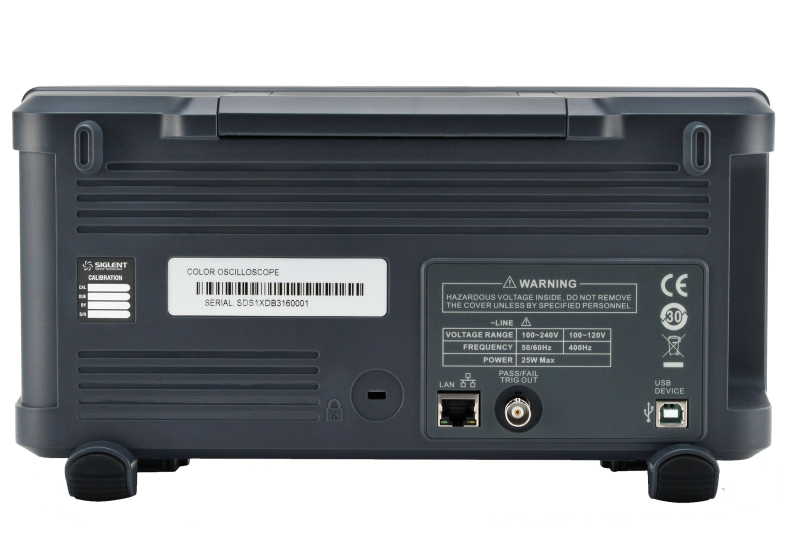
LAN and USB-TMC are standard on every model. The instrument answers SCPI over VXI-11, over Telnet on port 5024 and over a raw socket on port 5025, so it drops into an existing test framework without a vendor library — a Python socket and a command string are enough. The rear pass/fail line is a 3.3 V TTL output a fixture can read directly.
On the four-channel models an embedded web server adds a browser interface with a virtual front panel, in desktop and mobile layouts — useful for a screened room, a climate chamber, or simply a bench you would rather not stand at.
In the box
Every model arrives ready to work. The probes are matched to the model’s bandwidth, which on an oscilloscope at this price is a meaningful part of what you are buying.
| Oscilloscope | SDS1202X-E, SDS1104X-E or SDS1204X-E |
| Passive probes | Two PP215 with the SDS1202X-E · four PP510 with the SDS1104X-E · four PP215 with the SDS1204X-E, each with its accessory kit |
| Power cord | Regional mains lead |
| USB cable | USB-A to USB-B, for USB-TMC remote control |
| Quick start guide | Printed |
| Calibration certificate | Factory certificate of conformance |

Options and accessories
Everything below is stocked and can ship with the instrument. Prices exclude VAT. Note which items are four-channel only — they cannot be fitted to an SDS1202X-E at any price.
| Code | What it is | Price |
|---|---|---|
| SLA1016 | 16-channel logic probe module — the MSO hardware. Four-channel models only. 1 GSa/s, 14 Mpts/ch, supplied with interface cable, flying leads and grabbers. | €328 |
| SAG1021I | 25 MHz isolated USB arbitrary waveform generator module. Four-channel models only, and the source the Bode-plot function needs. ±42 Vpk isolated output. | €239 |
| SDS1000X-E AWG licence | The activation licence that unlocks generator control inside the oscilloscope. Required in addition to the SAG1021I hardware — the module alone will not do anything. | €95 |
| SDS1000X-E Wi-Fi module | Wireless module with its activation licence, for benches where an Ethernet run is impractical. | €102 |
| SDS1X-E-RMK | 19-inch 4U rack shelf with front panel and handles. Also fits the SDS1000X-U, SDS2000X-E and SDS800X HD. | €125 |
| BAG-S1 | Soft carry case sized for the whole SDS1000X-E family. | €59 |
| PP215 | Spare or extra 200 MHz 1×/10× passive probe, 150 V / 300 V RMS CAT II. | €30 |
| PP510 | Spare or extra 100 MHz 1×/10× passive probe, 150 V / 300 V RMS CAT II. | €16 |
| STB-3 | Demonstration and training board — square, sine, AM, fast edge, PWM, I²C, CAN and LIN sources for teaching and for checking an instrument. | €189 |
Two things worth knowing before you order an option
The AWG needs both parts. The SAG1021I module is the hardware; the AWG activation licence is what unlocks generator control inside the oscilloscope. A four-channel X-E needs both — €239 + €95 — and the module on its own will not do anything.
You do not need a decoding licence. I²C, SPI, UART/RS-232, CAN and LIN are standard on every SDS1000X-E. The “SDS1000X-DC” decoding licence sold elsewhere on this site is for the older SDS1000X family and does nothing for an X-E.
Add to your instrument
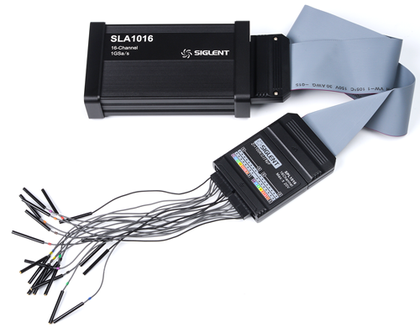
SLA1016 logic probe module
Sixteen digital channels alongside the four analogue ones. The single biggest capability step available for a four-channel SDS1000X-E.
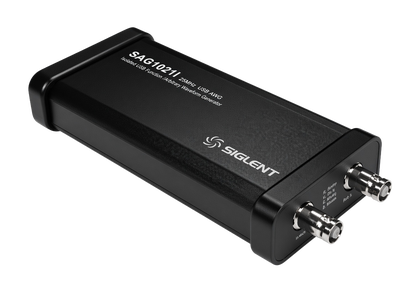
SAG1021I AWG module
The isolated 25 MHz source that turns a four-channel X-E into a Bode-plot instrument. Needs the activation licence as well.
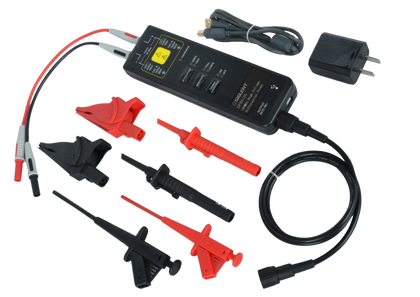
Differential high-voltage probes
For floating measurements the 400 Vpk scope inputs cannot make on their own — gate drives, DC buses, mains-referenced circuits. DPB4080 to DPB5700A.
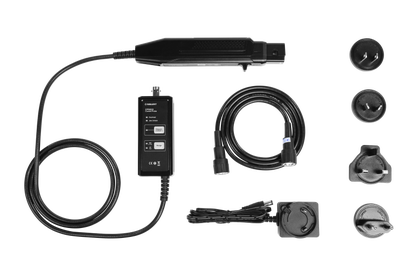
Current probes
Clamp round a conductor and read amps without breaking the circuit. CP4000 and CP5000 series, 60 A to 500 A.

HPB4010 10 kV probe
DC to 40 MHz, 1:1000, for ignition, insulation and electrostatic work.
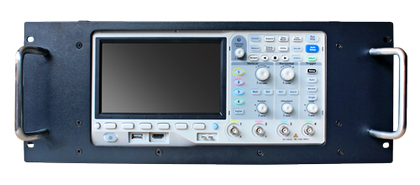
SDS1X-E-RMK rack shelf
19-inch, 4U, with handles — for building the instrument into a fixed test rack.
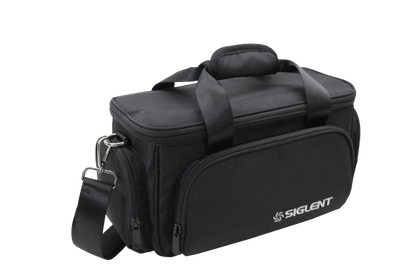
BAG-S1 carry case
Padded soft case for the instrument, its probes and its leads. The difference between a bench scope and a portable one.
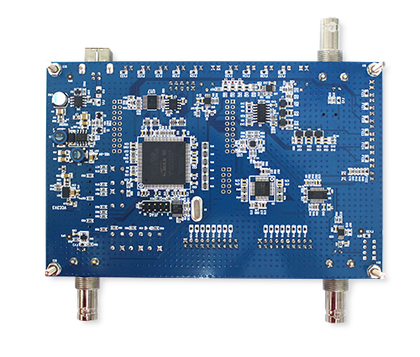
STB-3 demo and training board
Known-good square, sine, AM, fast-edge, PWM, I²C, CAN and LIN signals — for teaching, and for proving an instrument is behaving.
Manuals, data sheets and downloads
Every document Siglent publishes for this series. These links go to the factory download service, which always serves the current revision — so a bookmark here does not go stale when a manual is reissued.
The complete specification for all three models, including every function marked four-channel-only.
How to drive the instrument: acquisition, triggering, serial decode, maths, measurement, history, sequence, pass/fail and the four-channel-only functions.
Unpacking, first power-up, front and rear panel layout and the safety notes.
The full SCPI command set for the SDS1000, SDS2000X and SDS2000X-E families — everything needed to automate the instrument over LAN or USB-TMC.
Block diagrams, disassembly and the performance verification procedure.
How the sample logger and the measurement logger work in practice on the four-channel models.
Measuring power-supply control-loop response with the Bode plot function and the SAG1021I module.
Measuring the modulation index of an AM signal on an SDS oscilloscope.
The binary waveform file format, for anyone post-processing captures on a computer.
Specifications for the whole Siglent probe range, including the supplied PP215 and PP510.
Which probe and accessories ship with which oscilloscope, as published by the factory.
Licences for the open-source components used in the instrument firmware.
Firmware
The two-channel and four-channel models take different firmware — check the model on your front panel before installing anything.
For the SDS1104X-E and SDS1204X-E.
The operating-system image for the four-channel models — read the release notes before installing.
For the SDS1202X-E.
Older firmware revisions, operating-system images and documents for every other Siglent instrument are on our downloads page, searchable by model number.
All downloadsQuestions we are asked
What is the real difference between the two-channel and four-channel models?
Far more than two channels. The four-channel models have two 1 GSa/s converters and two 14 Mpts memory modules, and about a dozen functions exist only on them: 16 digital channels, the USB AWG module, Bode plot, control from a web browser, search and navigate, channel labels, the hardware counter, the data logger, NTP and FFT peaks and markers. If any of that matters, the SDS1202X-E is not a cheaper version of the same instrument.
Does it really sample at 1 GSa/s with 14 Mpts?
On one channel per converter, yes. The two-channel model has a single ADC and a single memory module, so with both channels on each gets 500 MSa/s and 7 Mpts. The four-channel models have two of each — CH1 and CH2 share one, CH3 and CH4 the other — so if you only need two channels, use CH1 and CH3 and both keep the full 1 GSa/s and 14 Mpts. It is the most useful thing to know about the series and it is in no product listing.
Do I have to buy the serial decoding?
No. I²C, SPI, UART/RS-232, CAN and LIN triggering and decoding are included on every SDS1000X-E, with nothing to license. Be careful of one thing: we also sell an “SDS1000X-DC Serial Decoding Activation License”. That is for the older SDS1000X family, not the X-E, and an X-E owner should not buy it.
What do I need for a Bode plot?
A four-channel model, the SAG1021I module (€239) and the AWG activation licence (€95) — the module on its own does nothing, because the licence is what unlocks generator control inside the oscilloscope. With both fitted the instrument sweeps from 10 Hz, over a scan bandwidth of 500 Hz to 120 MHz, at up to 500 points, and the module's ±42 Vpk isolation lets you inject into a live feedback loop.
Can I add the 16 digital channels later?
Yes, on the four-channel models. The SLA1016 is hardware — a module, its interface cable, flying leads and grabbers — that connects to the Sbus port. It works at 1 GSa/s with 14 Mpts per channel and a 4 ns minimum detectable pulse. The two-channel SDS1202X-E has no Sbus port and cannot take it.
How high a voltage can I measure?
The inputs are rated 400 Vpk (DC + peak AC below 10 kHz) at 1 MΩ, and the supplied probes are CAT II 300 V RMS. Anything beyond that — a DC bus, a mains-referenced gate drive, an inverter — needs a differential probe such as the DPB series, or the HPB4010 for high-voltage work. Do not put a mains-referenced circuit on a scope input: both probe grounds are joined inside the instrument.
Can I control it from a script or a PC?
Yes, on every model. LAN and USB-TMC are standard, with SCPI over VXI-11, Telnet on port 5024 and a raw socket on port 5025. The four-channel models add an embedded web server, so they can also be driven from a browser — that one is not available on the SDS1202X-E.
Which probes come with it?
Two PP215 with the SDS1202X-E, four PP510 with the SDS1104X-E and four PP215 with the SDS1204X-E, each with its accessory kit — matched to the model's bandwidth, so nothing extra is needed to start work.
Is this series still current?
Yes. It is still in the Siglent price list, still manufactured, and firmware is still being issued. If you want 12-bit vertical resolution and deeper memory instead, look at the SDS800X HD or the SDS1000X HD — they cost more and buy a different thing.
What warranty and support do I get?
Three years of manufacturer warranty, handled by us in the Netherlands as the official Siglent distributor for the European Union. We hold stock, and we can supply the instrument with an ISO or DKD/DAkkS calibration certificate if you need one.
Two channels or four? Ask before you order.
Tell us what you measure and we will tell you honestly which model covers it — the SDS1202X-E often does, and it is half the price of the SDS1204X-E. We are the official Siglent distributor for the European Union, we hold stock in the Netherlands, and we can supply the instrument with an ISO or DKD/DAkkS calibration certificate.