

SDS1000X-U Series
One model, and a simple proposition: four channels at 100 MHz for €359, with 14 Mpts of memory, 400,000 waveforms per second and serial decoding included. The least expensive four-channel oscilloscope Siglent make.
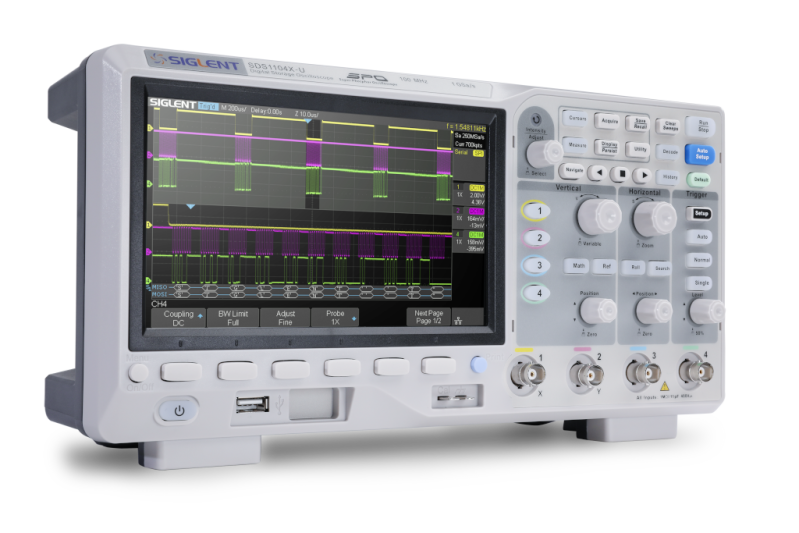
The cheapest way to get four channels
The SDS1000X-U series has exactly one member, the SDS1104X-U. It is the entry point of Siglent’s SDS1000X family and it exists for a single reason: to put four channels, 100 MHz and 14 Mpts of memory on a bench for €359.
What it does not do is cut the things that usually get cut at this price. Serial triggering and decoding for I²C, SPI, UART/RS-232, CAN and LIN is standard with nothing to license. The acquisition engine is the family’s: 400,000 waveforms per second in sequence mode, 80,000 history frames, 256-level intensity grading, 38 automatic measurements computed over every sampled point, hardware pass/fail and search-and-navigate.
Where it is different from the SDS1000X-E is underneath: one acquisition memory and one converter instead of two. That has consequences you should understand before you order, and they are set out in full in the next section rather than left in a data sheet.
The €60 question: SDS1104X-U or SDS1104X-E?
Both are four-channel 100 MHz oscilloscopes, they look almost identical, and they sit €60 apart. Nearly everyone who considers one considers the other, so here is the whole comparison in one table rather than in two data sheets. Bold marks the better figure in each row.
| SDS1104X-U | SDS1104X-E | |
|---|---|---|
| Price | €359 | €419 |
| Bandwidth | 100 MHz | 100 MHz |
| Analogue channels | 4 | 4 |
| Acquisition memories / ADCs | One | Two |
| Sample rate, four channels on | 250 MSa/s | 500 MSa/s |
| Record length, four channels on | 3.5 Mpts per channel | 7 Mpts per channel |
| Sample rate, two channels on | 500 MSa/s | 1 GSa/s (on CH1 and CH3) |
| Record length, two channels on | 7 Mpts per channel | 14 Mpts per channel (on CH1 and CH3) |
| Record length, one channel | 14 Mpts | 14 Mpts |
| Waveform capture rate | 400,000 wfm/s (sequence) | 400,000 wfm/s (sequence) |
| Serial trigger & decode | I²C, SPI, UART, CAN, LIN — standard | I²C, SPI, UART, CAN, LIN — standard |
| FFT length | 128 kpts, with peaks and markers | 1 Mpts, with peaks and markers |
| Minimum vertical scale | 1 mV/div | 500 µV/div |
| Fastest timebase | 2 ns/div | 1 ns/div |
| Input capacitance | 11 pF ±2 pF | 17 pF ±3 pF |
| Search and navigate | Yes | Yes |
| 16 digital channels (SLA1016) | Not supported | Option |
| USB AWG module (SAG1021I) | Not supported | Option |
| Bode plot / control-loop response | Not supported | Yes |
| Control from a web browser | Not supported | Yes |
| Data logger, counter, labels, NTP | Not supported | Yes |
Sample rates from both data sheets. ⚠ The per-channel record lengths are not in either data sheet — they come from the shared SDS1000X-E & SDS1000X-U user manual, EN05B, “Memory Depth”, which prints the table and states that the X-U has one acquisition memory.
Buy the SDS1104X-U when
The budget is fixed and four channels matter more than the last factor of two. A school buying twelve of them saves €720. Your signals are buses, rails, audio, control loops and switching nodes rather than fast edges. You know you will never want mixed-signal or a Bode plot. And if you probe high-impedance nodes, its 11 pF input is genuinely the gentler one.
Spend the €60 when
You want the option of adding the SLA1016 logic module, the SAG1021I generator, a Bode plot or browser control later — none of which can ever be fitted to an X-U. Or you regularly run all four channels on fast signals, where €60 doubles both the sample rate and the record length. Honestly, for a single instrument on a working bench, this is usually the right answer.
See the SDS1000X-E series
What you get for €359
All standard. There are no software licences for this model — not because they are included, but because none exist.
Four channels for €359
The cheapest four-channel oscilloscope Siglent make. Four channels is the difference between guessing at the relationship between two signals and watching it.
Serial decode included
I²C, SPI, UART/RS-232, CAN and LIN hardware triggering and decoding, with the tabular event list. No licence to buy, on the entry model of the range.
400,000 waveforms per second
100,000 wfm/s normally and 400,000 wfm/s in sequence mode — the same acquisition engine as the rest of the SDS1000X family. Rare events get found.
14 Mpts of record length
On a single channel, standard. Capture at a slow timebase and use the hardware zoom afterwards rather than guessing the right sweep speed beforehand.
256-level intensity grading
SPO display technology, with colour-temperature mode as well: how often the trace lands somewhere becomes brightness, or colour. Jitter and modulation become visible.
128 k FFT with peaks and markers
A hardware maths co-processor, a peak table sorted by amplitude, and enough frequency resolution to separate two tones 2 kHz apart at 300 kHz.
38 automatic measurements
With statistics, gating and history, computed over every sampled point rather than the 700 on screen. Plus search and navigate through history frames.
Hardware pass/fail
Up to 40,000 mask decisions per second against a template you draw, with a 3.3 V TTL output on the rear panel to drive a fixture.
The two features that sell this instrument
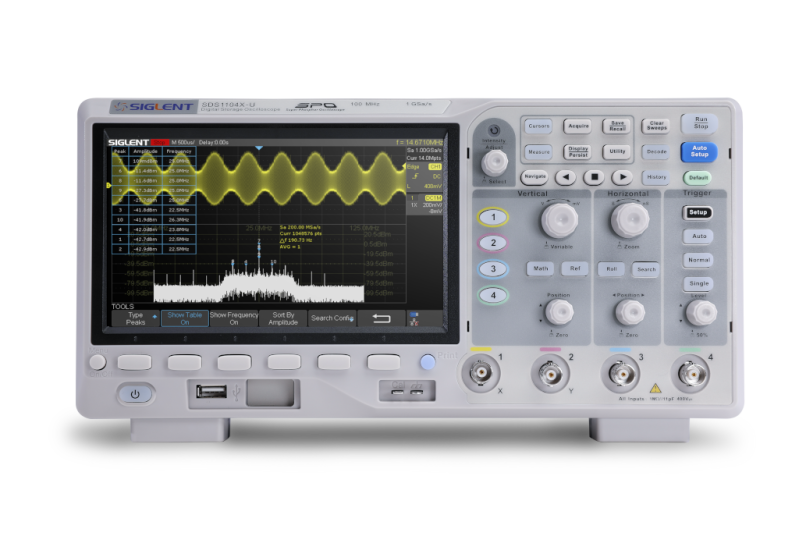
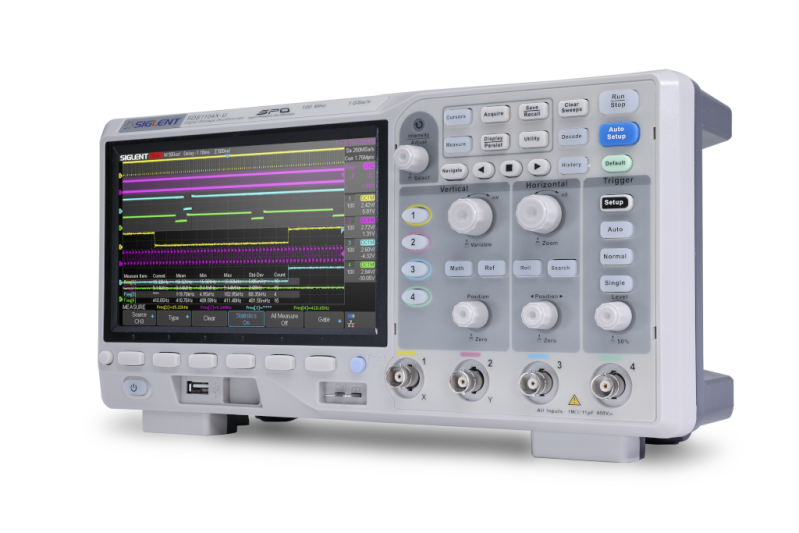
Both are screenshots from an SDS1104X-U, not renderings, and both are functions that competing scopes at this price either license separately or do not have.


Where the SDS1104X-U is used
This is a general-purpose bench instrument bought mainly by people who need four channels and have a budget. These are the places it earns its keep — and each one is written for what this model actually does, not for the family.
Teaching and student laboratories
The classic use, and what the price is for. Four channels, a 7-inch 800×480 screen readable across a bench, ten one-button shortcuts and ten interface languages. Cheap enough to equip a whole room and rugged enough to survive one.
Electronics repair and component-level service
Four channels means the supply rail, the clock, the enable line and the output all at once. 38 automatic measurements with statistics for the routine checks; deep memory and zoom for the fault that will not repeat on demand.
Embedded bring-up and hobby projects
Clock, chip select, data and reset on four inputs, with I²C, SPI, UART, CAN and LIN decoding included. At 250 MSa/s across four channels this comfortably covers the buses an 8- or 32-bit microcontroller actually runs.
Audio and low-frequency analogue
Where 100 MHz and 250 MSa/s are never the limit. The 128 k FFT with its peak table finds harmonics and hum; roll mode out to 100 s/div watches drift; the maths set gives you difference, integral and derivative of what you are measuring.
Power supplies, chargers and battery circuits
Ripple, switching nodes, soft start and load steps — four channels lets you watch input, output, control and current together. Use a differential probe for anything floating and a current clamp for the inductor.
Automotive and vehicle electronics
CAN and LIN triggering and decoding are standard. Trigger on an identifier or an error frame, then use sequence mode and 80,000 history frames to find the message that only misbehaves when the engine is hot.
Production and functional test
Hardware pass/fail runs 40,000 mask decisions a second and drives a TTL line. LAN with VXI-11, Telnet and raw sockets means it scripts over SCPI like any other instrument, and the price means every station can have one.
Field service and installation
2.6 kg, one mains lead, no fan noise worth mentioning, and a soft case if it has to travel. The rack shelf builds it into a fixed test position when it does not.
Four channels changes what you can ask
Two channels answers “what does this signal look like, and how does it relate to that one”. Four answers “what happened, in what order, and what was the supply doing at the time”. On a bus that is clock, data, chip select and the rail; on a converter it is input, output, gate drive and current; on a control board it is command, feedback, output and enable.
Almost every difficult measurement turns out to be about causality between more than two things, which is why a four-channel instrument at €359 is a better bench decision than a two-channel one with a bigger number on the front.
Four jobs, start to finish
Four measurement problems this instrument is genuinely good at, worked through the way you would actually do them, with the numbers that decide whether it can.
Watching a whole SPI transaction at once
A sensor on an SPI bus returns the wrong register. Two channels show you the clock and the data, but not whether chip select framed them or whether the rail sagged.
Put clock, MOSI, chip select and the 3V3 rail on the four inputs, trigger on the SPI condition and read the decoded frame from the event list above the trace. All four channels run at 250 MSa/s with 3.5 Mpts each — roughly 25 samples per bit on a 10 MHz bus, and 14 ms of record.
Four channels, standard SPI trigger and decode. This is the measurement that justifies four channels over two, and it is the reason this model exists.
Two tones 2 kHz apart on a 300 kHz supply
A switching supply is making an audible beat. There is something near the switching frequency, but on the timebase it just looks like a fat trace.
Turn on the FFT, set peaks and the peak table, and sort by amplitude. Over 131,072 points the resolution is about 15 Hz, so 300 kHz and 302 kHz appear as two separate peaks with their amplitudes listed rather than one smeared hump.
128 k FFT with peaks and markers — standard on this model. The screenshot in the section above is exactly this measurement.
An I²C sensor that never answers
A newly built board reads zeros from a sensor. The bus looks alive on the scope, so the question is whether the master is addressing the right device at all.
Probe SDA and SCL, switch on I²C decoding and read the event table: address, read/write bit, data bytes and whether the device acknowledged. A missing acknowledge on the address byte tells you in one screen that nothing is answering, which counting edges would take an afternoon to establish.
Standard I²C trigger and decode with the tabular event list — nothing to license, and two channels is all it needs.
Teaching why sample rate matters
A laboratory exercise on sampling and aliasing, using the instrument's own behaviour as the demonstration rather than a slide.
Feed a 20 MHz square wave in and measure the rise time with one channel on at 1 GSa/s. Turn on the other three and the rate drops to 250 MSa/s; the reading changes and the reason is visible on screen, because the instrument prints its current sample rate in the top-right corner the whole time.
One acquisition memory, honestly displayed. A limitation you can see is a teaching aid; an invisible one is a trap.
Specifications
From the SDS1000X-U data sheet, Rev. DS010AH-E01A, except the per-channel record lengths, which come from the shared user manual EN05B.
| Model | SDS1104X-U — the only model in the series |
| Bandwidth (−3 dB) | 100 MHz |
| Channels | 4 |
| Sample rate | 1 GSa/s one channel · 500 MSa/s two channels · 250 MSa/s four channels |
| Record length | 14 Mpts one channel · 7 Mpts/ch two channels · 3.5 Mpts/ch three or four channels |
| Vertical resolution | 8-bit |
| Vertical scale | 1 mV/div to 10 V/div in 1-2-5 steps (probe 1×) |
| Input | 1 MΩ ±2% in parallel with 11 pF ±2 pF · max. 400 Vpk (DC + peak AC below 10 kHz) |
| DC gain accuracy | ±3.0% from 5 mV/div to 10 V/div · ±4.0% at 2 mV/div |
| Rise time (typical) | 3.5 ns |
| Bandwidth limit | 20 MHz |
| Acquisition modes | Normal, peak detect, average (4 to 1024), ERES (0.5 to 3 bits) |
| Timebase | 2 ns/div to 100 s/div · accuracy ±25 ppm · roll mode from 50 ms/div |
| Waveform capture rate | 100,000 wfm/s normal · 400,000 wfm/s sequence |
| Sequence and history | Up to 80,000 segments · up to 80,000 history frames, with search and navigate |
| Trigger types | Edge, slope, pulse width, window, runt, interval, dropout, pattern, video (NTSC, PAL, 720p, 1080i, 1080p, custom) |
| Serial trigger & decode | I²C, SPI, UART/RS-232, CAN, LIN — standard |
| Maths | +, −, ×, ÷, FFT (128 kpts, peaks and markers), d/dt, ∫dt, √ · FFT windows: rectangular, Blackman, Hanning, Hamming, flat-top |
| Measurements | 38 parameters with statistics, gating, zoom, history and reference — computed over all sampled points, up to 14 Mpts |
| Cursors | Manual and track, time and voltage |
| Pass/fail | Hardware-based, up to 40,000 decisions per second, 3.3 V TTL output |
| Display | 7-inch TFT-LCD, 800 × 480, 24-bit colour, 500:1, 300 nits · 256-level intensity grading and colour-temperature mode |
| I/O | USB host · USB device (USB-TMC) · LAN · pass/fail · trigger out |
| Remote control | SCPI over VXI-11, Telnet (port 5024) and raw socket (port 5025) |
| Languages | English, German, French, Italian, Portuguese, Russian, Japanese, Korean, simplified and traditional Chinese |
| Power | 100–240 V 50/60 Hz or 100–120 V 400 Hz · 50 W max |
| Dimensions | 312 × 132.6 × 151 mm |
| Weight | 2.6 kg net · 3.8 kg packed |
| Environment | 0 to +40 °C operating · 85% RH · to 3,000 m |
| Standards | EMC 2014/30/EU, IEC/EN 61326-1 · UL 61010-1 and UL 61010-2-030, CAN/CSA-C22.2 equivalents |

It automates like the rest of the family
LAN and USB-TMC are standard. The instrument answers SCPI over VXI-11, over Telnet on port 5024 and over a raw socket on port 5025, so a Python socket and a command string are enough to drive it — no vendor library required. EasyScopeX and a LabVIEW driver are in the downloads below.
The rear pass/fail output is a 3.3 V TTL line driven by the hardware mask comparator at up to 40,000 decisions a second, which is what makes this a credible instrument for a functional-test fixture and not just a bench scope.
In the box
Four probes, one for each channel. On an oscilloscope at this price that is a meaningful part of what you are paying for.
| Oscilloscope | SDS1104X-U |
| Passive probes | Four PP510 — 100 MHz, 1×/10×, 150 V / 300 V RMS CAT II, each with its accessory kit |
| Power cord | Regional mains lead |
| USB cable | USB-A to USB-B, for USB-TMC remote control |
| Quick start guide | Printed |
| Calibration certificate | Factory certificate of conformance |

Options and accessories
Everything Siglent list for this series, and everything we stock for it. Prices exclude VAT.
What the SDS1104X-U cannot take
The SLA1016 logic probe module and the SAG1021I arbitrary waveform generator module are not supported on this model, and neither is the Bode plot or browser control. There is no licence that adds them, and no hardware port for them — the front panel has no Digital key and the rear has no Sbus connector. If you want any of that, the instrument to buy is the SDS1104X-E at €419.
| Code | What it is | Price |
|---|---|---|
| SDS1X-E-RMK | 19-inch 4U rack shelf with front panel and handles. Named by Siglent for the SDS1000X-U as well as the SDS1000X-E and SDS2000X-E. | €125 |
| BAG-S1 | Soft carry case. Listed by Siglent for the SDS1000X-E; the SDS1104X-U is the same 312 × 132.6 × 151 mm chassis, so it fits. | €59 |
| PP510 | Spare or extra 100 MHz 1×/10× passive probe — the one supplied with the instrument. | €16 |
| STB-3 | Demonstration and training board — square, sine, AM, fast edge, PWM, I²C, CAN and LIN sources. The natural companion in a teaching laboratory. | €189 |
| ISFEOUT OF STOCK | Isolated front end — two isolated channels, ±600 Vpk input, floating to 1000 Vrms from earth and 2000 Vrms between the two. USB powered. ⚠ 1 MHz bandwidth — it buys isolation, not speed. | €121 |
| HPB4010 | 10 kV high-voltage probe, DC–40 MHz, 1:1000. | €459 |
| CP4020 | AC/DC current clamp, 60 A peak, 200 kHz — the entry point of the CP current-probe range. | €409 |
| DPB5150 | 70 MHz differential high-voltage probe, 1500 V, 50×/500×. | €825 |
Add to your instrument

Step up to the SDS1104X-E
Two acquisition memories instead of one: 500 MSa/s and 7 Mpts on all four channels, a 1 Mpts FFT, and MSO, AWG, Bode plot and web control as later options.
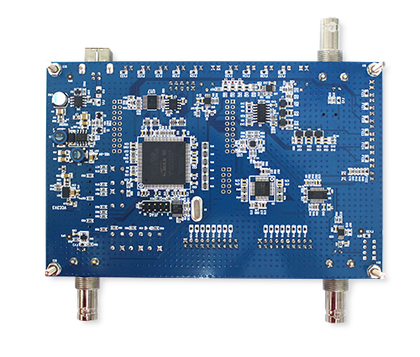
STB-3 demo and training board
Known-good square, sine, AM, fast-edge, PWM, I²C, CAN and LIN signals — for teaching, and for proving an instrument is behaving.
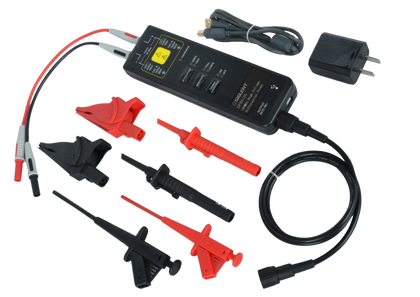
Differential high-voltage probes
For floating measurements the 400 Vpk inputs cannot make on their own — gate drives, DC buses, mains-referenced circuits.
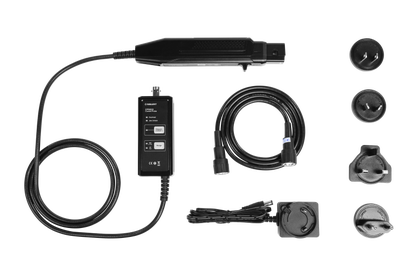
Current probes
Clamp round a conductor and read amps without breaking the circuit. CP4000 and CP5000 series, 60 A to 500 A.
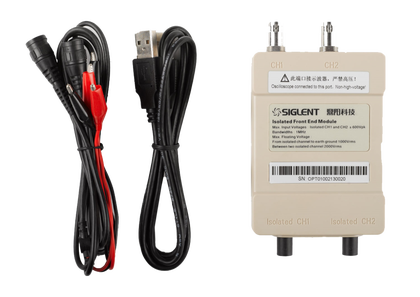
ISFE isolated front end
Two isolated channels, ±600 Vpk, floating to 1000 Vrms from earth — but only 1 MHz of bandwidth. Currently out of stock; ask us for the lead time.
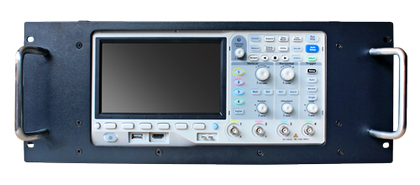
SDS1X-E-RMK rack shelf
19-inch, 4U, with handles — Siglent name the SDS1000X-U for this kit explicitly.
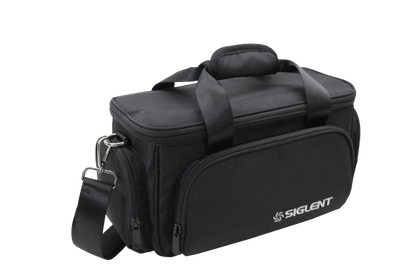
BAG-S1 carry case
Padded soft case for the instrument, its four probes and its leads.

HPB4010 10 kV probe
DC to 40 MHz, 1:1000, for ignition, insulation and electrostatic work.
Manuals, data sheets and downloads
Everything Siglent publish for this model. These links go to the factory download service, which always serves the current revision, so a bookmark here does not go stale when a document is reissued. The user manual and quick start guide are shared with the SDS1000X-E — that is correct, not a mislabelled file. There is no separate service manual for the X-U.
The full SDS1000X-U specification. Note that it publishes the maximum record length but not the per-channel split — that is in the user manual.
Shared with the SDS1000X-E, and the only document that prints the memory depth for two, three and four channels. See “Memory Depth”.
Unpacking, first power-up, front and rear panel layout and the safety notes. Also shared with the SDS1000X-E.
The SCPI command set for the SDS1000, SDS2000X and SDS2000X-E families — what you need to drive this instrument from a test script.
The binary waveform file format, for post-processing captures on a computer.
Specifications for the whole Siglent probe range, including the supplied PP510.
Which probe and accessories ship with which oscilloscope, as published by the factory.
Licences for the open-source components used in the instrument firmware.
Firmware and software
⚠ The SDS1104X-U takes its own firmware image. SDS1000X-E firmware is a different build and must not be installed on this instrument — check the model on your front panel first.
The firmware for this model. ⚠ SDS1000X-E firmware is a different image — do not install it on an X-U.
The PC application: remote front panel, screen capture, waveform and setup transfer.
Instrument driver for the SDS1000, SDS2000X and SDS2000X-E families.
Older revisions and documents for every other Siglent instrument are on our downloads page, searchable by model number.
All downloadsQuestions we are asked
How many models are in the SDS1000X-U series?
One — the SDS1104X-U, 100 MHz with four channels. There is no 200 MHz version and no two-channel version. If you need either, you are looking at the SDS1000X-E series.
What is the difference between the SDS1104X-U and the SDS1104X-E?
The X-E has two acquisition memories and two converters; the X-U has one. With all four channels running the X-U samples at 250 MSa/s with 3.5 Mpts each, while the X-E manages 500 MSa/s with 7 Mpts each. The X-E also has a 1 Mpts FFT rather than 128 k, goes down to 500 µV/div rather than 1 mV/div, and can later take the SLA1016 logic module, the SAG1021I generator, Bode plot and web control — none of which the X-U supports. The difference on our shelf is €60.
So should I just buy the SDS1104X-E?
Usually, yes, and we would rather say so than sell you the wrong instrument. €60 doubles both the sample rate and the record length when all four channels are on, and it keeps the upgrade path open. Buy the X-U when the budget is fixed and four channels matter more than the last factor of two — a school buying twelve of them, for instance, where €60 each is €720 of departmental budget.
Can I add the 16 digital channels or a signal generator later?
No. The SLA1016 logic module and the SAG1021I generator are not supported on the SDS1104X-U, and neither is the Bode plot or browser control. There is no licence that adds them. The front panel makes it visible: where the four-channel SDS1000X-E has a Digital key, this instrument has none. If mixed-signal work is anywhere in your plans, that decision is made when you choose the oscilloscope.
Do I have to buy the serial decoding?
No. I²C, SPI, UART/RS-232, CAN and LIN triggering and decoding are included, with nothing to license. That is unusual at this price and it is the strongest thing about this model.
Is 250 MSa/s enough with all four channels on?
For most of what this instrument is bought for, yes. 250 MSa/s is roughly ten samples per period at 25 MHz and about 25 samples per bit on a 10 MHz SPI bus. Where it becomes the limit is fast edges — if you are measuring rise times near the 3.5 ns the front end can resolve, put that signal on its own and let it have the full 1 GSa/s.
Does anything about it beat the SDS1104X-E?
One thing, and it is real: the input capacitance is 11 pF ±2 pF against the X-E's 17 pF ±3 pF, so the instrument loads a high-impedance node less. Also the price.
How high a voltage can I measure?
The inputs are rated 400 Vpk (DC + peak AC below 10 kHz) and the supplied PP510 probes are 150 V / 300 V RMS CAT II. Beyond that you need a differential probe from the DPB range, or the HPB4010 for high-voltage work. Never put a mains-referenced circuit on a scope input — all four probe grounds are joined inside the instrument.
Can I control it from a script?
Yes. LAN and USB-TMC are standard, with SCPI over VXI-11, Telnet on port 5024 and a raw socket on port 5025, so it drops into an existing framework without a vendor library. EasyScopeX and a LabVIEW driver are in the downloads below. There is no browser interface on this model — that is an SDS1000X-E feature.
What warranty and support do I get?
Three years of manufacturer warranty, handled by us in the Netherlands as the official Siglent distributor for the European Union. We hold stock, and we can supply the instrument with an ISO or DKD/DAkkS calibration certificate if you need one.
Not sure the €60 is worth it?
Tell us what you measure and we will say plainly whether the SDS1104X-U covers it. Sometimes it does and you keep the €60; often the SDS1104X-E is the better instrument and we will say that instead. We are the official Siglent distributor for the European Union, we hold stock in the Netherlands, and we can supply either with an ISO or DKD/DAkkS calibration certificate.