

Siglent RF Signal Generators
The SSG family covers 9 kHz to 67 GHz: analog RF and microwave sources, vector generators with internal I/Q, and multi-channel sources that keep their outputs in phase. Phase noise from −135 dBc/Hz at 1 GHz, output levels up to +30 dBm, and AM/FM/ΦM, pulse and I/Q modulation.

The whole range on one frequency axis
Siglent's SSG generators run from bench RF work and education to radar, satcom and millimetre-wave development. Each marker below is a model you can order: the number is its top frequency. Every series starts at 9 kHz, except the SSG6000A, which starts at 100 kHz.
Swipe sideways to see the whole axis.
Top frequency per model. The bars begin below the left edge of the axis (9 kHz or 100 kHz). All values are also in the comparison table and the model line-up.
Three questions that pick the series
A signal generator is chosen on frequency first, modulation second and the number of outputs third. Answer these and one or two series are left.
Take the highest carrier you must generate, including harmonics you want to test at. To 3.2 GHz: SSG3000X Plus. To 6 GHz: SSG5000X. To 20 GHz: SSG5000A. To 40 GHz: SSG6000A. To 67 GHz: SSG6089A.
No suffix means analog: AM, FM, ΦM and pulse. -IQE has an I/Q modulator fed by an external baseband source. -V has the baseband generator built in, for LTE, 5G NR, WLAN and your own waveforms.
A single-channel generator is enough for most tests. Phased arrays, MIMO receivers and beamforming need carriers with a fixed phase relation: the SSG6M80A has two or four coherent outputs in one instrument.
RF signal generators, to 6 GHz
Bench sources for receiver and component test, education, EMC pre-compliance and wireless development.
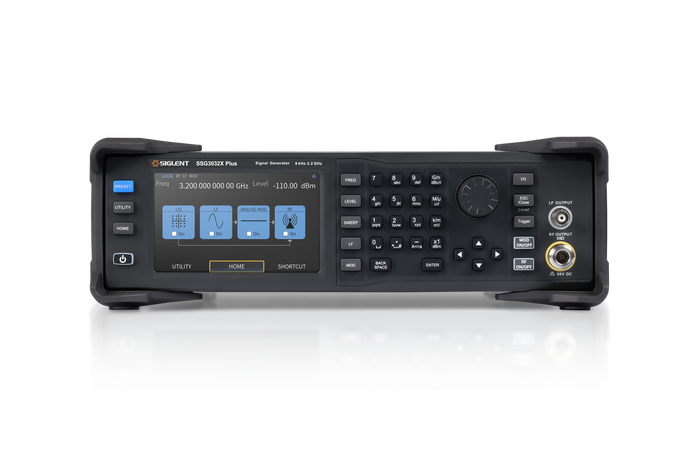


Microwave signal generators, to 67 GHz
Analog sources with an OCXO reference for radar, satcom, LO substitution and millimetre-wave work.


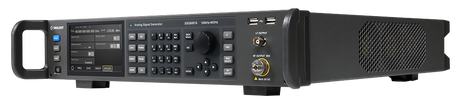
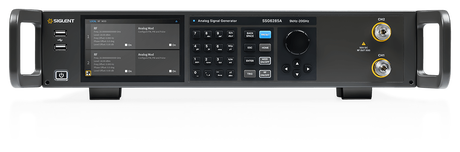
Wideband vector and multi-channel
Two instruments for the jobs a single analog output cannot do: very wide modulation, and several outputs that stay in phase.

What the family does well
Four strengths, each with the figure from the data sheet behind it.

Microwave to 67 GHz
The SSG6000A covers 13.6, 20 and 40 GHz, and 67 GHz with the SSG6089A, at −135 dBc/Hz phase noise (1 GHz, 10 kHz offset, typ.). A factory-fitted option brings that to −149 dBc/Hz (typ.).

Wideband vector signals
The SSG6082A-V modulates 500 MHz wide as standard and 1000 MHz as an option, with symbol rates up to 625 MHz. The SSG5000X-V brings internal I/Q to 4 and 6 GHz. Waveforms are built in SigIQPro.
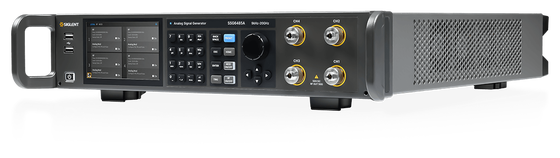
Outputs that stay in phase
The SSG6M80A puts two or four microwave sources behind one reference. In coherent mode the channels hold their relative phase within 1° to 2.5°, depending on the band, over five hours.

Accurate levels, fine steps
Level setting in 0.01 dB steps, frequency resolution of 0.01 Hz or 0.001 Hz, and frequency and level sweeps with list mode on every series.
Compare the SSG series
Frequency range, phase noise, level and modulation of every series and variant, side by side. The models of each series are in the table below it.
| Series | Frequency range | Phase noise at 1 GHz | Highest specified level | Modulation | Supplied |
|---|---|---|---|---|---|
| SSG3000X Plus | 9 kHz – 2.1 / 3.2 GHz | −117 dBc/Hz (20 kHz) | +13 dBm | AM/FM/ΦM · pulse | Webshop |
| SSG3000X-IQE Plus | 9 kHz – 2.1 / 3.2 GHz | −117 dBc/Hz (20 kHz) | +13 dBm | AM/FM/ΦM · pulse · external I/Q | Webshop |
| SSG3000X | 9 kHz – 3.2 GHz | −110 dBc/Hz (20 kHz) | +13 dBm | AM/FM/ΦM · pulse | Webshop |
| SSG3000X-IQE | 9 kHz – 3.2 GHz | −110 dBc/Hz (20 kHz) | +13 dBm | AM/FM/ΦM · pulse · external I/Q | Webshop |
| SSG5000X | 9 kHz – 4 / 6 GHz | −120 dBc/Hz (20 kHz) | +26 dBm | AM/FM/ΦM · pulse | Webshop |
| SSG5000X-V | 9 kHz – 4 / 6 GHz | −120 dBc/Hz (20 kHz) | +26 dBm | AM/FM/ΦM · pulse · internal I/Q, 75 / 150 MHz | Webshop |
| SSG6000A-V | 9 kHz – 8 GHz | < −132 dBc/Hz (10 kHz) | +30 dBm | AM/FM/ΦM · pulse option · internal I/Q, 500 / 1000 MHz | Webshop |
| SSG5000A | 9 kHz – 13.6 / 20 GHz | −120 dBc/Hz (20 kHz) | +25 dBm | AM/FM/ΦM · pulse option | Webshop |
| SSG6000A | 100 kHz – 13.6 / 20 / 40 GHz | −135 dBc/Hz (10 kHz) | +24 dBm | AM/FM/ΦM · pulse option | Webshop |
| SSG6089A | 100 kHz – 67 GHz | −135 dBc/Hz (10 kHz) | +24 dBm | AM/FM/ΦM · pulse option | On request |
| SSG6M80A · 2 or 4 channels | 9 kHz – 13.6 / 20 GHz | −135 dBc/Hz (10 kHz) | +25 dBm per channel | FM/ΦM · pulse option · phase-coherent | On request |
Typical values, summarised for comparison. Phase noise is given at the offset in brackets. The guaranteed specifications and their conditions are in the data sheet of each series.
Every model in one table
All 21 current models, with the two that have a successor. The I/Q column answers the most asked question: only -IQE (external baseband) and -V (internal baseband) models modulate I/Q.
| Model | Frequency (CW) | Level setting range | I/Q modulation | Supplied |
|---|---|---|---|---|
| SSG3000X Plus 0.01 Hz resolution · −117 dBc/Hz at 1 GHz, 20 kHz offset (typ.) | ||||
| SSG3021X Plus | 9 kHz – 2.1 GHz | −110 to +13 dBm | None (analog) | Webshop |
| SSG3021X-IQE Plus | 9 kHz – 2.1 GHz | −110 to +13 dBm | External I/Q · 10 MHz – 2.1 GHz | Webshop |
| SSG3032X Plus | 9 kHz – 3.2 GHz | −110 to +13 dBm | None (analog) | Webshop |
| SSG3032X-IQE Plus | 9 kHz – 3.2 GHz | −110 to +13 dBm | External I/Q · 10 MHz – 3.2 GHz | Webshop |
| SSG3000X 0.01 Hz resolution · −110 dBc/Hz at 1 GHz, 20 kHz offset (typ.) | ||||
| SSG3032X | 9 kHz – 3.2 GHz | −110 to +13 dBm | None (analog) | Webshop |
| SSG3032X-IQE | 9 kHz – 3.2 GHz | −110 to +13 dBm | External I/Q · 10 MHz – 3.2 GHz | Webshop |
| SSG3021X End of life | 9 kHz – 2.1 GHz | −110 to +13 dBm | None (analog) | Successor: SSG3021X Plus |
| SSG3021X-IQE End of life | 9 kHz – 2.1 GHz | −110 to +13 dBm | External I/Q · 10 MHz – 2.1 GHz | Successor: SSG3021X-IQE Plus |
| SSG5000X 0.001 Hz resolution · −120 dBc/Hz at 1 GHz, 20 kHz offset (typ.) | ||||
| SSG5040X | 9 kHz – 4 GHz | −140 to +26 dBm | None (analog) | Webshop |
| SSG5060X | 9 kHz – 6 GHz | −140 to +26 dBm | None (analog) | Webshop |
| SSG5040X-V | 9 kHz – 4 GHz | −140 to +26 dBm | Internal I/Q · 10 MHz – 4 GHz · 75 MHz wide, 150 MHz as an option | Webshop |
| SSG5060X-V | 9 kHz – 6 GHz | −140 to +26 dBm | Internal I/Q · 10 MHz – 6 GHz · 75 MHz wide, 150 MHz as an option | Webshop |
| SSG6000A-V 0.001 Hz resolution · < −132 dBc/Hz at 1 GHz, 10 kHz offset | ||||
| SSG6082A-V | 9 kHz – 8 GHz | −140 to +30 dBm | Internal I/Q · 10 MHz – 8 GHz · 500 MHz wide, 1000 MHz as an option | Webshop |
| SSG5000A OCXO reference · −120 dBc/Hz at 1 GHz, 20 kHz offset (typ.) | ||||
| SSG5083A | 9 kHz – 13.6 GHz | −130 to +25 dBm | None (analog) | Webshop |
| SSG5085A | 9 kHz – 20 GHz | −130 to +25 dBm | None (analog) | Webshop |
| SSG6000A OCXO reference · 0.001 Hz resolution · −135 dBc/Hz at 1 GHz, 10 kHz offset (typ.) | ||||
| SSG6083A | 100 kHz – 13.6 GHz | −130 to +24 dBm | None (analog) | Webshop |
| SSG6085A | 100 kHz – 20 GHz | −130 to +24 dBm | None (analog) | Webshop |
| SSG6087A | 100 kHz – 40 GHz | −130 to +24 dBm | None (analog) | Webshop |
| SSG6089A | 100 kHz – 67 GHz | −110 to +24 dBm | None (analog) | On request |
| SSG6M80A OCXO reference · 0.001 Hz resolution · −135 dBc/Hz at 1 GHz, 10 kHz offset (typ.) · phase-coherent channels | ||||
| SSG6283A | 9 kHz – 13.6 GHz · 2 channels | −110 to +25 dBm | None (analog) | On request |
| SSG6285A | 9 kHz – 20 GHz · 2 channels | −110 to +25 dBm | None (analog) | On request |
| SSG6483A | 9 kHz – 13.6 GHz · 4 channels | −110 to +25 dBm | None (analog) | On request |
| SSG6485A | 9 kHz – 20 GHz · 4 channels | −110 to +25 dBm | None (analog) | On request |
The level setting range depends on the frequency; the widest band is shown. The level that is specified and the level that can be set differ: see the data sheet of the series.
Options and upgrades
Most options are licence keys that can be added after the purchase: a higher top frequency, a pulse-train generator, more I/Q bandwidth. A few are hardware that is fitted at the factory and has to be ordered with the instrument; they are marked.
| Series | I/Q | Options and upgrades | Where |
|---|---|---|---|
| SSG3000X Plus | External I/Q on -IQE models, baseband from an SDG6000X | Pulse-train generator (SSG3000X Plus-PT) · 2.1 → 3.2 GHz upgrade (SSG3000X Plus-21BW32, with external I/Q: SSG3000X-IQE Plus-21BW32) · OCXO reference (10M_OCXO_L, fitted at the factory) | Series page |
| SSG3000X | External I/Q on -IQE models, baseband from an SDG6000X | Pulse-train generator (SSG3000X-PT) · 2.1 → 3.2 GHz upgrade (SSG3000X-21BW32, with external I/Q: SSG3000X-IQE-21BW32). These keys do not fit the Plus models. | Licence keys |
| SSG5000X | Internal I/Q on -V models, 75 MHz wide | Pulse-train generator (SSG5000X-PT) · 4 → 6 GHz upgrade (SSG5000X-F60) · OCXO reference (10M_OCXO_L, fitted at the factory). -V models: I/Q bandwidth to 150 MHz (SSG5000XV-B150) · Zigbee and Z-Wave signals (SSG5000XV-IOT) · SigIQPro waveform licences | Licence keys |
| SSG6000A-V | Internal I/Q, 500 MHz wide | I/Q bandwidth to 1000 MHz (SSG6080AV-B1000) · pulse modulation (SSG6080AV-PU) · pulse-train generator (SSG6080AV-PT) · SigIQPro waveform licences for 5G NR, LTE, WLAN, Bluetooth and more | Series page |
| SSG5000A | Analog only | Pulse modulation (SSG5080A-PU) · pulse-train generator (SSG5080A-PT) · 13.6 → 20 GHz upgrade (SSG5080A-F85) · 110 dB attenuator module (SSG5080A-LP, fitted at the factory) | Licence keys |
| SSG6000A · SSG6089A | Analog only | Pulse modulation (SSG6080A-PU) · pulse-train generator (SSG6080A-PT) · 13.6 → 20 GHz upgrade (SSG6080A-F85). Fitted at the factory, to order with the instrument: low phase noise (SSG6080A-LPH2) and high output power (SSG6080A-HP20 / -HP40) | Series page |
| SSG6M80A | Analog only | Pulse modulation (SSG6M80A-PU) · pulse-train generator (SSG6M80A-PT) · 13.6 → 20 GHz upgrade (SSG6283A-F85 for 2 channels, SSG6483A-F85 for 4 channels) | Series page |
Order codes as printed in the data sheets. Which options fit depends on the model; ask us when in doubt. Errors and omissions excepted.
Which series for which work
Six typical jobs and the series we would look at first.
Sensitivity, selectivity and filter measurements, EMC pre-compliance, teaching labs.
Bluetooth, Zigbee, Z-Wave and custom I/Q waveforms from an internal baseband generator.
5G NR, LTE and WLAN signals up to 1000 MHz wide, radar pulses, amplifier linearity tests.
A clean microwave carrier with an OCXO reference for converters, mixers and link tests.
The lowest phase noise in the family, with a factory option for the most demanding clock and radar work.
Two or four outputs that keep their relative phase, each with its own frequency, level and phase setting.
Not sure which SSG fits your application?
Tell us your frequency range, the modulation you need and the level at the device under test. We recommend the generator and the options, and send you a quotation, with calibration if you need it.
Frequently asked questions
What is the difference between an analog and a vector signal generator?
An analog generator produces a clean carrier with AM, FM, phase and pulse modulation: the tool for receiver test, LO substitution and general RF work. A vector generator adds I/Q modulation, so it can produce digital standards such as LTE, 5G NR and WLAN and your own waveforms. In the Siglent range the SSG5000X-V and the SSG6082A-V have an internal baseband generator. The -IQE models of the SSG3000X and SSG3000X Plus have an I/Q modulator that needs an external baseband source such as an SDG6000X. The SSG5000A, SSG6000A, SSG6089A and SSG6M80A are analog.
Which frequency ranges are available?
From 9 kHz to 67 GHz. The SSG3000X Plus and SSG3000X reach 3.2 GHz, the SSG5000X 6 GHz, the SSG6082A-V 8 GHz, the SSG5000A and the multi-channel SSG6M80A 20 GHz, and the SSG6000A 13.6, 20 or 40 GHz. The SSG6089A extends the SSG6000A family to 67 GHz.
Which Siglent signal generator has the lowest phase noise?
The SSG6000A family and the SSG6M80A: −135 dBc/Hz at 1 GHz and 10 kHz offset (typical). On the SSG6000A a low-phase-noise option, fitted at the factory, brings this to −149 dBc/Hz (typical). The SSG6082A-V is specified below −132 dBc/Hz, the SSG5000X and SSG5000A reach −120 dBc/Hz, the SSG3000X Plus −117 dBc/Hz and the SSG3000X −110 dBc/Hz (the last four at 20 kHz offset).
Which models are offered on request, and why?
The 67 GHz SSG6089A and the multi-channel SSG6M80A. Their configuration depends on the application: channel count, frequency range and options that are fitted at the factory. So instead of a fixed webshop price we prepare a personal offer together with the Siglent factory. Each has its own page with the specifications, the documents and a request form. All other models can be ordered directly in the webshop.
How wide is the I/Q modulation bandwidth of the vector models?
The SSG6082A-V offers 500 MHz as standard and 1000 MHz with option SSG6080AV-B1000, with symbol rates up to 625 MHz. The SSG5000X-V offers 75 MHz as standard and 150 MHz with option SSG5000XV-B150. Waveforms are built in the SigIQPro PC software, with optional licences per standard.
What is a multi-channel phase-coherent signal generator used for?
For tests that need several carriers with a fixed phase relation: phased-array and beamforming antennas, MIMO receivers, radar. The SSG6M80A has two or four outputs behind one reference. In coherent mode the channels hold their relative phase within 1° to 2.5°, depending on the frequency band, over five hours at a stable temperature.
Which modulation types are supported?
AM, FM and phase modulation on every single-channel series, and FM and phase modulation on the SSG6M80A. Pulse modulation is standard on the SSG3000X, SSG3000X Plus and SSG5000X, and a licence option on the SSG5000A, SSG6000A, SSG6082A-V and SSG6M80A. A pulse-train generator is an option on every series. The vector models add arbitrary I/Q modulation.
Can a generator be calibrated to ISO 17025?
Every instrument comes with the factory calibration certificate. An accredited ISO/DKD (DAkkS) calibration, new or as a recalibration, is available on request; see our calibration services.