

Differential high-voltage probes
Nine probes from €399 to €2,089 — 50 MHz to 400 MHz, up to ±7,000 V. For every measurement where the point you need to probe is not at earth potential.
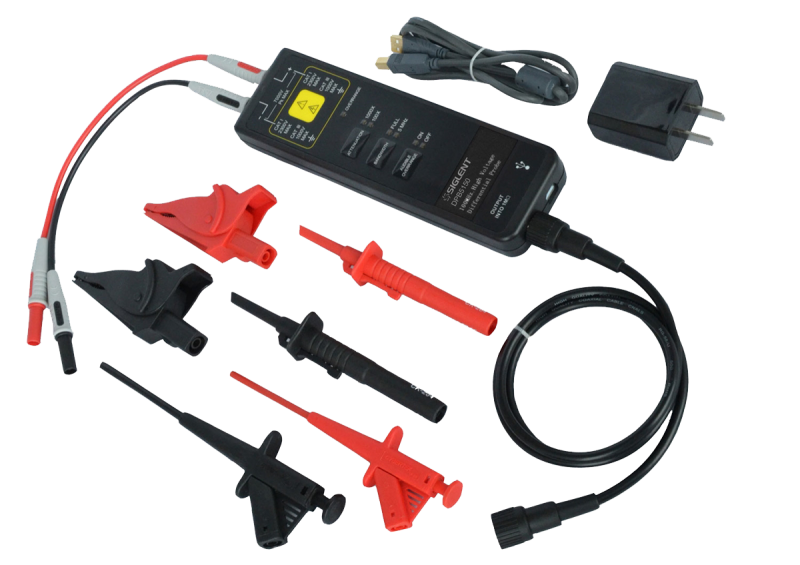
The ground clip is the problem
A standard passive probe’s ground clip is wired to the oscilloscope’s chassis, and the chassis is wired to mains earth. Clip it onto anything that is not already at earth potential — the low side of a half-bridge, a floating rail, a switch node referenced to the mains — and you have connected that point to earth through the instrument. The result is a short circuit through your front end, usually a destroyed probe and channel, and in a mains-referenced circuit a genuine hazard to whoever is holding it.
A differential probe removes the earth connection entirely. It measures the voltage between its two tips and sends only that difference to the scope, so neither tip is tied to anything. That is what makes it possible to put a probe across the high-side gate-source of a bridge, or directly across a mains line, without the circuit ever knowing the oscilloscope is there.
Two ratings govern what is safe: the differential voltage you can measure between the tips, and the common-mode voltage the pair may sit at relative to earth. They are different numbers, and both matter — the table below lists them separately for exactly that reason.
Which one do you need?
Answer two questions: how many volts sit between the two points, and how fast does the signal move? Voltage sets the model, bandwidth sets whether you want the A version.
General power & mains work
Single-phase mains, low-voltage drives, SMPS primaries, inverter output. 50 MHz is ample for anything at mains frequency and its harmonics.
DPB1300 — €399
Converters & fast switching
Half-bridges, gate drive, SiC and GaN converters. Take the A model when the edge itself is the measurement — 3.5 ns rather than 5 ns rise time.
DPB6150A €750 · 100 MHz
DPB6150D €1,420 · 400 MHz
also DPB5150 €812, DPB5150A €1,080, and SDP versions for SAPBus scopes
Traction, HV DC & industrial
EV traction inverters, high-voltage DC links, industrial drives and grid equipment. 1000 V CAT III common-mode rating for distribution-level work.
DPB5700 €1,559 · 70 MHz
DPB5700A €2,089 · 100 MHz
Five models
All five give ±2% DC accuracy, an overload indicator with an audible alarm, and two switchable attenuation ratios. They differ in how much voltage they take and how fast they are.
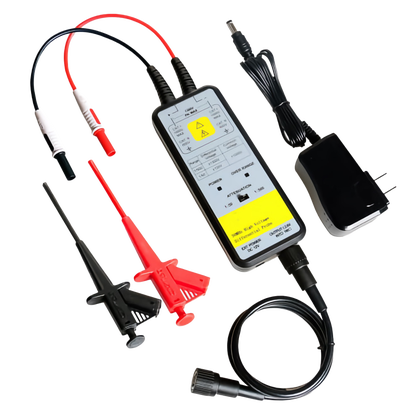
- ±130 V / ±1,300 V differential
- 600 V CAT III · 1000 V CAT II
- Rise time ≤7 ns
- ±2% DC accuracy
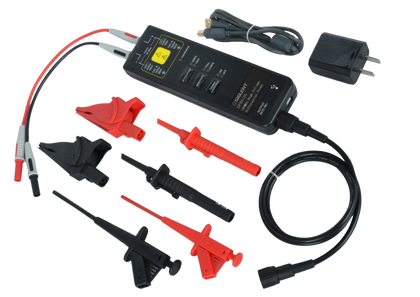
- ±150 V / ±1,500 V differential
- 600 V CAT III · 1000 V CAT II
- Rise time ≤5 ns
- ±2% DC accuracy
- ±150 V / ±1,500 V differential
- 600 V CAT III · 1000 V CAT II
- Rise time ≤3.5 ns
- ±2% DC accuracy
- ±700 V / ±7,000 V differential
- 1000 V CAT III · 2300 V CAT I
- Rise time ≤5 ns
- ±2% DC accuracy
- ±700 V / ±7,000 V differential
- 1000 V CAT III · 2300 V CAT I
- Rise time ≤3.5 ns
- ±2% DC accuracy
The 6150 range — same ±1,500 V, two ways to connect
Four probes at ±1,500 V and ±2% accuracy, in 100 MHz and 400 MHz versions. The only real difference between a DPB and an SDP is how it attaches to the oscilloscope — but that difference decides whether it will work with your instrument at all.
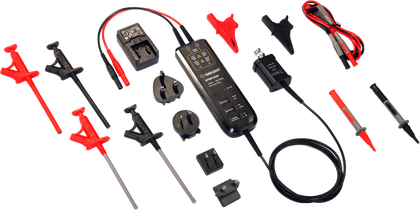
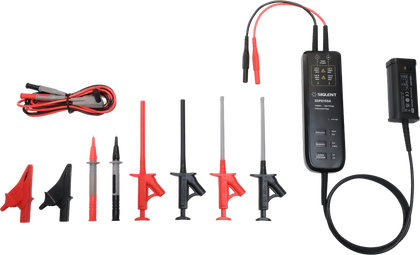
USB-C powered with a plain BNC output, so it works with any oscilloscope of any brand. Rated 1000 V CAT III / 600 V CAT IV — the higher of the two ratings — and it ships with a full lead and clip set. It is also the cheaper pair.
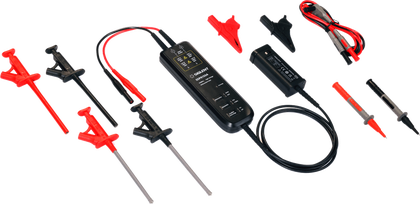
Powered and configured by the oscilloscope over SAPBus: the scope names the probe, sets its attenuation and reads the channel directly in volts. Needs an SDS7000A, SDS6000A, SDS6000L, SDS5000X or SDS3000X HD, and is rated 600 V CAT III / 1000 V CAT II.
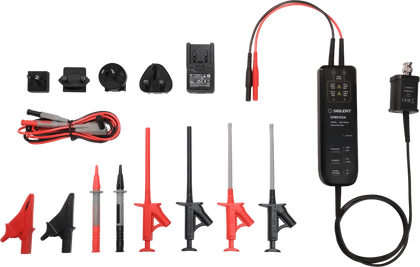
- ±150 V / ±1,500 V differential
- 1000 V CAT III · 600 V CAT IV
- USB-C — any oscilloscope
- ±2% DC accuracy
- ±150 V / ±1,500 V differential
- 1000 V CAT III · 600 V CAT IV
- USB-C — any oscilloscope
- ±2% DC accuracy
- ±150 V / ±1,500 V differential
- 600 V CAT III · 1000 V CAT II
- Powered by the scope (SAPBus)
- ±2% DC accuracy
- ±150 V / ±1,500 V differential
- 600 V CAT III · 1000 V CAT II
- Powered by the scope (SAPBus)
- ±2% DC accuracy
All nine compared
| Model | Bandwidth | Rise time | Attenuation | Max differential | Common mode to earth | Price |
|---|---|---|---|---|---|---|
| DPB1300 | 50 MHz | ≤7 ns | 50X / 500X | ±130 V / ±1,300 V | 600 V CAT III · 1000 V CAT II | €399 |
| DPB5150 | 70 MHz | ≤5 ns | 50X / 500X | ±150 V / ±1,500 V | 600 V CAT III · 1000 V CAT II | €812 |
| DPB5150A | 100 MHz | ≤3.5 ns | 50X / 500X | ±150 V / ±1,500 V | 600 V CAT III · 1000 V CAT II | €1,080 |
| DPB5700 | 70 MHz | ≤5 ns | 100X / 1000X | ±700 V / ±7,000 V | 1000 V CAT III · 2300 V CAT I | €1,559 |
| DPB5700A | 100 MHz | ≤3.5 ns | 100X / 1000X | ±700 V / ±7,000 V | 1000 V CAT III · 2300 V CAT I | €2,089 |
| DPB6150A ANY SCOPE | 100 MHz | — | 50X / 500X | ±150 V / ±1,500 V | 1000 V CAT III · 600 V CAT IV | €750 |
| DPB6150D ANY SCOPE | 400 MHz | — | 100X / 1000X | ±150 V / ±1,500 V | 1000 V CAT III · 600 V CAT IV | €1,420 |
| SDP6150A SAPBUS | 100 MHz | — | 50X / 500X | ±150 V / ±1,500 V | 600 V CAT III · 1000 V CAT II | €1,130 |
| SDP6150D SAPBUS | 400 MHz | — | 100X / 1000X | ±150 V / ±1,500 V | 600 V CAT III · 1000 V CAT II | €1,710 |
Prices exclude VAT. Max differential is the voltage measurable between the tips; common mode to earth is how far the pair may float. Both limits apply at once. Errors and omissions excepted.
Shared specifications
| CMRR | >80 dB at DC · >60 dB at 100 kHz · >50 dB at 1 MHz |
|---|---|
| Input impedance | 5 MΩ single-ended / 10 MΩ across the inputs (DPB1300, DPB5150/A) 20 MΩ single-ended / 40 MΩ across the inputs (DPB5700/A) |
| Input capacitance | <4 pF single-ended, <2 pF across inputs (DPB1300, DPB5150/A) <5 pF single-ended, <2.5 pF across inputs (DPB5700/A) |
| Noise (Vrms) | 50X <50 mV, 500X <300 mV · 100X <200 mV, 1000X <1.2 V |
| Propagation delay | Probe ≈9 ns (DPB1300 ≈10 ns) · BNC lead (1 m) ≈5 ns |
| Overload protection | Red overload indicator and audible alarm (mutable), with automatic save |
| Bandwidth limit | ≥−3 dB at 5 MHz (DPB5000 series) |
| Terminating load | ≥100 kΩ |
| Power | USB 5 V / 1 A adapter (DPB5000 series) · DC 12 V / 1.2 A (DPB1300) |
| Probe body | 195 × 65 × 28 mm · 216 g (DPB5000 series) |
Read the category rating, not just the voltage
A measurement category describes how much transient energy the installation can deliver, not how many volts it sits at. The same 1,000 V means something very different at a wall socket than at a distribution board, because the fault current available behind it is not the same.
Local level — wall sockets, appliances, cord-connected equipment.
Distribution level — distribution boards, fixed installations, three-phase equipment.
Signal level — secondary circuits not connected to the mains.
A probe rated 1000 V CAT II is not safe on a 1000 V CAT III circuit. Match the category to where you are probing first, then check the voltage. If you are unsure which category your measurement falls into, ask us before you connect anything.
Frequently asked
Why can I not just use a normal passive probe?
A standard probe’s ground clip is connected to the oscilloscope’s chassis, which is connected to mains earth. Clip it to anything that is not at earth potential — the low side of a half-bridge, a floating rail, a mains-referenced switch node — and you short that point to earth through the scope. At best you destroy the probe and the front end; at worst you injure someone. A differential probe has no earth connection at its tips: it measures the voltage between two points and sends the difference to the scope.
What is the difference between differential voltage and common-mode voltage?
Differential voltage is what you want to measure — the difference between the two tips. Common-mode voltage is how far both tips sit above earth. Both have limits, and they are different numbers. A DPB5700 will measure ±7,000 V between its tips, but the pair together must stay within 1000 V CAT III of earth. Exceed the common-mode rating and the probe stops being safe, whatever the differential reading says.
Which attenuation should I use?
The lower ratio for the lowest noise, the higher one for headroom. On a DPB5150 that is 50X up to ±150 V with <50 mV of noise, or 500X up to ±1,500 V with <300 mV. Pick the lowest ratio your signal fits inside — every step up in range costs you resolution.
Do I need 70 MHz or 100 MHz?
For mains-frequency and general power work, 70 MHz is far more than enough. The 100 MHz A-models earn their premium on fast switching — SiC and GaN half-bridges, gate drive, and anywhere the edge itself is the measurement. Their 3.5 ns rise time against 5 ns is the specification that matters there, not the bandwidth number.
What does CAT III or CAT II actually mean?
The category describes how much transient energy the installation can deliver, not just the voltage. CAT II is wall-socket level, CAT III is distribution level — fixed installations, distribution boards, three-phase equipment. A probe rated 1000 V CAT II is not safe on a 1000 V CAT III circuit. Match the category to where you are probing, then the voltage.
Can I use two channels instead of a differential probe?
Subtracting two ground-referenced channels works for low voltages at low frequencies, but the two probes must be matched, the common-mode rejection is poor, and both grounds still connect the circuit to earth. It does not solve the safety problem at all. For any floating or mains-referenced measurement, use a differential probe.
Tell us where you are probing
The voltage between the two points, how far they float above earth, and how fast the signal moves. Those three answers pick the probe — and we will say plainly when the cheaper one is enough. Measuring current as well? The deskew fixture matters before you multiply V by I.