

Oscilloscope probes
Nine passive probes from €16 to €230 — 70 MHz to 1.5 GHz. No power, no probe bus, standard BNC: they work with any oscilloscope of any brand or age.
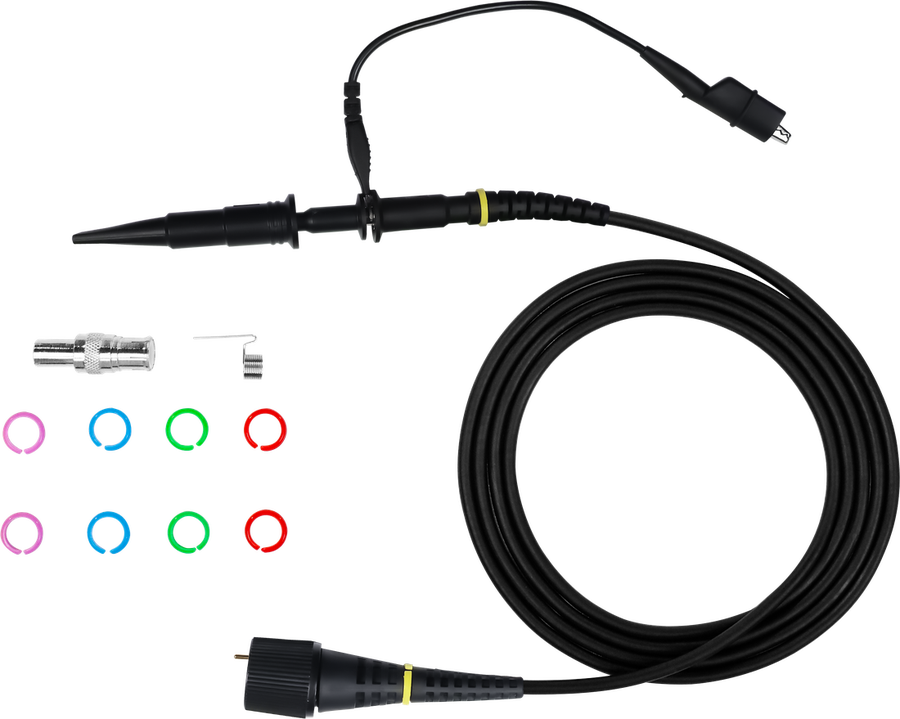
Three numbers decide which one you need
Bandwidth is the obvious one, and the rule of thumb is to match it to the oscilloscope — a 200 MHz probe on a 500 MHz scope makes it a 200 MHz scope. Input capacitance is the one most people ignore, and it matters more: 12 pF at the tip forms an RC with the source impedance and rounds the edge you came to look at. Voltage rating decides where the probe is safe, and the category matters as much as the number of volts.
Everything here is passive — no power supply, no probe bus, plain BNC — so it works with any oscilloscope of any brand, including the one already on your bench and the one that replaces it.
1X is not a free doubling of sensitivity
On a switchable probe, the 1X position looks like it gives you ten times the signal for nothing. It does not. Switching to 1X takes the bandwidth from the rated figure down to about 6 MHz, and raises the tip capacitance from roughly 20 pF to 85–120 pF. It also halves the voltage rating, from 300 V RMS to 150 V RMS.
Use 1X deliberately, for low-level signals well under a megahertz where you need the amplitude and the circuit can tolerate the loading. For anything else, leave the switch on 10X — and if you find yourself wanting 1X often, the answer is usually a more sensitive oscilloscope setting rather than a different probe position.
Switchable 1X / 10X probes
The general-purpose probes, and the ones supplied with most oscilloscopes. Pick the bandwidth that matches your instrument.
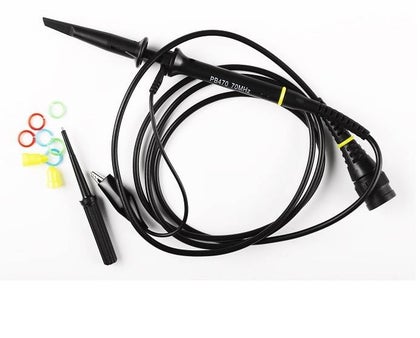
- 18.5–22.5 pF at 10X input capacitance
- 300 V RMS CAT II
- Standard BNC — any oscilloscope
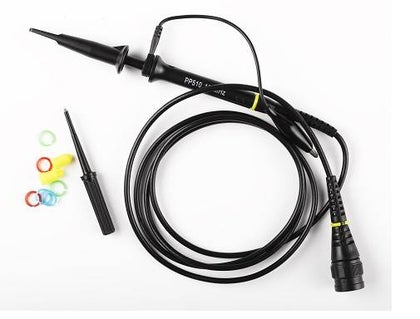
- 18.5–22.5 pF at 10X input capacitance
- 300 V RMS CAT II
- Standard BNC — any oscilloscope
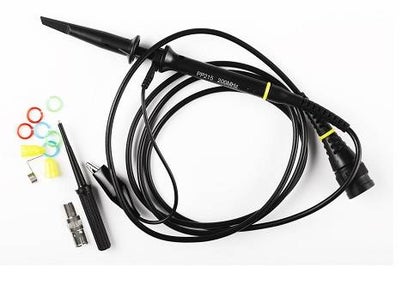
- 18.5–22.5 pF at 10X input capacitance
- 300 V RMS CAT II
- Standard BNC — any oscilloscope
10X probes — lower capacitance, more bandwidth
Fixed 10X, and built for it: 11 or 12 pF at the tip rather than 20, which is what lets them reach 350 and 500 MHz. This is where you go when the probe has become the limiting factor rather than the oscilloscope.
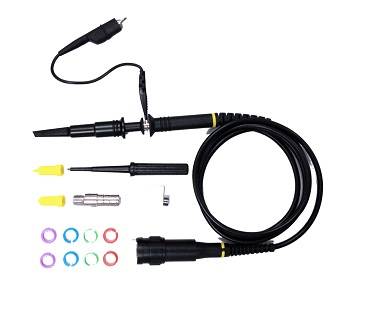
- 12 pF input capacitance
- 300 V RMS CAT II
- Standard BNC — any oscilloscope
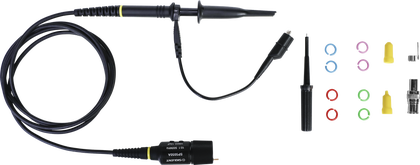
- 12 pF input capacitance
- 300 V RMS CAT II
- Standard BNC — any oscilloscope
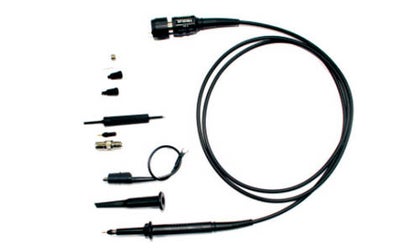
- 11 pF input capacitance
- 400 V RMS CAT II
- Standard BNC — any oscilloscope
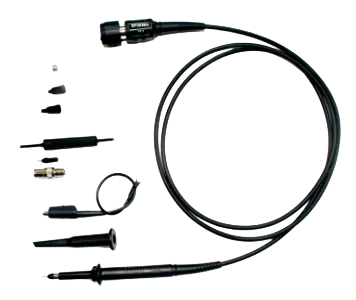
- 11 pF input capacitance
- 400 V RMS CAT II
- Standard BNC — any oscilloscope
Two specialists
One rated for the field, one built for speed. Neither is a general-purpose probe, and both are the right answer in their own place.
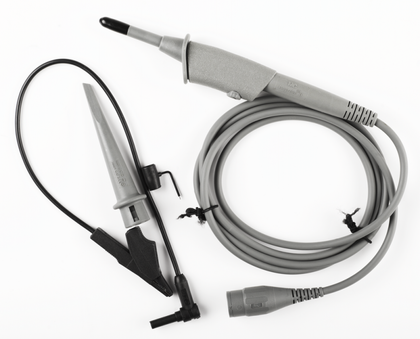
- 16 pF input capacitance
- 600 V CAT III · 1000 V CAT II
- Standard BNC — any oscilloscope
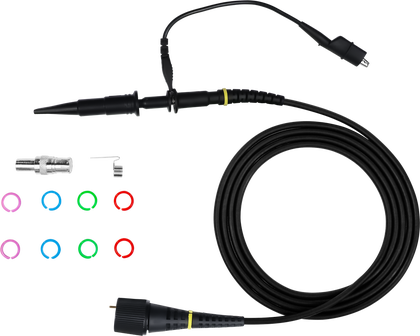
- 1.8 pF input capacitance
- 8.5 V max · 500 Ω
- Standard BNC — any oscilloscope
600 V CAT III and 1000 V CAT II, where every other passive probe here stops at 300 or 400 V CAT II. It is the probe supplied with the SHS1000 handheld oscilloscopes, and the one to take into a cabinet.
1.5 GHz at 1.8 pF, achieved with a 500 Ω transmission-line design rather than 10 MΩ. That 500 Ω is a real load: superb on a driven, terminated line, wrong on a high-impedance node. Maximum input 8.5 V.
All nine compared
| Model | Bandwidth | Attenuation | Input capacitance | Voltage rating | Price |
|---|---|---|---|---|---|
| PB470 | 70 MHz | 1X / 10X | 18.5–22.5 pF at 10X | 300 V RMS CAT II | €16 |
| PP510 | 100 MHz | 1X / 10X | 18.5–22.5 pF at 10X | 300 V RMS CAT II | €16 |
| PP215 | 200 MHz | 1X / 10X | 18.5–22.5 pF at 10X | 300 V RMS CAT II | €30 |
| SP2035A | 350 MHz | 10X | 12 pF | 300 V RMS CAT II | €63 |
| SP5050A | 500 MHz | 10X | 12 pF | 300 V RMS CAT II | €95 |
| SP3050A | 500 MHz | 10X | 11 pF | 400 V RMS CAT II | €109 |
| SP3150A | 500 MHz | 10X | 11 pF | 400 V RMS CAT II | €109 |
| PB925 | 250 MHz | 10X | 16 pF | 600 V CAT III · 1000 V CAT II | €125 |
| SP6150A | 1.5 GHz | 10:1 | 1.8 pF | 8.5 V max · 500 Ω | €230 |
All 10 MΩ input impedance except the SP6150A, which is 500 Ω. Switchable probes drop to about 6 MHz and 85–120 pF in the 1X position. Prices exclude VAT. Errors and omissions excepted.
Probe accessories
Tips, ground leads and trim tools wear out or go missing long before the probe itself does.
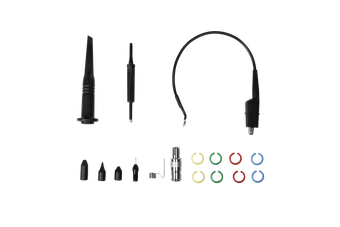
Accessory kits exist for the whole passive range, including the PAK1 set for the PB470, PP510 and PP215. Not every kit is listed individually — tell us the probe model and we will quote it.
Ask usApplication examples
Six jobs a passive probe is asked to do, and which one suits each.
Digital logic and clocks
Rise times of a few nanoseconds on a board you can reach with a hook clip. A 100 or 200 MHz probe covers most of it; step up when the edge starts looking rounder on screen than it should.
PP510 or PP215
Switch-mode supply work
Switch-node voltage at a few hundred kilohertz, but with edges far faster than the switching rate. Bandwidth here is about the edge, not the fundamental.
SP3050A at 500 MHz, 11 pF
Mains-adjacent and field service
Anywhere the category rating matters as much as the bandwidth. The PB925 is the only passive probe here rated 600 V CAT III, and it is the one supplied with the SHS1000 handheld scopes.
PB925
High-speed digital on terminated lines
Once the signal is on a driven 50 Ω line and the edge is in picoseconds, tip capacitance decides whether you see the real waveform. 1.8 pF instead of 12 pF changes the answer.
SP6150A — but read the 500 Ω caveat
Replacing a damaged probe
Probes are consumables. A cracked tip, a stretched ground lead or a compensation trimmer that will no longer hold costs accuracy long before the probe stops working outright.
Match the bandwidth of your oscilloscope
Building out channel count
Four channels need four probes, and most oscilloscopes ship exactly one per channel. A spare set means a four-channel capture is never held up by a broken tip.
Buy a matched set
Frequently asked
What does 1X and 10X actually change?
Far more than the scale factor. On a switchable probe, 10X gives you the full rated bandwidth — 70, 100 or 200 MHz — with around 20 pF at the tip. Switch to 1X and the bandwidth collapses to about 6 MHz and the capacitance rises to 85–120 pF. 1X is for low-level, low-frequency signals where you need the amplitude; it is not a free doubling of sensitivity.
Why does input capacitance matter so much?
Because it is a load on the circuit. 12 pF at the tip forms an RC with the source impedance and rounds the very edge you are trying to measure. On a 1 kΩ node, 12 pF is a 12 ns time constant — enough to visibly slow a fast edge. That is why the better probes here quote 11 or 12 pF rather than 20, and why active probes exist at all.
Do I need to compensate the probe every time?
Every time you move it to a different oscilloscope or a different channel, yes. The trimmer matches the probe’s capacitance to that specific input. Use the calibration square wave on the front panel and adjust until the corners are flat — overshoot or droop on a square wave is a mis-compensated probe, and every amplitude measurement you take after that is wrong.
What is the difference between the SP3050A and the SP3150A?
Electrically nothing — both are 500 MHz, 11 pF, 400 V CAT II. The SP3150A is the version characterised for oscilloscopes with more than 2 GHz of bandwidth, and it is the probe supplied with the SDS7000A. On a fast front end, order the SP3150A.
Why is the SP6150A so much faster than the others?
It is a transmission-line probe: 500 Ω input resistance instead of 10 MΩ, which is what lets it hold 1.8 pF and reach 1.5 GHz. That 500 Ω is a real load, so it belongs on driven, low-impedance lines. On a high-impedance node it will pull the signal down and give you a wrong answer.
Can I use these probes on a non-Siglent oscilloscope?
Yes. Every probe on this page connects over a standard BNC and needs no power or probe bus, so it works with any oscilloscope of any brand or age. Only the compensation range has to match your input, and at 8–35 pF these cover essentially every instrument you will meet.
Not sure which probe matches your oscilloscope?
Tell us the model and what you are measuring. Matching the probe to the instrument is usually a thirty-second answer — and buying more bandwidth than the scope can use is money wasted.