

SHS800X & SHS1000X Series
A two-channel oscilloscope, a 6000-count multimeter and a data logger in one sealed, battery-powered instrument. 100 or 200 MHz at 1 GSa/s, with fully isolated channels on the SHS1000X.
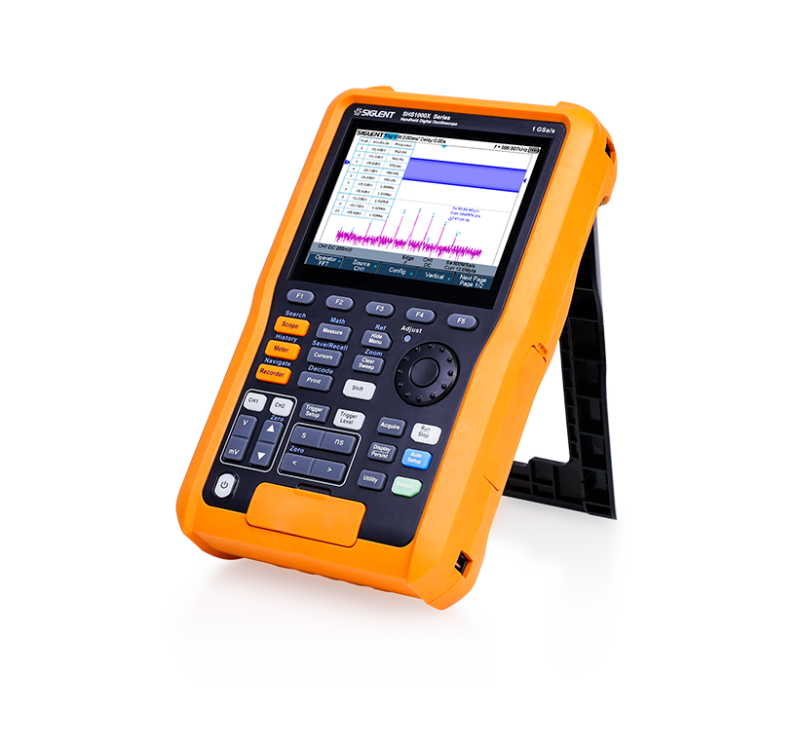
A bench instrument that goes to the fault
Most measurement problems outside a laboratory are not about resolution. They are about access: the equipment cannot be moved, the cabinet is live, there is no mains socket within reach, and the thing you need to probe is not at earth potential. A handheld oscilloscope exists for exactly that situation.
These are not cut-down instruments. Both series run a 1 GSa/s ADC with 12 Mpts of memory, capture up to 400,000 waveforms per second, decode I²C, SPI, UART, CAN and LIN without a licence, and carry a genuine 6000-count multimeter on a separate isolated channel. The housing is sealed to IP51 and the battery runs for a working session.
The choice between the two series is not about performance — bandwidth, sampling, memory, display and features are identical. It is about isolation, and that is worth understanding before you order.
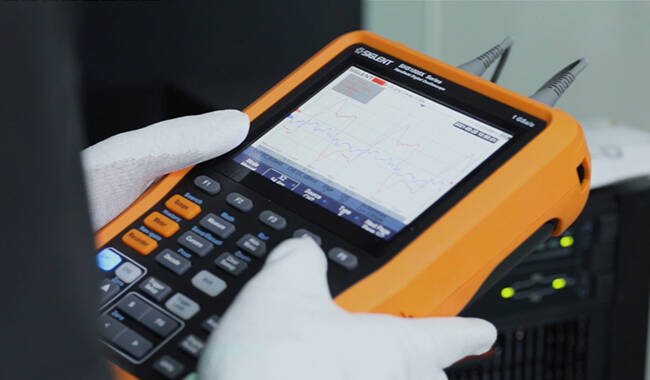
The one decision that matters: isolation
On an ordinary oscilloscope the two probe grounds are joined inside the instrument. Connect them to two points at different potentials and that internal link becomes a wire between those points — a short circuit through your oscilloscope. On a bench, where everything shares a ground, it never comes up. In a cabinet, on a half bridge, or across a floating supply, it is the whole problem.
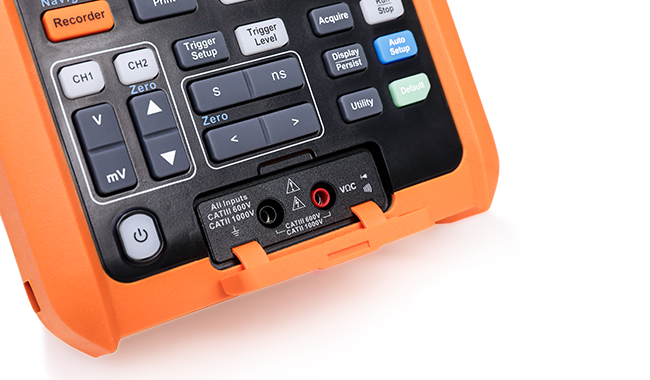
The SHS800X has two scope channels on a common ground, plus one isolated multimeter channel. The SHS1000X isolates everything from everything: each scope channel from the other, from the multimeter, from the power adaptor and from the USB ports. The safety ratings follow directly from that.
| Maximum input | SHS800X | SHS1000X |
|---|---|---|
| Scope input, signal to protective earth | CAT II 300 Vrms | CAT III 600 Vrms / CAT II 1000 Vrms |
| Scope input, BNC ground to protective earth | CAT II 30 Vrms | CAT III 600 Vrms / CAT II 1000 Vrms |
| Scope input, signal to BNC ground | CAT II 300 Vrms | CAT III 300 Vrms |
| Multimeter input | CAT III 300 Vrms / CAT II 600 Vrms | CAT III 600 Vrms / CAT II 1000 Vrms |
Four models
Two series, each in 100 and 200 MHz. Prices exclude VAT.
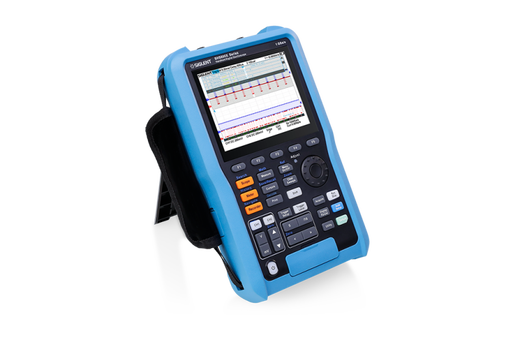
The entry point to the range: 100 MHz, two channels and the full handheld feature set, for bench-grade work away from the bench.
Twice the bandwidth of the SHS810X and otherwise identical — the choice when edges rather than isolation are the limiting factor.
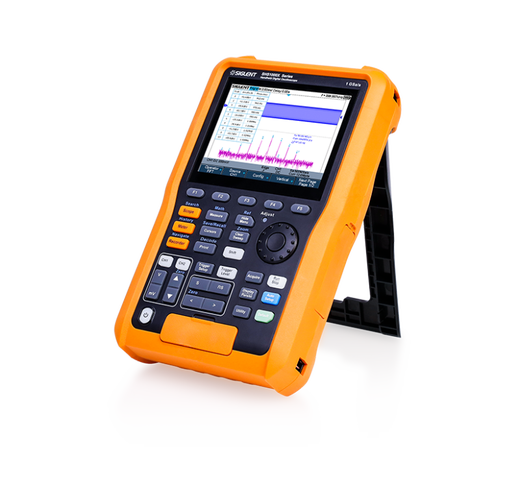
100 MHz with fully isolated channels — two scope inputs that can sit at different potentials without shorting through the instrument.
The top of the range: 200 MHz and full isolation, for high-energy and floating measurements where both bandwidth and safety margin matter.
How to choose
If everything you measure shares a ground and stays under about 300 V, an SHS800X does the same measurements for roughly half the money. If you work on floating, mains-referenced or high-energy circuits — or you need two channels at different potentials at the same time — buy the SHS1000X; that is the entire reason it exists. Choose 100 or 200 MHz afterwards, on the edges you actually need to resolve.
The same instrument underneath
Everything below is identical across all four models.
1 GSa/s and 12 Mpts
Both channels share a single 1 GSa/s ADC: 1 GSa/s and 12 Mpts on one channel, 500 MSa/s and 6 Mpts each with both running.
400,000 waveforms per second
100,000 wfm/s in normal mode and 400,000 wfm/s in sequence mode, with SPO technology and 256-level intensity grading to make infrequent events visible.
Serial decode at no extra cost
I²C, SPI, UART, CAN and LIN triggering and decoding are included — not licensed options as on many competing instruments.
6000-count multimeter
A genuine DMM on its own isolated channel: DC/AC volts with true RMS, DC/AC current, resistance to 60 MΩ, capacitance to 400 µF, diode and continuity.
1 Mpts FFT
A hardware maths co-processor runs the FFT over up to a million points, so spectra have real frequency resolution and still refresh quickly.
Recorders that run for a day
The sample logger records at up to 25 kSa/s for roughly 22 hours; the measurement logger tracks four values at intervals from 0.1 s for around 25 hours.
IP51, and built to be carried
A sealed dust and drip-proof housing tested to IEC 60529, 276 × 168 × 68 mm, 1.75 kg with the battery, with a fold-out stand.
A working day between charges
6900 mAh: about 5.5 hours on an SHS800X and 4 hours on an SHS1000X, recharging in 4 hours with the instrument switched off.
Specifications
From the SHS800X / SHS1000X data sheet, EN01D.
| Analogue channels | 2, plus 1 independent multimeter channel |
| Bandwidth | 100 MHz or 200 MHz depending on model |
| Sample rate | 1 GSa/s single channel · 500 MSa/s per channel with both active |
| Memory depth | 12 Mpts single channel · 6 Mpts per channel with both active |
| Waveform capture rate | 100,000 wfm/s normal · 400,000 wfm/s sequence |
| Vertical range | 2 mV/div to 100 V/div, offset to 400 V |
| Trigger types | Edge, slope, pulse width, window, runt, interval, dropout, pattern, video |
| Serial trigger & decode | I²C, SPI, UART, CAN, LIN — included |
| Maths | +, −, ×, ÷, FFT (1 Mpts), d/dt, ∫dt, √ |
| Counter | Hardware 6-digit, channel selectable |
| Multimeter | 6000 count — DCV, true-RMS ACV, DCI, ACI, resistance, capacitance, diode, continuity |
| Sample logger | 1 Sa/s to 25 kSa/s, to internal flash or a USB stick |
| Measurement logger | Up to 4 values, interval 0.1 s to 10 minutes |
| Display | 5.6-inch TFT LCD, 640 × 480, 24-bit colour, 500:1, 200 nits |
| I/O | USB host (isolated type A, memory sticks) · USB device (micro-B, remote control) |
| Battery | 6900 mAh · 5.5 h (SHS800X) or 4 h (SHS1000X) · 4 h charge |
| Ingress protection | IP51, tested to IEC 60529 |
| Dimensions / weight | 276 × 168 × 68 mm · 1.75 kg with battery |
| Safety | UL 61010-1, 61010-2-030 and 61010-2-033; CAN/CSA C22.2 equivalents |
Accessories
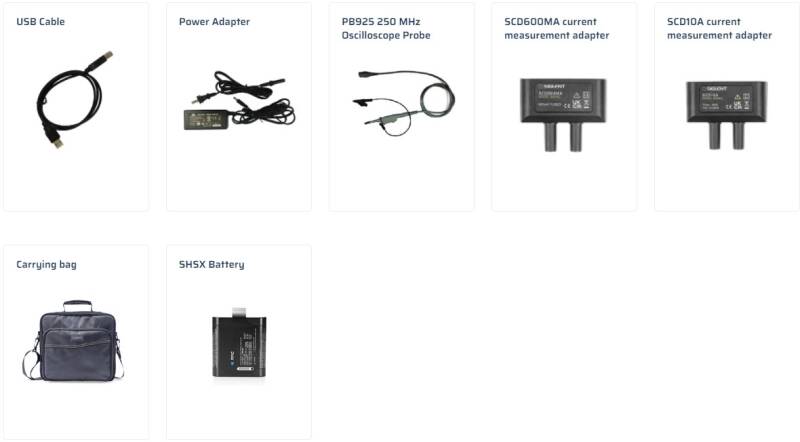
Each instrument ships with its probes, power adaptor and battery. Prices exclude VAT.
| Code | Accessory | Price |
|---|---|---|
| RRC2057 | Spare 7.2 V 6900 mAh battery | €99 |
| GSCH4000A | Smart external battery charger | €198 |
| BAG-H1 | Soft carry case | €39 |
| PB925 | 10X probe, 250 MHz, CAT III 600 V / CAT II 1000 V | €102 |
| SCD10A | Current-measurement adaptor, 6 A and 10 A ranges | €11 |
| SCD600mA | Current-measurement adaptor, 60 mA and 600 mA ranges | €11 |
| 12V-4A-SHS1000X | Power adaptor for the SHS1000X | €40 |
| 12V-3A-SHS800X | Power adaptor for the SHS800X | €30 |
Where they are used
Industrial maintenance
Drives, PLC cabinets and machine wiring, where the instrument has to come to the fault and the fault is rarely at earth potential.
Automotive and EV service
CAN and LIN decoding is built in, and the isolated models can sit across a high-voltage pack without referencing chassis.
Solar and energy storage
Inverter and string measurements at working voltages, with a CAT III rated multimeter in the same hand.
Field service generally
Scope, multimeter and data logger in one instrument that runs on its own battery for a shift.
Questions we are asked
What is the difference between the SHS800X and the SHS1000X?
Isolation. The SHS800X has two scope channels that share a common ground, plus one isolated multimeter channel. The SHS1000X isolates everything from everything: the two scope channels from each other, from the multimeter, from the power adaptor and from the USB ports. Everything else — bandwidth options, sample rate, memory, display, decoding, the multimeter — is the same.
Why does channel isolation matter?
Because two probe grounds joined inside the instrument become a wire between two points in your circuit. If those points are at different potentials — the two sides of a half bridge, a floating supply, a high-side gate drive — that wire is a short circuit through the oscilloscope. Isolated channels let each input sit wherever it needs to.
Which model should I buy?
If everything you measure shares a ground and is under about 300 V, the SHS800X does the same job for roughly half the money. If you work on floating, mains-referenced or high-energy circuits, or you need two channels at different potentials at once, buy the SHS1000X — that is what it is for. Then choose 100 or 200 MHz on the edges you need to see.
Do I need to buy the serial decoding separately?
No. I²C, SPI, UART, CAN and LIN triggering and decoding are included on every model in both series.
Is the multimeter a real multimeter?
Yes — a 6000-count DMM on its own isolated channel, with true-RMS AC volts, DC and AC current, resistance to 60 MΩ, capacitance to 400 µF, diode and continuity. For the current ranges you need one of the SCD adaptors: SCD600mA for 60 and 600 mA, SCD10A for 6 and 10 A.
How long does the battery last?
About 5.5 hours on an SHS800X and 4 hours on an SHS1000X from the 6900 mAh pack, recharging in about 4 hours with the instrument off. A spare battery (RRC2057) and an external charger (GSCH4000A) are available if the instrument has to stay in service continuously.
Can it survive a working environment?
The housing is IP51 rated for dust and dripping water, tested to IEC 60529, with moulded bumpers and a fold-out stand. It is built to be carried to the equipment rather than to sit on a bench.
Which probe is supplied?
The SHS810X ships with the PP510, the SHS820X with the PP215, and both SHS1000X models with the PB925 — a 250 MHz 10X probe rated CAT III 600 V / CAT II 1000 V, which is what the isolated models' input rating requires.
Not sure whether you need isolation?
Tell us what you measure and at what voltage, and we will tell you honestly whether the SHS800X is enough — it often is. We are the official Siglent distributor for the European Union.