

SDS7000A Series
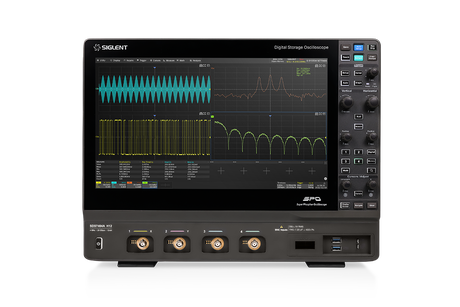
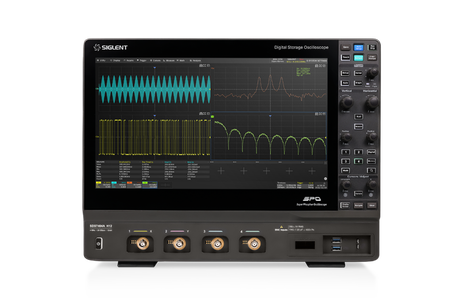
Siglent’s flagship bench: 3 to 8 GHz across four channels, a 12-bit ADC, up to 20 GSa/s and 2 Gpts of memory, a million waveforms a second, and a 15.6″ full-HD touchscreen driven by a real Linux workstation.
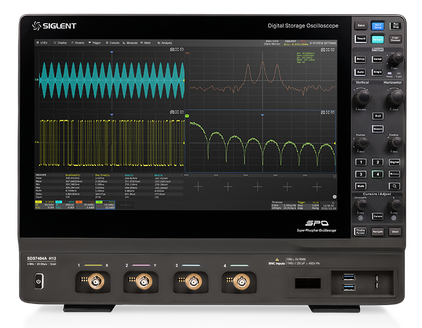
12-bit resolution, all the way to 8 GHz
Bandwidth normally costs you resolution. The SDS7000A digitises with a genuine 12-bit ADC — 4,096 codes rather than the 256 of an 8-bit instrument — and keeps them right out to the top of the range. At 1 V/div that is eight volts across the screen and roughly 2 mV per code, so 20 mV of ripple riding on a fast edge arrives as ten codes of measurable signal. The same window on an 8-bit scope quantises at 31 mV, and that ripple is simply not in the record to begin with.
In ERES the same acquisition path reaches 16 bits. Behind it sit 3 to 8 GHz of bandwidth on four channels at up to 20 GSa/s, a noise floor of 220 µVrms at 4 GHz and as much as 2 Gpts of memory — with SPO technology painting up to a million waveforms per second, so the glitch that fires once in a hundred thousand cycles is on screen while you are looking at it.
Why it earns the bench space
Twelve bits at these bandwidths is still the exception — much of this class digitises a multi-gigabit edge with eight. The converter is only half the story, so the data sheet also specifies the effective number of bits for every model: what actually reaches the screen once the front end has had its say. At 1,000,000 waveforms per second, rising to 1,100,000 in sequence mode where several instruments at this bandwidth manage a fifth to half as much, the fault that fires once in a hundred thousand cycles turns up in minutes instead of overnight.
And very little of it is chargeable extra. Bode plot, segmented acquisition, 124,000-frame history, search and navigation, SignalScan, DVM, counter, waveform histogram, 60+ automatic measurements, a 32 Mpts FFT and the five everyday serial buses (I²C, SPI, UART, CAN, LIN) are all standard — on rival platforms most of those arrive as separate line items on the quotation. Behind the 15.6″ touchscreen sits a real x86 workstation, Core i3-8100 or better with 32 GB and Linux, so hardware mask testing at 80,000 frames per second and full USB, Ethernet and MIPI D-PHY compliance runs finish on the bench instead of becoming an export-to-PC job for the next morning. Add the SPL2016 and it is a 4+16-channel mixed-signal system.
Five models
Choose the bandwidth your fastest edge needs — then decide whether you need full speed on all four channels at once. Everything else in the series is common.
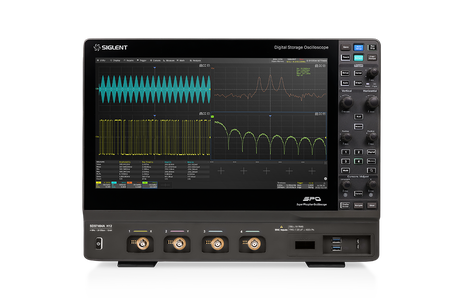
- 20 GSa/s (2 channels) · 10 GSa/s (3–4 channels)
- 500 Mpts/ch standard
- Full 3 GHz on every channel
- 20 GSa/s (2 channels) · 10 GSa/s (3–4 channels)
- 500 Mpts/ch standard
- Full 4 GHz on every channel
- 20 GSa/s (2 channels) · 10 GSa/s (3–4 channels)
- 500 Mpts/ch standard
- Limited to 4 GHz in 3–4 channel mode
- 20 GSa/s on all four channels
- 1 Gpts/ch standard
- Full 6 GHz on every channel
- 20 GSa/s (2 channels) · 10 GSa/s (3–4 channels)
- 500 Mpts/ch standard
- Limited to 4 GHz in 3–4 channel mode
A model or AP model?
This is the one real decision in the series — and it is about channel count at full speed, not about bandwidth.
SDS7304A · 7404A · 7604A · 7804A
- 20 GSa/s across two channels · 10 GSa/s across three or four
- 500 Mpts/ch standard · 1 Gpts/ch optional in dual-channel mode
- On the 6 and 8 GHz models, bandwidth drops to 4 GHz when three or four channels are active
- Spectrum Analyzer mode (RTSA / DDC) — A models only
SDS7604AP
- 20 GSa/s on all four channels simultaneously
- Full rated bandwidth on every channel — no de-rating
- 1 Gpts/ch standard (1–2 ch) · up to 2 Gpts optional
- No Spectrum Analyzer mode
Rule of thumb: if you regularly probe three or four high-speed signals at the same time, the AP earns its premium. If you work on one or two at a time, an A model gives you the same bandwidth for substantially less.
What every model shares
3 to 8 GHz, 12-bit
Four analog channels with a genuine 12-bit ADC (16-bit in ERES) — the vertical resolution to see what an 8-bit scope buries in quantisation noise, at bandwidths up to 8 GHz.
Up to 20 GSa/s
20 GSa/s of real-time sampling, and on the AP models that rate is available on all four channels at once rather than only two.
Up to 2 Gpts memory
500 Mpts/ch as standard, 1 Gpts/ch standard on AP models and up to 2 Gpts optional — long enough to capture a slow event at full sample rate.
1,000,000 wfm/s
SPO technology with 256-level intensity grading and colour-temperature display, so infrequent anomalies actually appear on screen.
Workstation inside
An Intel Core i3-8100 or better with 32 GB of memory and 250 GB of storage running Linux — which is what makes 32 Mpts FFT and deep analysis usable.
15.6″ full-HD touch
A 1920 × 1080 capacitive multi-touch display with gestures, plus DVI-D, DisplayPort and HDMI out, mouse, keyboard and browser control over dual gigabit LAN.
Analysis that usually needs a second instrument
Licensed software that runs on the scope’s own workstation hardware.
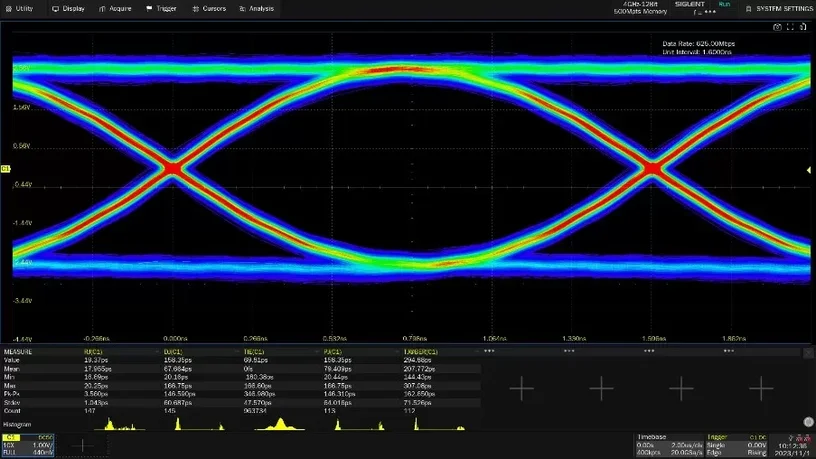
Eye diagram & jitter analysis
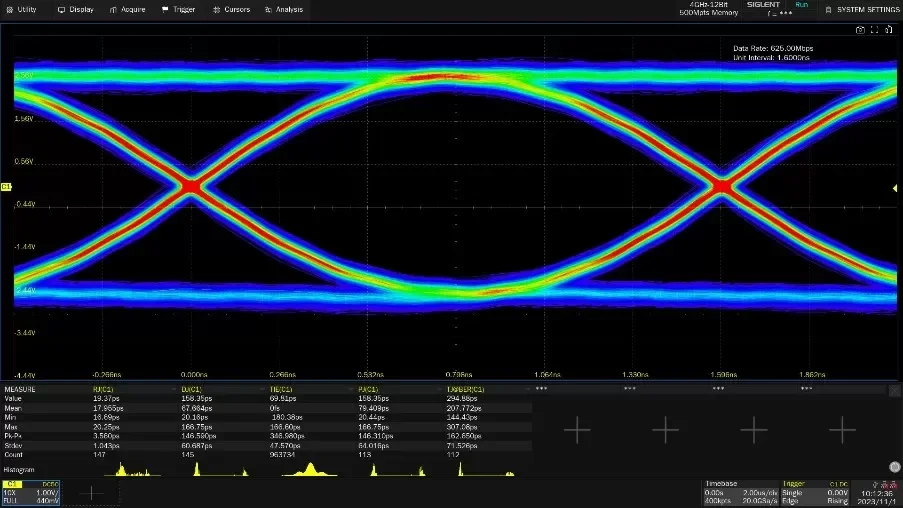
A colour-graded eye built from the captured signal, with the full jitter breakdown underneath — TJ, RJ, DJ and the rest — so you can tell a random noise problem from a deterministic one. This is the measurement that decides whether a high-speed link ships, and on the SDS7000A it is a licence rather than a separate instrument.
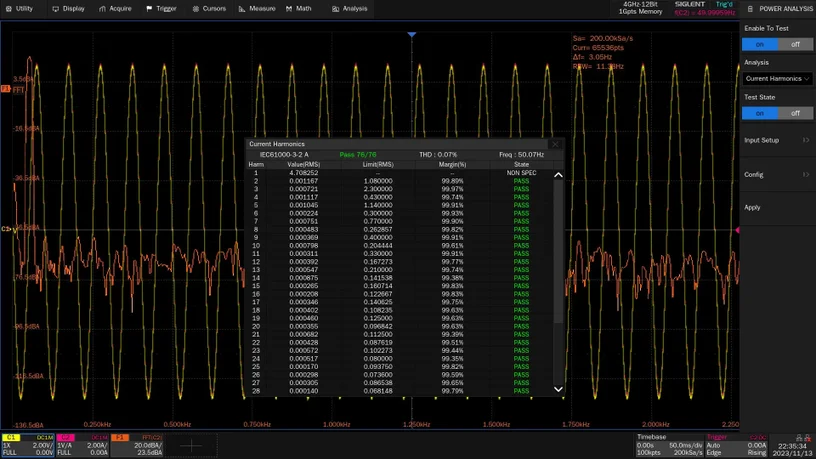
Power analysis
Switching loss, harmonics against the limit line, modulation, inrush and safe-operating area — computed on the scope with the harmonic table alongside the waveform. Pair it with the DF2001A deskew fixture: at these edge rates, a few hundred picoseconds of probe skew is the difference between a real loss figure and a fictional one.
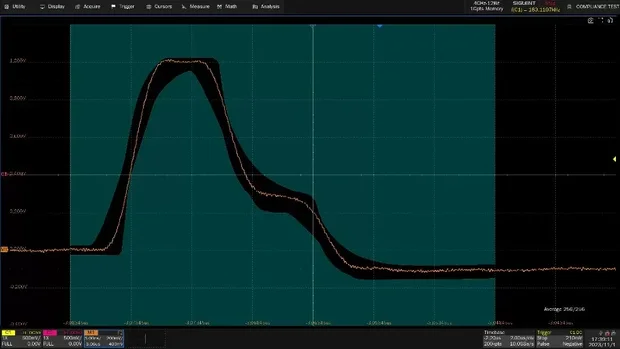
Ethernet & USB compliance test
Automated pass/fail against the standard’s own template: 100BASE-T, 1000BASE-T, the automotive 100BASE-T1 and 1000BASE-T1 variants, and USB 2.0. Catch a compliance failure at your bench, not at the test house.
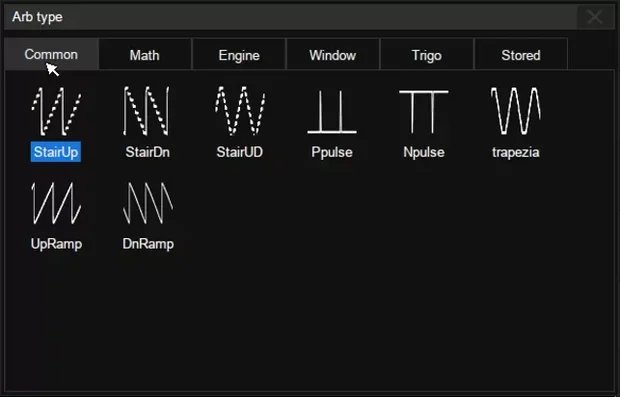
Built-in 50 MHz generator
The SDS7000A-FG licence turns on an internal arbitrary/function generator — 50 MHz, 125 MSa/s, 16 kpts — for stimulus-response work and Bode plots without dragging a separate source onto the bench.
Specifications
Bandwidth, sample rate and memory differ per model (see the cards above); everything below is common to the series.
| Analog channels | 4 + EXT · 16 digital channels with the optional SPL2016 logic probe |
| Vertical resolution | 12-bit ADC — up to 16-bit in ERES mode |
| Waveform capture rate | Up to 1,000,000 wfm/s (SPO technology) · 256-level intensity grading & colour-temperature display |
| Background noise | 300 µVrms at 8 GHz · 220 µVrms at 4 GHz |
| Trigger types | Edge, Slope, Pulse width, Window, Runt, Interval, Dropout, Pattern, Video (HDTV), Qualified, Nth edge, Setup/Hold, Delay, Serial — plus Zone Trigger |
| Serial trigger & decode (standard) | I²C, SPI, UART, CAN, LIN |
| Serial (optional licence) | CAN FD, CAN XL, FlexRay, I²S, MIL-STD-1553B, SENT, Manchester, ARINC429, USB 2.0, SpaceWire, SPMI, 8B/10B, MIPI RFFE |
| Segmented capture | Sequence mode up to 124,000 segments · History up to 124,000 frames |
| Measurements | 60+ parameters with statistics, histogram, trend, track and gating — also on Math, History and Memory traces |
| Math | 4 traces · 32 Mpts FFT (magnitude & phase), filter, integrate, differentiate, √, MaxHold/MinHold, ERES, envelope · formula editor |
| Analysis tools | Search, Navigate, History, SignalScan, Mask Test, DVM, Counter, Waveform Histogram, Bode plot · Power Analysis, Eye/Jitter and Compliance Test as licences |
| Spectrum analyzer mode | RTSA / DDC / signal analysis — A models only |
| Digital channels | 16 channels · up to 1 GSa/s · 50 Mpts record length (SPL2016) |
| Waveform generator | Built-in, 50 MHz, 125 MSa/s, 16 kpts — enabled by the SDS7000A-FG licence |
| Display | 15.6″ HD TFT-LCD, 1920 × 1080, capacitive multi-touch with gestures |
| Processor system | Intel Core i3-8100 or better · 32 GB memory · 250 GB storage · Linux |
| Interfaces | 4× USB 3.1 Gen 1 Host · 2× USB 3.0 Host · USB 2.0 Device (USBTMC) · 2× 1000M LAN (LXI, VXI-11, Socket, Telnet, web server) |
| Video & other I/O | DVI-D, DisplayPort 1.2, HDMI 1.4 · mic in / audio out · External Trigger In · Aux Out (Trig Out, Pass/Fail) · 10 MHz In and Out |
| Remote control | Built-in web server over LAN · full SCPI · external mouse and keyboard supported |
From the official SDS7000A series data sheet (EN04A); subject to change, errors & omissions excepted.
Licences & upgrades
Everything is a software licence — including the bandwidth upgrades, so a 3 GHz scope becomes a 4 GHz scope without leaving your bench.
| Option | Order code | Price | |
|---|---|---|---|
| Bandwidth upgrades | |||
| 3 GHz → 4 GHz bandwidth upgrade | SDS7000A-BW3T4 | €7,410.00 | View |
| 6 GHz → 8 GHz bandwidth upgrade | SDS7000A-BW6T8 | €27,800.00 | View |
| Analysis software | |||
| Eye diagram & jitter analysis | SDS7000A-EJ | €1,960.00 | View |
| Power analysis | SDS7000A-PA | €1,610.00 | View |
| Built-in 50 MHz waveform generator | SDS7000A-FG | €730.00 | View |
| Compliance test | |||
| 1000BASE-T1 compliance test | SDS7000A-CT-1000BASE-T1 | €3,820.00 | View |
| 1000BASE-T compliance test | SDS7000A-CT-1000BASE-T | €3,590.00 | View |
| 100BASE-T1 compliance test | SDS7000A-CT-100BASE-T1 | €2,310.00 | View |
| 100BASE-T compliance test | SDS7000A-CT-100BASE-T | €2,130.00 | View |
| USB 2.0 compliance test | SDS7000A-CT-USB2 | €510.00 | View |
| Serial trigger & decode | |||
| CAN FD trigger & decode | SDS7000A-CANFD | €540.00 | View |
| FlexRay trigger & decode | SDS7000A-FlexRay | €540.00 | View |
| I²S trigger & decode | SDS7000A-I2S | €540.00 | View |
| MIL-STD-1553B trigger & decode | SDS7000A-1553B | €540.00 | View |
| SENT trigger & decode | SDS7000A-SENT | €540.00 | View |
| ARINC 429 trigger & decode | SDS7000A-ARINC | €540.00 | View |
| Manchester decode | SDS7000A-Manch | €540.00 | View |
| USB 2.0 decode | SDS7000A-USB2 | €540.00 | View |
Bandwidth upgrades apply to the matching model only (BW3T4 to a 3 GHz unit, BW6T8 to a 6 GHz unit). Software licences are delivered electronically and are excluded from the 14-day EU return right once the key has been issued. See the full licence overview.
In the box
- SP3150A passive probe (1 per channel)
- Wireless mouse
- USB cable
- Power cord
- Front protective cover
- Quick start guide
- Calibration certificate
Recommended accessories
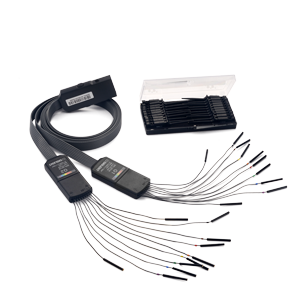
16 digital channels at up to 1 GSa/s — turns the scope into a true mixed-signal instrument.
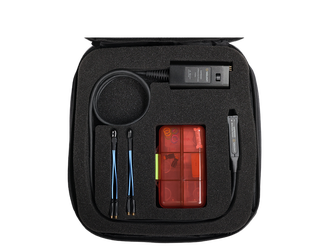
8 GHz differential active probe on the SAPBus interface — the probe that matches an 8 GHz front end.
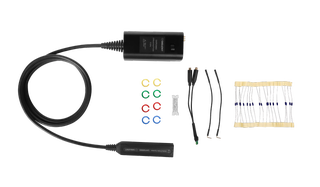
5 GHz differential active probe, 400 fF input capacitance — for high-speed single-ended and differential work.
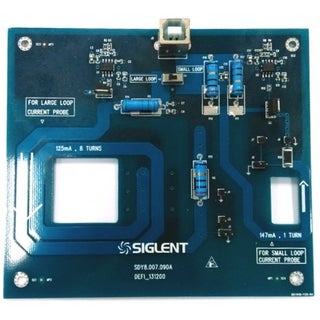
Deskews voltage and current probes before a power-analysis run — skew is the biggest error source in switching-loss measurement.
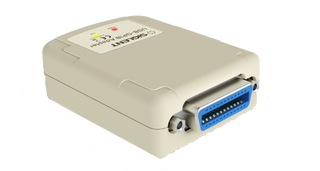
Adds GPIB alongside the standard dual LAN and USB interfaces.
Downloads
Specifying an 8 GHz bench is not a web-form decision
Tell us your fastest edge, how many channels you need at full rate, and which standards you have to prove — we will size the model, the probes and the licences together, with EU stock, calibration and support.
Frequently asked questions
What is the difference between the A (H12) and AP models?
Sampling and memory. The A models give 20 GSa/s across two channels and 10 GSa/s across three or four, with 500 Mpts/ch standard; on the 6 and 8 GHz A models the bandwidth is limited to 4 GHz once you use three or four channels. The AP models deliver the full bandwidth and 20 GSa/s on all four channels simultaneously, with 1 Gpts/ch standard and up to 2 Gpts optional. One caveat in the other direction: the Spectrum Analyzer mode is available on A models only.
Which model should I choose?
Pick the bandwidth your fastest edge needs, then decide how many channels must run at full speed at once. If you routinely probe three or four high-speed signals together, the AP is worth the premium; if you mostly work on one or two at a time, an A model gives you the same bandwidth for considerably less.
Can I upgrade the bandwidth later?
Yes, by software licence: SDS7000A-BW3T4 takes a 3 GHz model to 4 GHz, and SDS7000A-BW6T8 takes a 6 GHz model to 8 GHz. No hardware change and no return to the factory.
Is it a mixed-signal oscilloscope?
Yes, with the optional SPL2016 logic probe: 16 digital channels at up to 1 GSa/s and 50 Mpts, decoded and displayed alongside the four analog channels.
What comes as standard versus a paid licence?
Standard: the full trigger set with Zone Trigger, I²C/SPI/UART/CAN/LIN decode, 60+ measurements, 32 Mpts FFT, Search, Navigate, SignalScan, Mask Test, Bode plot, DVM, counter and histogram. Licensed: eye/jitter analysis, power analysis, the waveform generator, the compliance tests and the additional serial protocols.
How do I control it remotely?
It has a built-in web server reachable from a browser over either of its two gigabit LAN ports, full SCPI over LXI/VXI-11/socket/telnet and USBTMC, and it accepts an external mouse and keyboard. Video can be mirrored out over DVI-D, DisplayPort or HDMI.