

Probe tools & accessories
Two pieces of bench hardware that make other measurements trustworthy: a fixture that removes the timing skew between a voltage probe and a current probe, and a near-field probe set that shows where emissions are coming from.
The accessories that decide whether a measurement is valid
Power measurement multiplies voltage by current, and the answer depends on the two arriving at the oscilloscope at the same instant. They do not. A voltage probe and a current probe have different internal delays — a current probe's transformer and amplifier typically add several nanoseconds more than a passive voltage probe. On a 100 kHz switching converter that skew lands squarely in the switching edge, where almost all of the loss occurs, and switching-loss figures come out wrong by tens of percent while both probes are working perfectly.
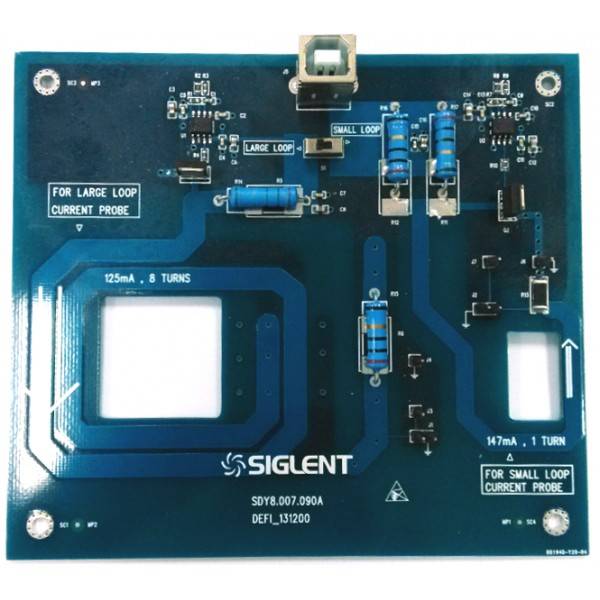
The DF2001A gives both probes the same signal at the same moment: a fixture with a voltage test point and a current loop driven from one source, so the delay between the two channels can be measured and dialled out in the oscilloscope's deskew setting. It takes a couple of minutes, it needs doing whenever the probe combination changes, and without it a power-analysis result is an estimate.
The SRF5030T answers a different question: not how big an emission is, but where it comes from. Four near-field heads — magnetic loops in several sizes and an electric-field probe — cover 300 kHz to 3 GHz. Moved across a running board with a spectrum analyser connected, they turn a failed radiated-emissions scan into a specific component, trace or cable. That is the difference between guessing at a fix and knowing which loop to shrink or which cable to re-route — and it is far cheaper to find out on your own bench than in a test house.
The models
2 products. Prices exclude VAT.
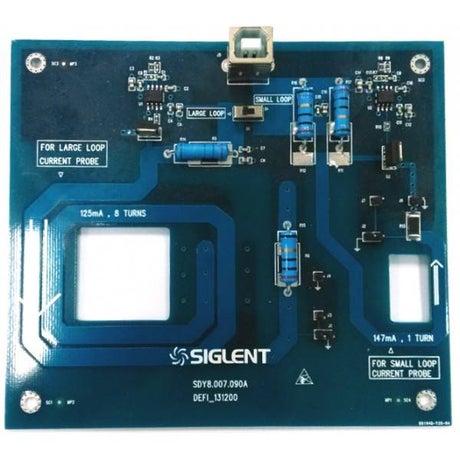
Drives a voltage test point and a current loop from the same source so the timing offset between a voltage probe and a current probe can be measured and corrected in the oscilloscope. Required for credible switching-loss and power-analysis results.
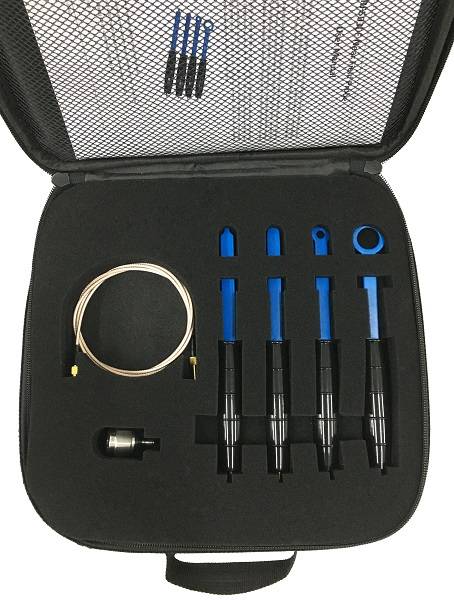
A set of near-field probes covering 300 kHz to 3 GHz — magnetic loops in several sizes plus an electric-field head — for locating the source of an emission on a live board during pre-compliance work.
Specifications side by side
Every model in this family, on one row each.
What these are used for
Deskewing before a power measurement
Measure the delay between the voltage and current channels on the DF2001A, enter it as deskew, and switching-loss numbers become repeatable.
Finding the source of an emission
Sweep a near-field loop over a running board and watch the analyser trace peak. The hot spot is the loop, trace or cable that needs attention.
Pre-compliance before a test house
Locate and fix the obvious emitters on your own bench. Chamber time is expensive and a failed visit costs a redesign cycle.
Checking probe-to-probe timing
Any measurement that compares two channels — not only power — benefits from knowing the skew between the probes carrying them.
Questions we are asked
Do I really need a deskew fixture?
If you multiply voltage by current, yes. A current probe typically lags a passive voltage probe by several nanoseconds, and switching loss is calculated exactly where that error lands. The fixture turns a systematic error into a number you enter once per probe combination.
How often should I deskew?
Whenever the probe combination changes — a different current probe, a different cable length, a different channel. The correction belongs to the pair of probes, not to the oscilloscope.
Can near-field probes measure whether my product passes EMC?
No, and nothing on a bench can. Compliance is measured at a defined distance in a controlled environment. Near-field probes are diagnostic: they tell you where the energy is coming from so you can fix it before booking chamber time.
What do I connect the SRF5030T to?
A spectrum analyser is the usual choice — an SSA3000X Plus or SVA1000X gives you the trace and the max-hold you want while moving the probe. An oscilloscope with an FFT will also show the larger offenders.
Not sure which one fits your measurement?
Tell us the instrument, the signal and what you are trying to see. We are the official Siglent distributor for the EU and we will point you at the right part — including when the right answer is a probe from another family, or nothing at all.