

Active probes
Five probes from 1 GHz to 8 GHz, single-ended and differential. About 1 pF at the tip instead of the 10–15 pF a passive probe presents — which is the whole reason they exist.
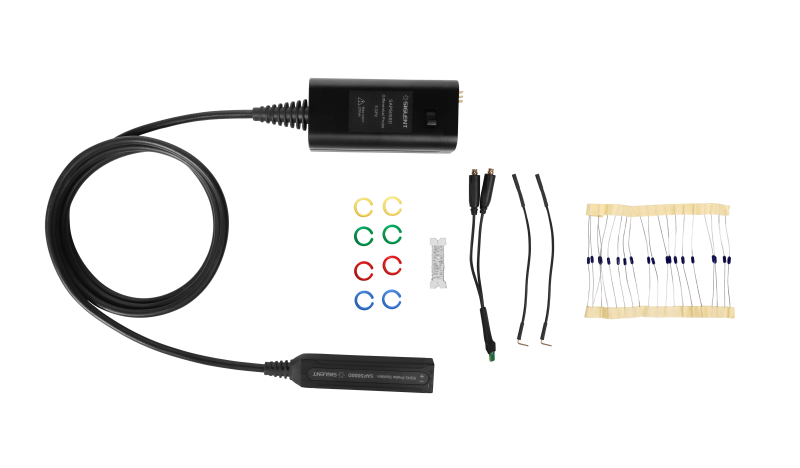
Above a few hundred megahertz, capacitance is the measurement
A 10X passive probe presents roughly 10–15 pF at the tip. On a slow signal that is invisible; on a fast one it forms an RC with the source impedance and rounds off the very edge you are trying to look at. At 1 GHz, 12 pF is an impedance of about 13 Ω — the probe stops being an observer and becomes part of the circuit.
An active probe puts an amplifier at the tip so the oscilloscope never has to drive that capacitance down a cable. The result is around 1 pF on the single-ended models and 300–400 fF on the fast differential ones — ten to forty times less loading, which is what makes a gigahertz measurement mean anything.
The trade is dynamic range. These probes handle ±2.5 V to ±8 V, not the hundreds of volts a passive probe tolerates, with an offset control to place that window where the signal actually sits. They are instruments for signals, not for power.
Buy for the system bandwidth, not the probe bandwidth
A probe and an oscilloscope combine into a system whose bandwidth is lower than either part alone. Siglent publish both figures, and the difference is not small:
>2.5 GHz as a probe — 2 GHz measured on an SDS6204A.
>5 GHz as a probe — 4 GHz measured on an SDS7404A.
So the honest question is not “how fast is the probe?” but “how fast is the probe on my oscilloscope?” Tell us which scope you have and we will give you the system figure before you order — it is the number your measurement actually lives with.
Single-ended active probes
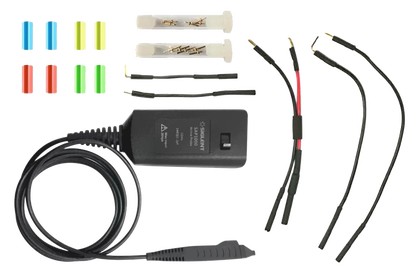
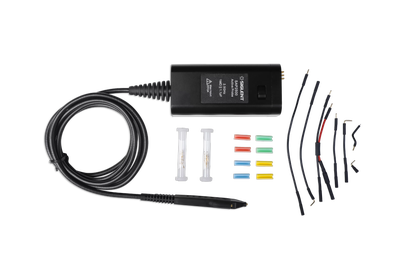
For signals referenced to the board’s own ground, where you can get a short ground connection to the node. 1 MΩ input and about 1 pF at the tip, with ±8 V of dynamic range and ±12 V of offset.
Differential active probes
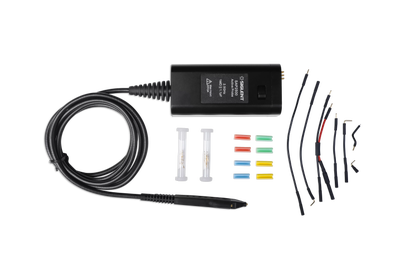
For a differential pair, a high-side gate-source, or anything where a ground reference would be a fiction. They also reject the common-mode noise a single-ended probe would faithfully record — and they go faster, down to 300 fF of differential input capacitance.
- 200 kΩ differential input
- ±4 V dynamic range
- ±8 V offset
- SAPBus interface
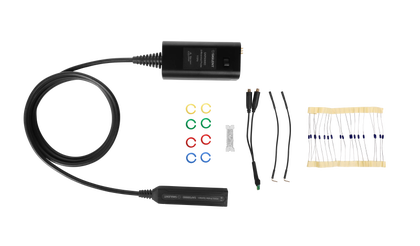
- 20 kΩ differential input
- ±2.5 V dynamic range
- ±12 V offset
- SAPBus interface
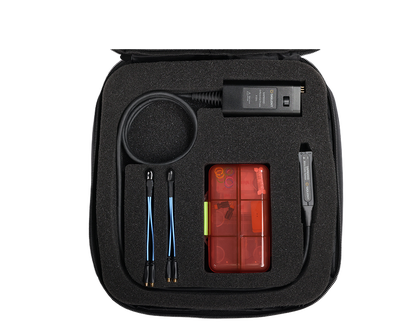
- 20 kΩ differential input
- — dynamic range
- ±12 V offset
- SAPBus interface
All five compared
| Model | Type | Bandwidth | Input capacitance | Input resistance | Dynamic range | Offset | Price |
|---|---|---|---|---|---|---|---|
| SAP1000 | Single-ended | 1 GHz | 1.2 pF | 1 MΩ | ±8 V | ±12 V | €865 |
| SAP2500 | Single-ended | 2.5 GHz | 1.1 pF | 1 MΩ | ±8 V | ±12 V | €1,439 |
| SAP2500D | Differential | >2.5 GHz | 1 pF | 200 kΩ differential | ±4 V | ±8 V | €2,359 |
| SAP5000D | Differential | >5 GHz | 400 fF | 20 kΩ differential | ±2.5 V | ±12 V | €3,469 |
| SAP8000D | Differential | 8 GHz | 300 fF | 20 kΩ differential | — | ±12 V | €12,345 |
All five use the SAPBus interface and a 130 cm cable, with 20 V non-destructive input. Differential models attenuate ÷10. Bandwidth quoted is the probe alone — the system figure on your oscilloscope will be lower. Prices exclude VAT. Errors and omissions excepted.
All five need a SAPBus oscilloscope
SAPBus carries power, identification and control down a single connector: the oscilloscope names the probe, applies its attenuation and offset, and reads the channel in the right units. That means these probes need a SDS7000A, SDS6000A, SDS6000L, SDS5000X and SDS3000X HD series instrument. If you own an older scope, or a different brand, the TPA10 adapter runs TekProbe Level II active probes up to 4 GHz instead.
Tips, heads and positioners
The amplifier decides the bandwidth; the tip decides whether you can reach the node and whether the connection is repeatable. Tips are consumables, and on a long characterisation run the right head or positioner saves more time than anything else on this page.
For the SAP1000, SAP2500 and SAP2500D
| SAP-ST1 | Straight tips, 5 per box — for SAP1000, SAP2500 and SAP2500D | €45 | View |
|---|---|---|---|
| SAP-PT | Pogo tips, 5 per box — sprung, for repeated probing of the same pad | €30 | View |
| SAP1-kit | Full accessory kit for the SAP1000 and SAP2500 — straight tips ×5, pogo tips ×5, L-in adapter, Z ground | €248 | View |
| SAP2-kit | Full accessory kit for the SAP2500D — straight tips ×5, pogo tips ×5, swivel tips ×2, tip savers ×2, Y lead | €298 | On request |
For the SAP5000D and SAP8000D
| SAP5-KIT | 20 lead resistors, 10 cm ground wire, 1 m silver wire, 2 swivel tips, 5 straight tips | €260 | View |
|---|---|---|---|
| SAP5-TEP | Replacement pin kit — 4 tungsten steel pins, 10 elastic pins | €229 | On request |
| DBT-50 | Adjustable pin head, SMP interface, connects to the probe amplifier | €680 | On request |
| SMA-50 | SMP-to-SMA lead for connecting the amplifier to a coaxial fixture | €580 | On request |
| SAP5-DRP45 | Socketed head DRP-45 with 2 swivel tips, 5 straight tips, 5 pogo tips | €680 | On request |
| SAP5-SRP45 | Socketed head SRP-45 with 2 swivel tips, 5 straight tips, 5 pogo tips | €680 | On request |
| SAP5-DSI50 | Solder-in head DSI-50 with 20 lead resistors and 1 m silver wire | €410 | On request |
| SAP5-SSI50 | Solder-in head SSI-50 with 20 lead resistors and 1 m silver wire | €410 | On request |
| PP201 | Two-legged positioner — holds the probe steady on the board | €355 | On request |
| PP301 | 3D positioner — full three-axis placement for repeatable probing | €410 | On request |
These accessories are not all listed individually on the shop yet. Tell us the probe model and what you are trying to reach, and we will quote the right kit from the current price list.
Application examples
Six measurements that need an active probe, and which one suits each.
High-speed digital and serial buses
DDR, PCIe, USB and SerDes signalling, where the edge is measured in picoseconds and 12 pF of passive-probe capacitance visibly changes the waveform before you ever read it.
SAP2500 single-ended, SAP5000D differential
Signal integrity and eye diagrams
Where the question is whether the link closes at all. Probe loading has to be small enough that the answer is about the design rather than the instrument.
SAP5000D or SAP8000D
Gate drive on wide-bandgap devices
SiC and GaN transitions with tens of nanoseconds of structure riding on them — and a gate-source node that floats, which is why the differential models exist.
SAP2500D upward
Clock distribution and jitter
Small timing displacements on a fast clock. A probe that rounds the edge also blurs the crossing point the jitter measurement depends on.
SAP2500 or faster
High-impedance node probing
A 1 MΩ single-ended active probe barely loads a node that a 10 MΩ passive probe would still spoil at high frequency — because above a few hundred megahertz it is the capacitance, not the resistance, that matters.
SAP1000 or SAP2500
Semiconductor and component characterisation
Device-level measurement where the probe has to be placed precisely and repeatably. The positioners and solder-in heads matter as much as the amplifier.
SAP5000D with a PP301 positioner
Frequently asked
Why does an active probe cost so much more than a passive one?
You are paying for an amplifier at the tip. A 10X passive probe presents 10–15 pF to the circuit; an active probe presents around 1 pF, and the differential models get down to 300–400 fF. That difference is what lets a gigahertz signal reach the oscilloscope with its shape intact, and it cannot be achieved passively.
Will I actually get the probe’s full bandwidth?
Not on its own — the system bandwidth is what you measure with, and it is always lower than the probe alone. Siglent specify both: the SAP2500D is >2.5 GHz as a probe but 2 GHz on an SDS6204A, and the SAP5000D is >5 GHz as a probe but 4 GHz on an SDS7404A. Buy for the system figure, not the headline.
What is SAPBus and does my oscilloscope have it?
SAPBus is Siglent’s active-probe interface. It carries power, identification and control down one connector, so the scope names the probe, applies its attenuation and offset, and reads the channel in the right units. It is on the SDS7000A, SDS6000A, SDS6000L, SDS5000X and SDS3000X HD series. Every probe on this page needs it.
Single-ended or differential?
Single-ended if the signal is referenced to the board’s own ground and you can get a short ground connection to it. Differential if the two points you care about are both moving — a high-side gate-source, a differential pair, or anything where a ground reference would be a fiction. Differential probes also reject the common-mode noise that a single-ended probe would faithfully record.
Do I need the accessory kits?
The probe ships usable, but the tips are consumables and the right head changes what you can reach. Solder-in heads give the most repeatable connection for long characterisation runs; socketed heads let you move between test points; positioners hold the probe steady so you are not doing it by hand for an afternoon. Tell us the probe and the job and we will suggest the kit.
Can I use a Tektronix active probe on my Siglent oscilloscope?
Yes, with the TPA10 adapter, which supports TekProbe Level II up to 4 GHz on the SDS5000X, SDS5000X HD and SDS6000A. Level I and TekVPI probes use different interfaces and will not fit.
Tell us the oscilloscope and the signal
Active probes are the one accessory where the headline number is not the number you get. Tell us which scope you own and what you are measuring, and we will give you the real system bandwidth — and the tip or head that will actually reach your node.