

Adjustable TDR probes
Four hand-held probes for impedance measurement on real hardware. A thumbwheel sets tip spacing anywhere from 0 to 6.5 mm, so one probe lands cleanly on a differential pair, a single trace, a connector pin or a bare wire.
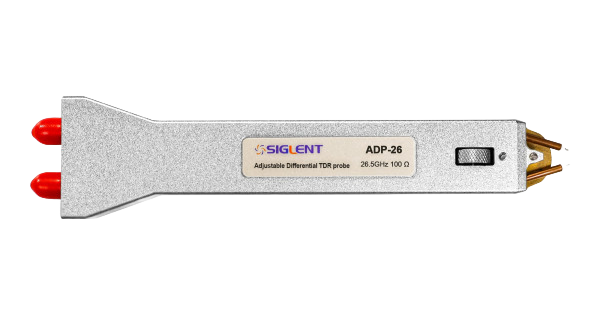
Impedance is measured where the fixture is not
Controlled-impedance design is verified on coupons and calibration boards, but faults appear on assembled hardware — a via that necks down, a connector footprint that was never tuned, a length of cable that is not the 100 Ω it claims to be. Soldering an SMA onto each suspect node is slow, changes the very discontinuity being investigated, and is often impossible on a populated board.
A TDR probe replaces the fixture with a contact. The instrument — a vector network analyser with a time-domain option, or an oscilloscope with a TDR source — launches a step and watches what comes back; the probe simply gets that step onto the trace with as little disturbance as possible. The reflection is then read as impedance against distance, so a discontinuity is located as well as quantified.
What makes these four practical is the adjustable pitch. A fixed-pitch probe fits one geometry; a thumbwheel that sets tip spacing continuously from 0 to 6.5 mm fits a 0.4 mm differential pair, a connector on a 2.54 mm grid and a pair of wires, without changing probes. Repeatability is specified at 2% or better over more than 100 contacts, which is what makes measurements comparable across a board rather than merely indicative. Choose the pitch from the geometry, the bandwidth from the rise time you need to resolve, and single-ended or differential from the trace itself: ASP is single-ended 50 Ω, ADP is differential 100 Ω.
The models
4 products. Prices exclude VAT.
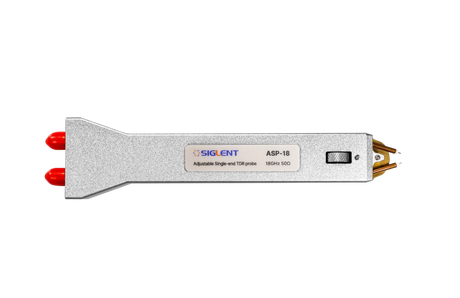
Single-ended 50 Ω probe to 18 GHz. The general-purpose choice for microstrip and stripline traces, connector pins and coaxial work.
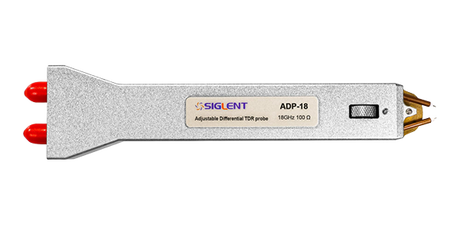
Differential 100 Ω probe to 18 GHz — for USB, Ethernet, LVDS and any other controlled-impedance pair.
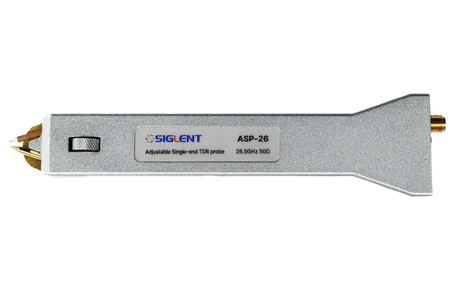
Single-ended 50 Ω probe to 26.5 GHz, for faster edges and the finer spatial resolution that comes with them.
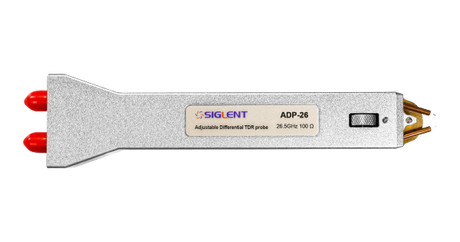
Differential 100 Ω probe to 26.5 GHz — the highest-resolution option, for multi-gigabit pairs where a small discontinuity still matters.
Where a TDR probe is the fastest way to an answer
Verifying trace impedance
Check that a differential pair really is 100 Ω on the finished board, not only on the coupon that came with the panel.
Locating a discontinuity
A TDR reports distance as well as magnitude, so a bad via or an unterminated stub can be found rather than inferred.
Connectors and cable assemblies
Measure the impedance a connector footprint actually presents, and check assembled cables against what the specification claims.
Incoming inspection
Repeatability of 2% or better over 100-plus contacts makes hand probing good enough to compare boards against each other and against a reference.
Questions we are asked
What instrument do I need to use these probes?
Anything that can perform a time-domain reflectometry measurement — a Siglent SNA5000A or SNA5000X-E vector network analyser with the TDR option, or an oscilloscope with a TDR source. The probe is the contact; the instrument makes the measurement.
What is the difference between ASP and ADP?
ASP is single-ended and referenced to 50 Ω, for a single trace against its ground. ADP is differential and referenced to 100 Ω, for a controlled-impedance pair. Use the one that matches the structure you are measuring — a differential pair measured single-ended will not give the differential impedance.
Should I buy the 18 GHz or the 26.5 GHz version?
Higher bandwidth resolves a faster edge, which means finer spatial resolution — the ability to separate two discontinuities that are close together. 18 GHz is enough for most board-level work; 26.5 GHz is worth it for multi-gigabit serial links where features are small and close.
How does the adjustable spacing work?
A thumbwheel on the probe body moves the tips continuously between 0 and 6.5 mm and holds the setting, so the same probe fits a fine-pitch differential pair, a connector on a 2.54 mm grid and a pair of wires without any change of hardware.
Not sure which one fits your measurement?
Tell us the instrument, the signal and what you are trying to see. We are the official Siglent distributor for the EU and we will point you at the right part — including when the right answer is a probe from another family, or nothing at all.