

Siglent KWR42A precise K-band waveguide mechanical calibration kit


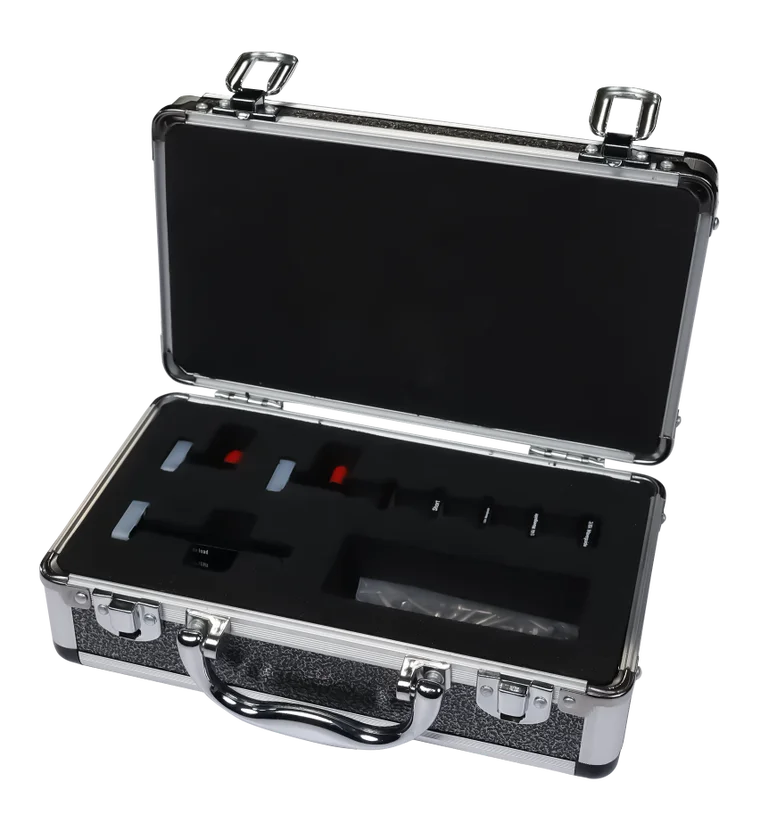
The Siglent KWR42A precise K-band waveguide mechanical calibration kit contains K-band load, K-band short, 1/8λ waveguide line, 1/4λ waveguide line and 3/8λ waveguide line, specified from 17.6 GHz to 26.7 GHz.
WR-42 waveguide, 18 – 26.5 GHz
The KWR42A is a WR-42 waveguide calibration kit for the K band, covering 18 to 26.5 GHz. It calibrates by Through-Reflect-Line rather than OSLT, and includes 2.92 mm coax-to-waveguide adapters so it can be driven from a coaxial test port.
A vector network analyser does not measure your device — it measures everything between its own receivers and your device, including the cables you fitted and every connector in between. Calibration is how that gets removed. You present standards whose behaviour is known precisely, the analyser measures them, and it then solves for the errors in the path. The reference plane moves from inside the instrument to the end of your cable, which is where your device actually starts.
Waveguide, not coaxial. Above about 18 GHz a great deal of hardware moves to waveguide because the loss is far lower than any coaxial line can manage. A coaxial standard cannot calibrate it — the reference plane is a flange, not a connector.
At a glance
- MethodTRL
- WaveguideWR-42, K band
- Frequency18 – 26.5 GHz
- Lines1/8λ · 1/4λ · 3/8λ
- Adapters2.92 mm m + f
Order code KWR42A · supplied by SIGLENT
What it calibrates
- Any WR-42 waveguide measurement in the 18–26.5 GHz K band
Gender matters
Waveguide standards mate by flange rather than by thread, so the male/female question does not arise.
Specifications
| Parameter | Value |
|---|---|
| Calibration method | Through-Reflect-Line (TRL) |
| Waveguide | WR-42, K band |
| Usable frequency range | 18 – 26.5 GHz |
| Standards specified over | 17.6 – 26.7 GHz |
| Reflect standards | K-band short circuits |
| Line standards | 1/8λ, 1/4λ and 3/8λ waveguide lines |
| Load | K-band waveguide load |
| Coax adapters | 2.92 mm male and 2.92 mm female coax-to-waveguide, 50 Ω |
| Analysers | SNA5000 and SNA6000A series |
Connector, gender and frequency are Siglent’s own, from the price list and the SNA5000A, SNA6000A and SNA5000X-E ordering tables. Siglent does not publish per-kit residual figures such as directivity or load match — if your application depends on them, ask us and we will request them from the factory.
Why waveguide is calibrated by TRL and not by OSLT
A coaxial kit gives the analyser an open, a short and a matched load. In waveguide two of those three are awkward: an open waveguide does not present a clean open circuit — it radiates — and a broadband matched load is difficult to make to the tolerance a calibration needs.
Through-Reflect-Line sidesteps both. Its standards are a direct flange-to-flange through, a reflect that only has to be repeatable rather than perfectly known (a short), and precision lines whose defining property is their physical length — a mechanical dimension, which at these frequencies can be held far more accurately than an electrical impedance. That is why TRL is generally the most accurate calibration available, not merely the one waveguide is stuck with.
A single line only works over the band where its electrical length is a useful fraction of a wavelength, which is why the kit carries three — 1/8λ, 1/4λ and 3/8λ — between them spanning 18 to 26.5 GHz.
What is in the case
The two coax adapters are what let a coaxial analyser drive a waveguide measurement at all — without them the kit has nothing to connect to. Note they are 2.92 mm, so on an SNA5022A or SNA5032A, whose ports are 3.5 mm NMD, you will need cabling that presents a 2.92 mm interface. Ask us and we will confirm the chain for your analyser.
Other kits in the range
All twenty-one mechanical kits, with a table matching every Siglent analyser to the kit it needs, are on the VNA mechanical calibration kits page. Electronic calibration is covered on the calibration kits overview.
Not sure this is the right kit?
Three things decide it: your analyser’s test-port connector, your top frequency, and the gender of the cables you calibrate to. Tell us the model and we will confirm which kit fits before you order — and whether an ECal module would serve you better.
More information
Specifications are taken from the manufacturer’s official documentation and are provided for guidance only. They are subject to change without notice, and errors and omissions may occur. The manufacturer’s current documentation is the definitive reference. Prices exclude VAT.