

Siglent CP6500 5 MHz 500 Amp Current Probe

The new Siglent CP6500 Current probe with 5 MHz Bandwidt a Maximum continuous current 500 Arms; Peak current 750 A; Switching ratio: 75 A/500 A; Accuracy: 75 A(±1%±10 mA); 500 A(±1%±100 mA); Standard DC12 V/1 A power adapter
750 A active current probe, DC–5 MHz
The CP6500 is an active split-core current probe with ±1% accuracy and 5 MHz of bandwidth, rise time ≤70 ns. 750 A peak is the largest current measurable with a clamp in this range, and it still holds ±1% accuracy.
It runs from its own 12 V adapter and connects over BNC, so it works with any oscilloscope of any brand — unlike the SAPBUS-powered SCP5000 equivalents, which need a recent Siglent scope. Two ranges (75 A (10X) and 500 A (100X)) cover small and large currents, with over-current indication on each.
What it does well
The things that decide whether a current measurement can be trusted.
±1% accuracy
Far tighter than any handheld clamp, and the reason these probes are used for efficiency and switching-loss measurement where the number itself has to stand up in a report.
5 MHz bandwidth
Rise time ≤70 ns. Fast enough to show the current edge itself, not just the envelope it sits in.
750 A peak, and still 5 MHz
Worth knowing: the SAPBUS SCP5500 covers the same 750 A but stops at 2 MHz. If you need both the current and the speed, this is the one — and it works with any oscilloscope.
Works with any oscilloscope
Its own DC 12 V supply and a plain BNC output. No proprietary probe bus, so it is not tied to one brand or one generation of scope.
Split core, no circuit broken
Clamp around the conductor and the circuit stays intact — no shunt inserted, no burden resistance added to the thing you are characterising.
Over-current indication
Warns at ≥75 A on the low range and ≥750 A on the high one, so a saturated core gets noticed rather than quietly distorting the waveform.
Key specifications
- Bandwidth DC to 5 MHz (−3 dB), rise time ≤70 ns
- 500 Arms continuous · 750 A peak
- Ranges 75 A (10X) and 500 A (100X)
- Current transfer ratio 0.1 V/A and 0.01 V/A
- Resolution 10 mA and 100 mA
- Accuracy ±1% ±10 mA and ±1% ±100 mA
- Jaw accepts conductors up to 20 mm
- Powered by the supplied DC 12 V adapter
Application examples
Traction inverters and EV powertrain
Phase current on a drive or traction inverter, with headroom for the peaks and bandwidth for the switching detail riding on top.
Industrial motor drives
Large three-phase currents where the waveform — not just the RMS figure — determines fuse, capacitor and semiconductor sizing.
Grid-tied storage and PV inverters
True DC response for string and battery current, with the bandwidth to see the converter working on top of the DC level.
High-power supply and test rigs
Electrolysis, plating and burn-in supplies, where the current is far beyond what a handheld clamp can carry.
Specifications
| Bandwidth | DC to 5 MHz (−3 dB) |
|---|---|
| Rise time | ≤70 ns |
| Maximum continuous current | 500 Arms |
| Peak current | 750 A |
| Ranges | 75 A (10X) and 500 A (100X) |
| Current transfer ratio | 0.1 V/A and 0.01 V/A |
| Measurement resolution | 10 mA and 100 mA |
| DC accuracy | ±1% ±10 mA and ±1% ±100 mA |
| Overload indication | ≥75 A and ≥750 A |
| Maximum rated voltage to earth | 300 V CAT III · 600 V CAT II |
| Maximum conductor diameter | 20 mm |
| Probe cable length | 1.5 m |
| BNC lead length | 100 cm |
| Power supply | DC 12 V / 1 A adapter (supplied) |
| Weight | 525 g |
Taken from the SIGLENT Probe Data Sheet. Errors and omissions excepted; specifications may change without notice.
In the box
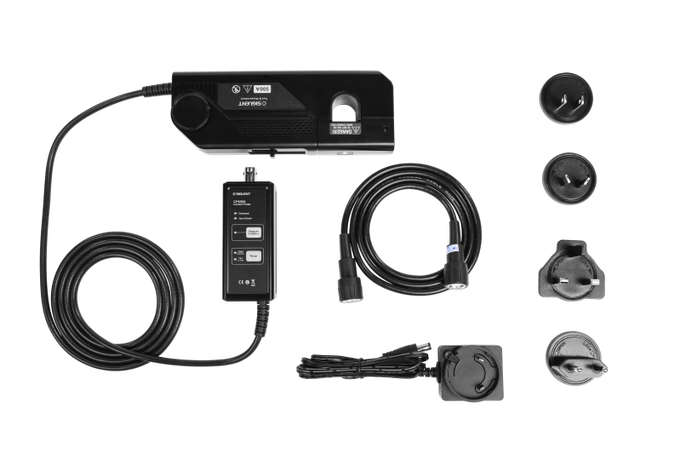
- Current probe
- DC 12 V / 1 A adapter
- BNC lead
- Instruction manual
Not sure this is the right probe?
Tell us the current you expect, the frequency it moves at, which oscilloscope you own and whether there is DC in the measurement. We will tell you which probe fits — including when a cheaper one covers it.