

Probe adapters
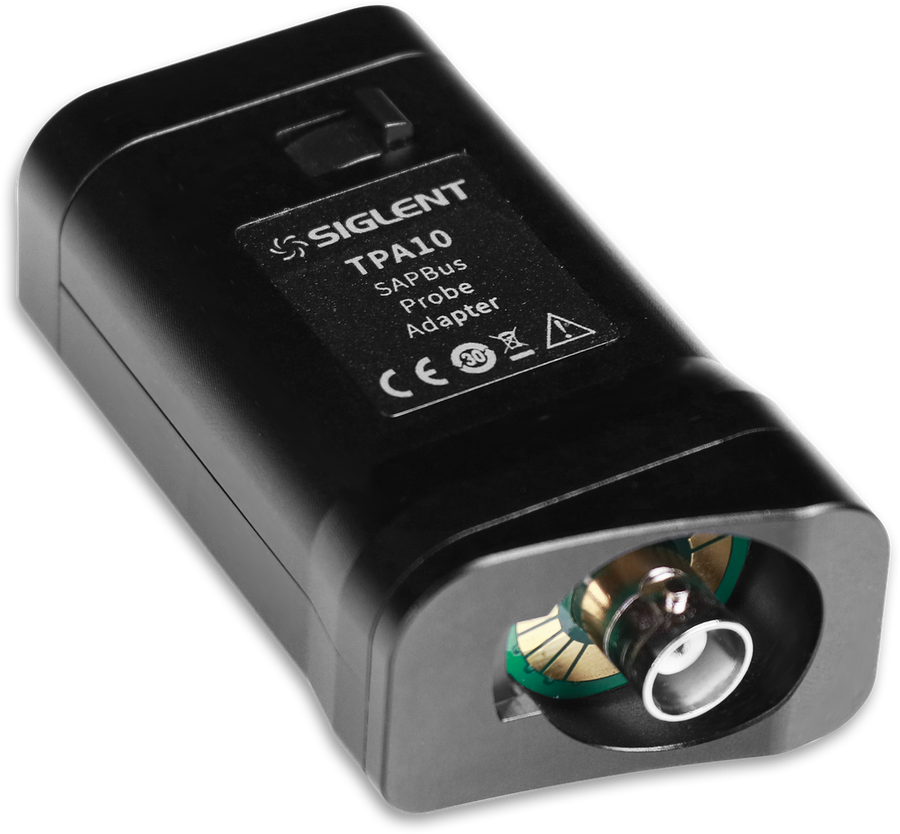
Keep the active probes you already own when the oscilloscope changes. The TPA10 puts Tektronix TekProbe Level II probes onto a Siglent SAPBus input, powered and offset-controlled by the scope, with no external supply. Its predecessor for LeCroy ProBus probes, the LPA10, has reached end of life.
An active probe is a large investment. An adapter protects it.
A modern active probe carries its amplifier in the probe head, so it needs power, and it needs the oscilloscope to know what is attached — the attenuation ratio, the offset range, the calibration constants. That handshake happens over a proprietary interface: Teledyne LeCroy call theirs ProBus, Tektronix call theirs TekProbe, and Siglent call theirs SAPBus. The connectors are not compatible and neither are the supply rails behind them.
That is what makes changing oscilloscope brand expensive. A pair of differential active probes and a current probe can easily be worth more than the instrument they plug into, and none of it moves across. The TPA10 sits between the two worlds: the scope end is SAPBus, the probe end is TekProbe Level II, and the adapter generates the ±15 V and ±5 V rails that the Tektronix probe expects and passes an offset command of −1.2 V to +1.2 V through to it. The oscilloscope powers the whole assembly — there is no separate brick to find bench space for — and the adapter is specified to 4 GHz, so it is never the limiting element in front of the probe.
The LPA10 did the same job for Teledyne LeCroy ProBus probes (ZD1000, ZD1500, AP033, AP034, CP030) and has been discontinued. Its page stays online as a reference for owners; the TPA10 is the adapter Siglent sells today. Because the TPA10 is specified for TekProbe, not ProBus, it is not a drop-in for LeCroy probes — if you own some, ask us what is still obtainable and what the native SAP probe for the same measurement costs.
The models
2 products. Prices exclude VAT.
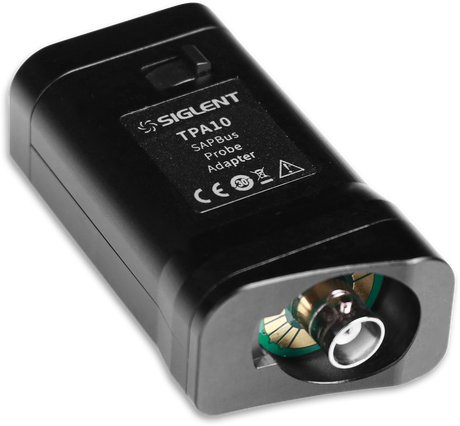
Runs Tektronix TekProbe Level II probes on a Siglent SAPBus oscilloscope. Supplies ±15 V and ±5 V, and passes scope offset control through to the probe.
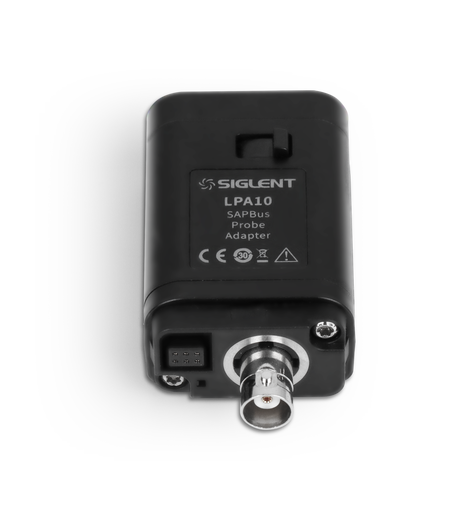
End of life — replaced by the TPA10. Ran Teledyne LeCroy ProBus probes — ZD1000 / ZD1500 differential, CP030 current, AP033 and AP034 active — on an SDS5000X or SDS6000A, supplying ±12 V (±2%). Page kept as a reference for owners.
Specifications side by side
Every model in this family, on one row each.
When an adapter earns its price
Changing oscilloscope brand
The scope is replaced but the probe set is not. One adapter per channel keeps a five-figure probe inventory in service instead of on a shelf.
Cross-checking a result
Measure the same node with the probe that produced the original data and with its Siglent equivalent. If the two disagree, the difference is in the probe, not in the instrument.
A probe with no modern equivalent
Some older ProBus and TekProbe heads — unusual geometries, specific current ranges — have no current replacement. The adapter keeps them usable.
Questions we are asked
What happened to the LPA10?
Siglent has discontinued the LPA10, its adapter for Teledyne LeCroy ProBus probes, and replaced it with the TPA10. The TPA10 is specified for Tektronix TekProbe Level II probes, so it is not a drop-in for LeCroy probes. If you own ZD, AP or CP030 probes, tell us the models and the oscilloscope: we will say what is still obtainable and quote the native SAP probe that covers the same measurement.
Which oscilloscopes does the TPA10 work with?
Siglent's price list names the SDS5000X, SDS5000X HD and SDS6000A. Other Siglent oscilloscopes with a SAPBus probe input exist (SDS3000X HD, SDS6000L, SDS7000A); ask us before ordering for one of those. The adapter draws its power from that interface, so no external supply is required.
Does the adapter reduce the probe's bandwidth?
The adapter is specified at 4 GHz, which is above the bandwidth of the probes normally connected through it, so in practice the probe remains the limit. The usual caution applies: the bandwidth you actually get is set by the slowest element in the chain — probe, adapter or oscilloscope.
Will the oscilloscope read the correct attenuation ratio automatically?
The adapter passes the probe's identification through to the scope where the probe interface provides it. Where it does not, set the attenuation ratio manually in the channel menu — and check it before trusting an absolute voltage reading.
What is the difference between TekProbe Level I and Level II?
Level I carries power only. Level II adds the communication that lets the oscilloscope read the probe and send it an offset command. The TPA10 is a Level II adapter, which is why it can pass −1.2 V to +1.2 V of offset through to the probe.
Not sure which one fits your measurement?
Tell us the instrument, the signal and what you are trying to see. We are the official Siglent distributor for the EU and we will point you at the right part — including when the right answer is a probe from another family, or nothing at all.