

Siglent ATT-20dB 20 dB Attenuator, 50 Ω, DC–4 GHz

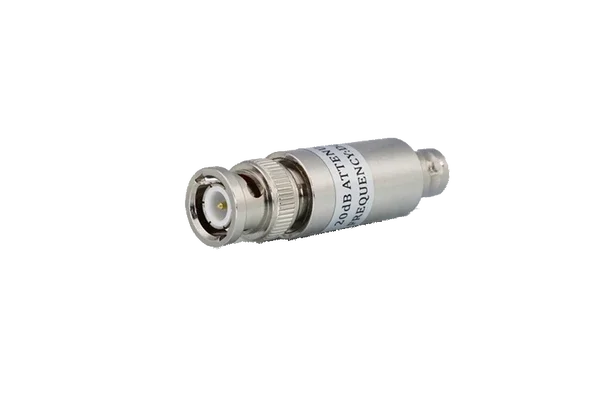
In-line 20 dB attenuator, 50 ohm, DC-4 GHz, 1 W, VSWR below 1.2. BNC male to female — protects analyser inputs and sets generator levels.
Twenty decibels between an unknown signal and your instrument
A fixed attenuator does one simple thing — it divides the signal passing through it by a known amount — and that turns out to be one of the most useful things you can keep on an RF bench. The ATT-20dB divides power by 100, and voltage by ten.
Its most common job is protective. A spectrum analyser input is a genuinely fragile thing: on an SVA1000X the maximum input is +30 dBm and the damage level is +33 dBm, and the difference between a working instrument and a repair is one connection to a source whose level nobody checked. With this pad in line, that source has to reach +50 dBm before the input sees its limit.
Its second job is quieter but just as useful. An attenuator absorbs reflections as well as signal, so putting one in front of a badly matched device improves the match you present by up to twice its value — the reflected wave has to pass through the pad on the way out as well as the way in. Ripple that was riding on your trace flattens out.
Protects an input that is easily destroyed
An analyser front end is the expensive part of the instrument. On an SVA1000X the maximum input is +30 dBm and the damage level +33 dBm — a margin you can cross in one careless connection. With this pad fitted, a +30 dBm source arrives at +10 dBm.
20 dB is a factor of 100 in power
Twenty decibels divides power by 100 and voltage by 10. It is the standard step when you genuinely do not know what a source is doing: enough to make an unknown safe, without burying a normal signal in the noise floor.
It also improves the match
A pad is a mismatch-eater. A reflection coming back off a poorly matched load passes through the attenuator twice, so 20 dB of padding improves the return loss you present by up to 40 dB. Ripple on the trace drops with it.
In-line BNC, nothing to set up
BNC male on one end, BNC female on the other. It goes between the cable and the port and stays there — no power, no configuration, and it doubles as a port saver on the connector behind it.
At a glance
- Attenuation20 dB
- Impedance50 Ω
- FrequencyDC – 4 GHz
- Power rating1 W (+30 dBm)
- VSWR≤ 1.2
- ConnectorsBNC (M) → BNC (F)
Order code ATT-20dB · supplied by SIGLENT
When to reach for it
Measuring a source you have not measured before
The case the pad exists for. Fit it first, read the level, and only then decide whether you can take it off. Twenty decibels of insurance costs a fraction of a front-end repair.
Bringing a generator down to a usable level
An SDG function generator can output far more than a sensitive receiver input wants to see. A fixed pad drops it by a known, repeatable amount — more predictable than trusting an output attenuator setting.
Killing ripple from a badly matched device
If a trace shows periodic ripple that moves when you change cable length, you are looking at reflections. Inserting the pad damps them at the cost of 20 dB of level.
Leaving it fitted as a port saver
Connector wear lands on the attenuator instead of the instrument port. Replacing a worn pad is routine; replacing a worn analyser input is not.
What 20 dB actually does to your level
Straight arithmetic, but worth having in front of you when you are deciding whether the pad is the right size for the job.
| Into the attenuator | In power | Out to the instrument | In power |
|---|---|---|---|
| +30 dBm | 1 W | +10 dBm | 10 mW |
| +20 dBm | 100 mW | 0 dBm | 1 mW |
| +10 dBm | 10 mW | −10 dBm | 100 µW |
| 0 dBm | 1 mW | −20 dBm | 10 µW |
The top row is the attenuator’s own limit: 1 W in, +10 dBm out. Do not exceed +30 dBm at its input.
Fitting it to an N-port analyser
This is a BNC attenuator, and our bench spectrum analysers, generators and VNAs have N female RF ports. One adaptor bridges them, and there are two clean ways to do it.
With an N (M) – BNC (F) adaptor
Adaptor into the instrument port, attenuator onto the adaptor, your BNC cable onto the attenuator. Two of exactly this adaptor are in the UKitSSA3X.
With an N–BNC cable
Run an N-BNC-2L from the instrument and put the attenuator at the far end, next to the device under test — which is usually where you want the padding anyway.
Three limits to keep in mind
- Attenuation is not free. Twenty decibels off the signal is also twenty decibels off your sensitivity — the displayed noise floor rises by the same amount. Fit the pad while you find out what a source is doing, then take it off to measure small things.
- It stops at 4 GHz. That covers the SSA3021X and SSA3032X and the lower SVA1000X models comfortably, but the SSA3075X and SVA1075X reach 7.5 GHz. Above 4 GHz this pad is outside its specification.
- A BNC adaptor caps you at 2 GHz. The N–BNC adaptors in the utility kit are rated DC–2 GHz, so a chain built from them is limited by the adaptor rather than by the attenuator. Worth knowing before you trust a reading at 3 GHz.
Specifications
As published by Siglent. 50 Ω throughout.
| Parameter | Value |
|---|---|
| Attenuation | 20 dB ± tolerance per Siglent specification |
| Impedance | 50 Ω |
| Frequency range | DC – 4 GHz |
| Power rating | 1 W (+30 dBm) maximum input |
| VSWR | ≤ 1.2 |
| Connectors | BNC male → BNC female, in-line |
Siglent does not publish a connector specification for this part. The BNC male / BNC female interface stated above is taken from the product itself and is consistent with the DC–4 GHz rating. If your application depends on it, ask us to confirm before ordering.
What you may need with it
The attenuator is BNC, so on most of our instruments it needs either an adaptor or a BNC-ended cable.
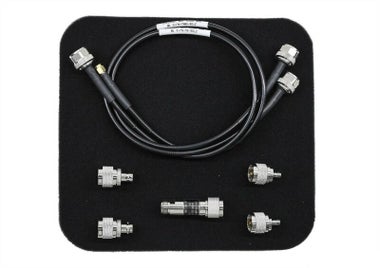
Contains the N–BNC adaptors this attenuator needs, plus a 10 dB pad rated to 6 GHz.
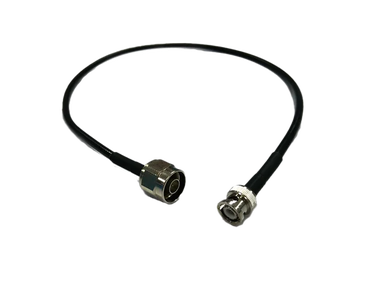
Connects an N-port instrument straight to this attenuator's BNC end.
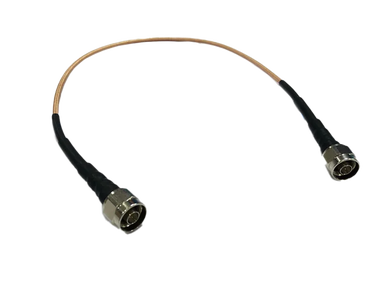
The general-purpose N cable for the same instruments.
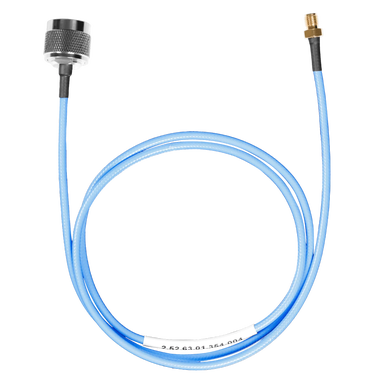
For SMA devices, where this attenuator's BNC interface does not reach.
The full range, with a table matching every Siglent instrument port to the cable it needs, is on the RF cables and adaptors page.
Not sure 20 dB is the right value?
Tell us the instrument, the source and roughly what level you expect, and we will tell you what padding you need — including whether you need any at all. We are the official Siglent distributor for the European Union.
More information
Specifications are taken from the manufacturer’s official documentation and are provided for guidance only. They are subject to change without notice, and errors and omissions may occur. The manufacturer’s current documentation is the definitive reference. Prices exclude VAT.