

SSG3000X Plus Series
RF signal generation from 9 kHz to 3.2 GHz at up to +20 dBm, with −117 dBc/Hz phase noise at 1 GHz and an optional OCXO reference. AM, FM, PM and pulse modulation are standard on every model.
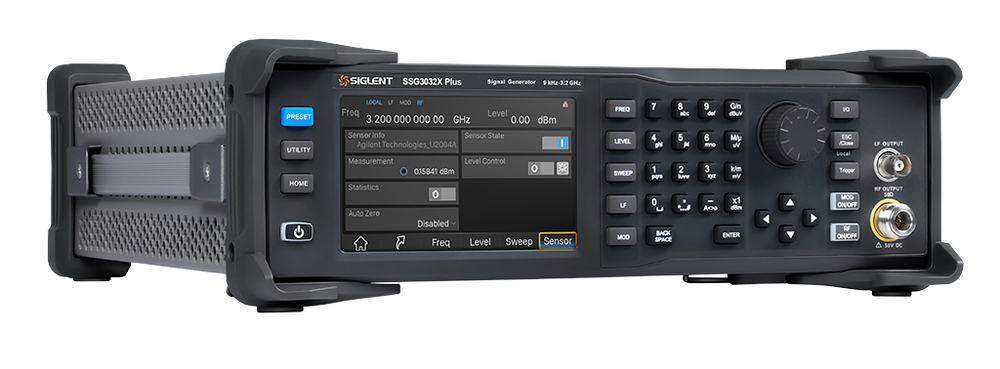
A signal generator is a reference
Whatever you are measuring — a receiver's sensitivity, a filter's shape, an amplifier's linearity — the answer is only as trustworthy as the source that produced the stimulus. Two properties decide that: how accurately the instrument knows the frequency it is producing, and how much noise sits either side of the carrier it produces.
The SSG3000X Plus is built around both. SSB phase noise is −117 dBc/Hz typical at 1 GHz and 20 kHz offset, and −110 dBc/Hz at 3 GHz. That matters directly on a blocking or sensitivity test, where noise skirts from the generator fall inside the receiver's channel and are indistinguishable from the device's own behaviour. For the timebase, the 10M_OCXO_L option replaces the standard reference with an oven-controlled oscillator: 100 ppb initial accuracy instead of 0.2 ppm, and 1 ppb temperature stability instead of ±1 ppm.
Around that core sits a complete modulation set — AM, FM and PM with internal, external or combined sources, and pulse modulation with 15 ns edges, none of it charged as an extra. Pulse trains and external I/Q are available on top. The front panel is a 5-inch capacitive touchscreen, and the whole instrument can be driven from a web browser over LAN.
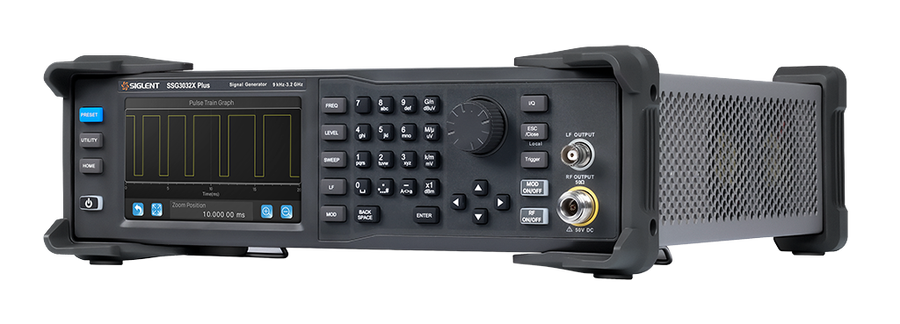
What defines the series
−117 dBc/Hz phase noise at 1 GHz
Measured at 20 kHz offset, typical — and −121 dBc/Hz at 100 MHz. On a receiver sensitivity or blocking measurement, noise skirts from the source land in the channel you are trying to measure, so a quieter carrier is a more honest result.
An OCXO reference option
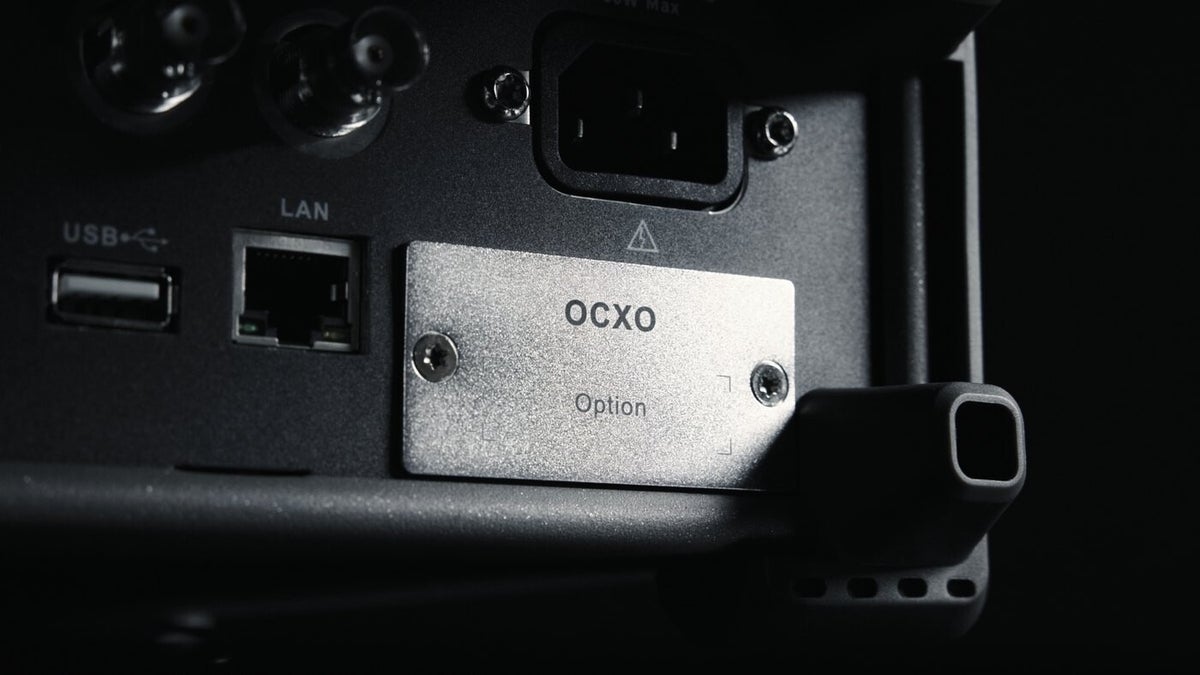
The 10M_OCXO_L takes initial accuracy from 0.2 ppm to 100 ppb and temperature stability from ±1 ppm to 1 ppb across 0–50 °C. The timebase sets the floor for every frequency the instrument generates.
The whole modulation suite as standard
AM, FM and PM with internal, external or combined sources, plus pulse modulation with 15 ns edges — none of it optional. Pulse trains and external IQ are available on top.
A bench instrument that is pleasant to drive
A 5-inch capacitive touchscreen with mouse and keyboard support, and full remote control from a web browser on a PC or a phone over LAN, USBTMC or optional GPIB.
Four models
Two frequency ceilings, each with or without the external I/Q interface. All prices exclude VAT. Software keys, the OCXO reference and the rack kit are under Options and accessories.
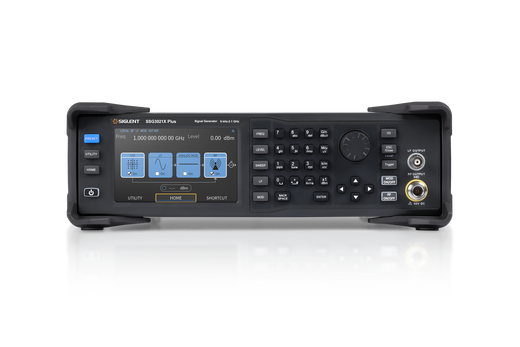
The 2.1 GHz base model — the full modulation suite, the 5-inch touchscreen and the same RF performance as the rest of the series.
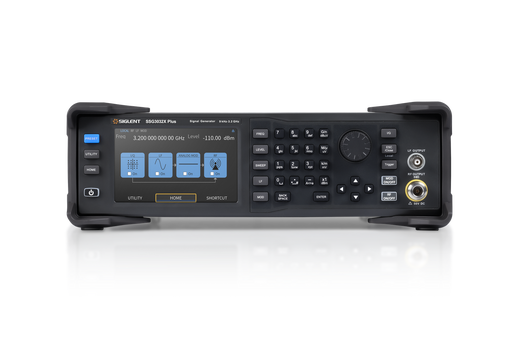
Full 3.2 GHz coverage, which takes in the 2.4 GHz ISM band with room above it for harmonic and out-of-band work.
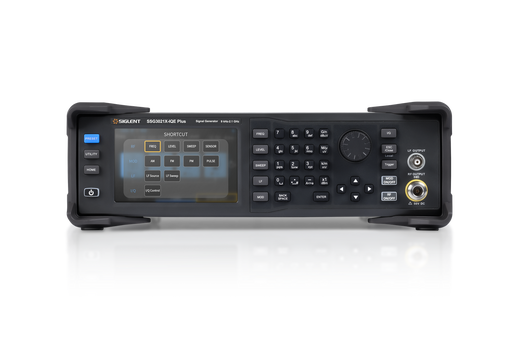
IQ 10 MHz – 2.1 GHz
2.1 GHz with the external IQ interface, for vector-modulated signals driven from an SDG6000X baseband generator.
IQ 10 MHz – 3.2 GHz
The top of the series: 3.2 GHz with external IQ, for wideband vector modulation across the whole range.
Buying 2.1 GHz now and upgrading later costs more
An SSG3021X Plus at €1,999 plus the €1,999 frequency key comes to €3,998, against €3,499 for an SSG3032X Plus bought outright — €499 more. On the IQE models the gap is €599. The upgrade path exists for when requirements change later, not as a way to spread the cost. If you already know you need 3.2 GHz, buy the 3.2 GHz model.
The instrument at work
What each capability looks like on the bench.
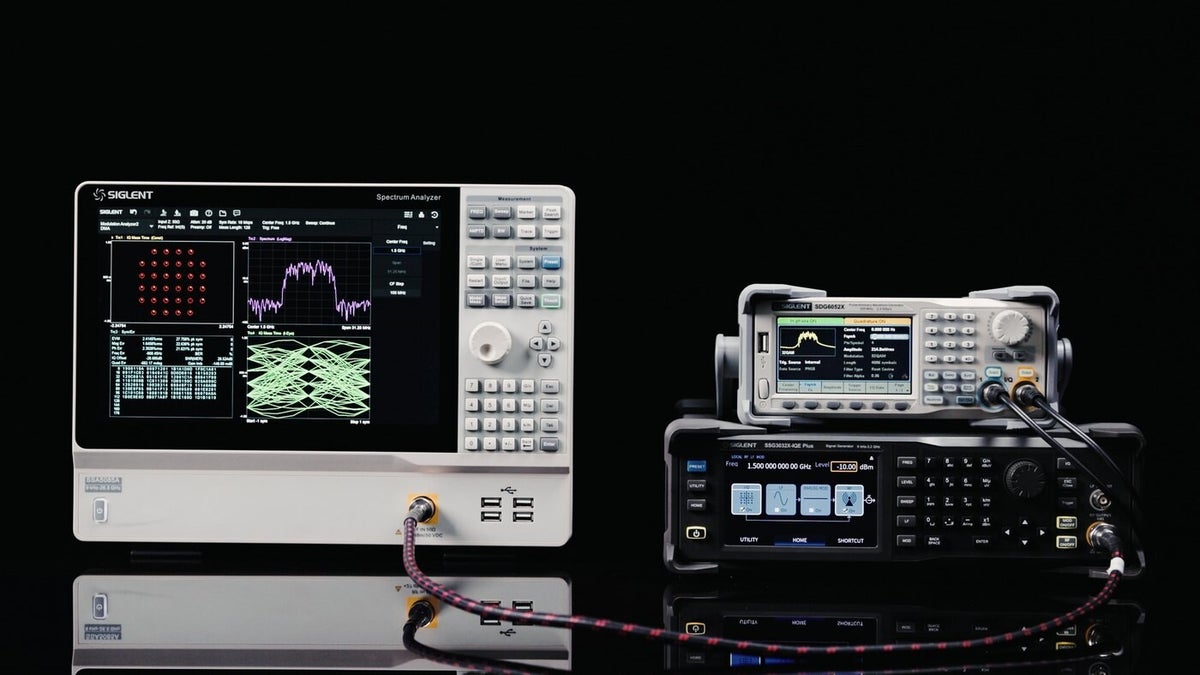
Vector modulation from an external baseband
An SDG6052X supplies I and Q to an SSG3032X-IQE Plus at 1.5 GHz, generating a 32QAM signal with root-raised-cosine filtering. On the analyser: the constellation, the spectrum, the eye and the EVM figures — the whole chain from one pair of instruments.
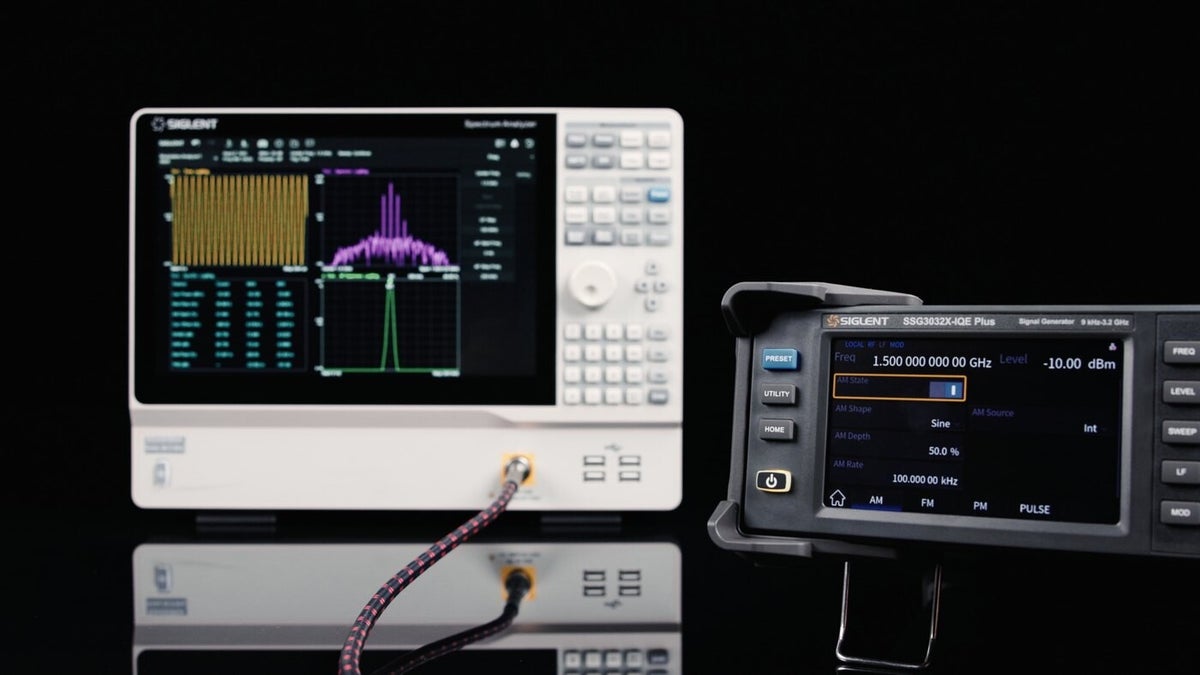
AM, FM and PM as standard
The analog modulation menu with AM switched on — sine shape, 50 % depth, 100 kHz rate, internal source — and the resulting modulated spectrum on the analyser beside it. FM and PM sit on the same screen, one tab away.
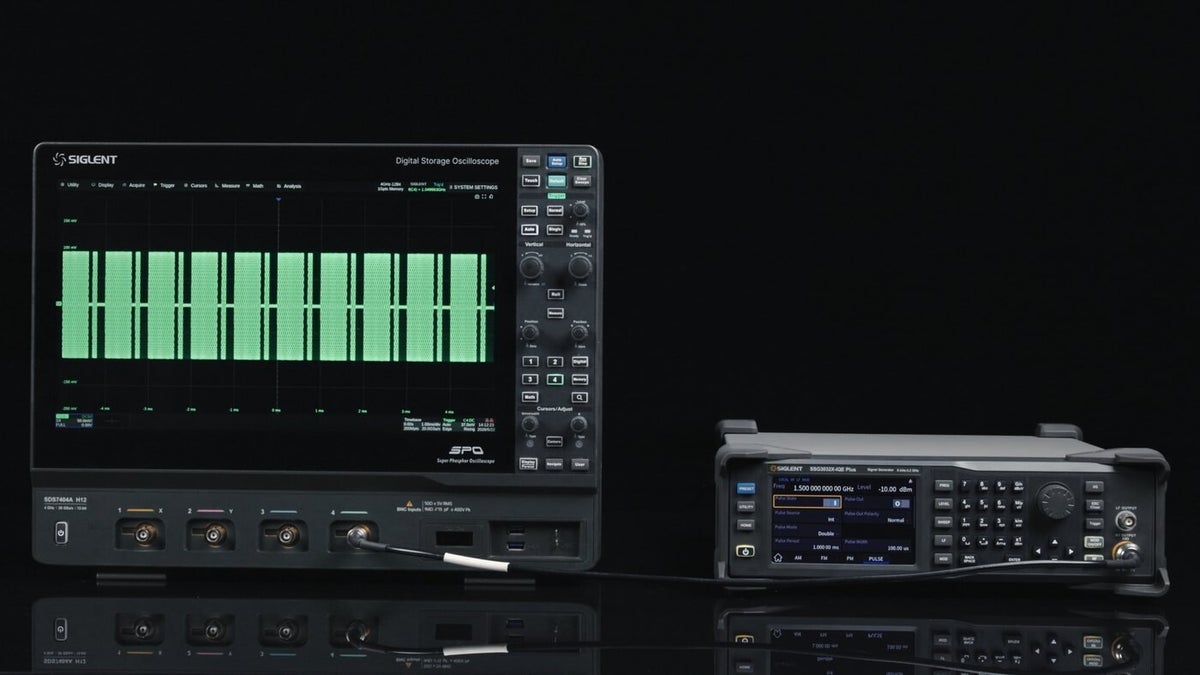
Pulse modulation, built in
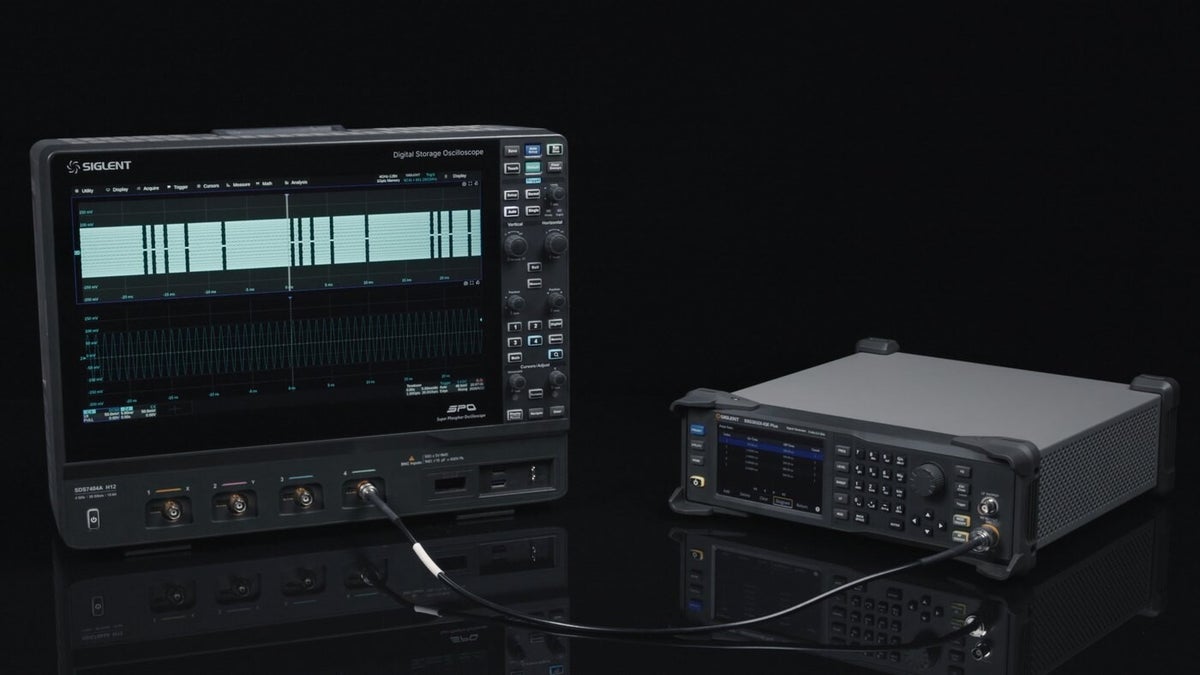
A double-pulse pattern at 1.5 GHz — 1 ms pulse period, 100 µs pulse width — captured on an SDS7404A. Pulse modulation is standard across the series, with 15 ns edges and a narrowest pulse of 20 ns.
Programmable pulse trains
With the PT option the generator plays a list of pulses, each with its own on-time, off-time and repeat count. Here the resulting burst pattern is captured on the oscilloscope, with a zoom on the carrier underneath.
The OCXO bay
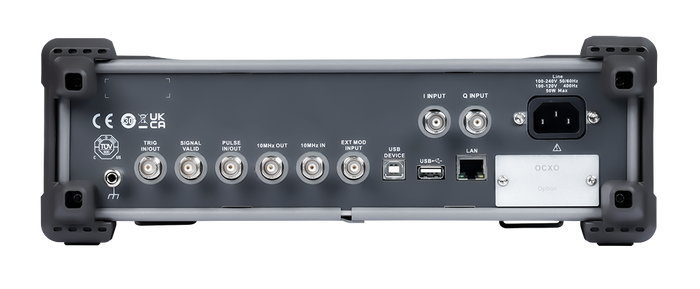
The oven-controlled reference is a factory-fitted option that occupies its own bay on the rear panel, beside the USB and LAN ports. Every frequency the instrument produces is referred to that timebase.
Three views
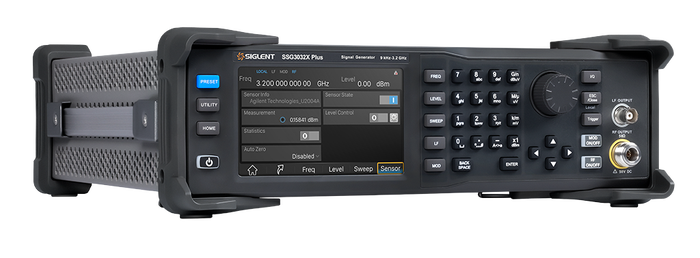
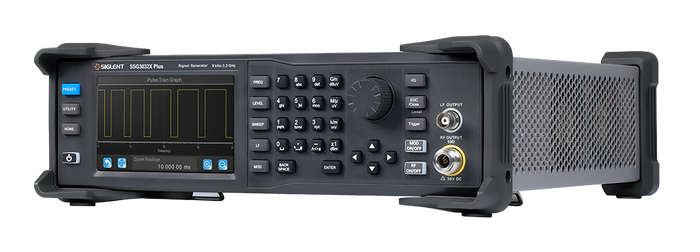
338 × 113 × 369 mm and 4.84 kg, with moulded bumpers and a carry handle. LF and RF outputs are on the front; USB, LAN, the reference in and out and the OCXO bay are on the rear panel.
Options and accessories
Six options, each its own product in the shop. The three software keys are activated on the instrument you already own; the OCXO is fitted at the factory, so order it together with the generator. Every unit is supplied with a quick-start guide, a USB cable and a power cord. Prices exclude VAT.
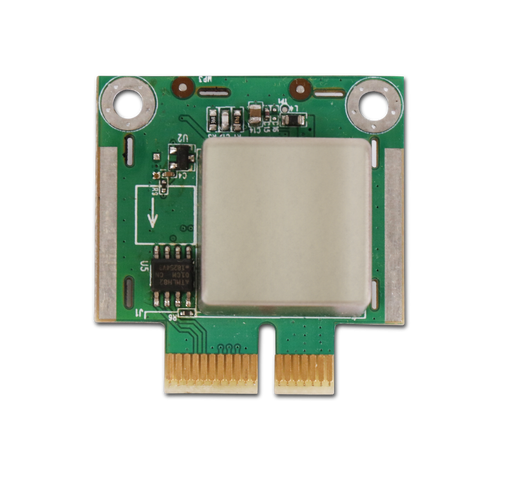
Oven-controlled timebase — 100 ppb initial accuracy, 1 ppb temperature stability over 0–50 °C and 50 ppb/year aging, against 0.2 ppm, ±1 ppm and 0.5 ppm/year as standard.
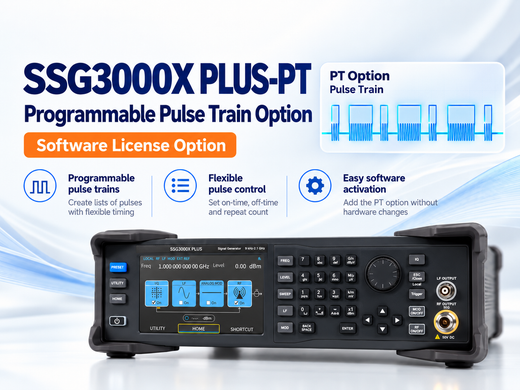
Sequences of pulses with independently programmable on-time, off-time and repeat count, rather than a single fixed pulse modulation.
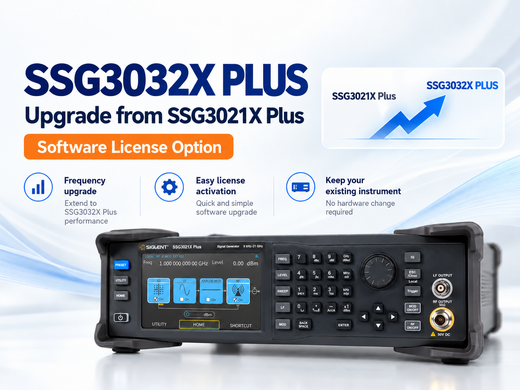
Software key that lifts a 2.1 GHz unit to the full 3.2 GHz range.
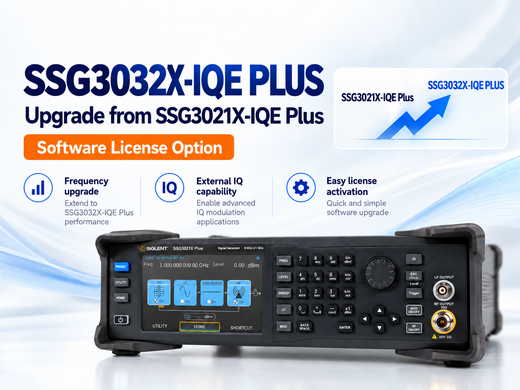
The same frequency upgrade for the external-IQ models.
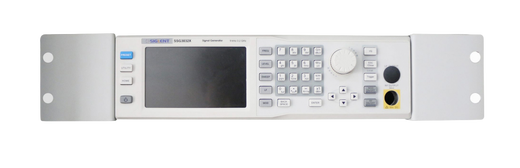
19-inch rack mounting hardware, shared with the SSG3000X, SSG5000X and SSG5000A.
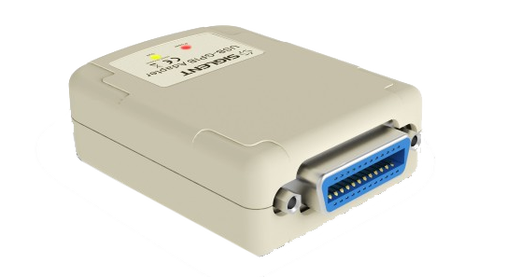
Adds GPIB control for benches and ATE racks still built around it.
Specifications
From the SSG3000X Plus data sheet, EN01A. Figures apply across the series unless a model is named.
| Frequency range | 9 kHz – 2.1 GHz or 9 kHz – 3.2 GHz |
| Frequency resolution | 0.01 Hz |
| Amplitude resolution | 0.01 dB |
| Level setting range | −110 dBm to +9 dBm (9–100 kHz) −110 dBm to +15 dBm (100 kHz–1 MHz) −110 dBm to +20 dBm (1 MHz–3.2 GHz) |
| Level accuracy | ≤ 0.7 dB (typ.) |
| SSB phase noise (20 kHz offset) | −121 dBc/Hz typ. at 100 MHz −117 dBc/Hz typ. at 1 GHz −110 dBc/Hz typ. at 3 GHz |
| VSWR | ≤ 1.8 (nom.), 1 MHz – 3.2 GHz |
| Harmonics | < −30 dBc, 1 MHz – 3.2 GHz, ≤ 13 dBm |
| Analog modulation | AM, FM and PM — internal, external or internal + external |
| Pulse modulation | Standard · on/off ratio ≥ 68 dBc (250 MHz – 3.2 GHz) |
| Pulse rise/fall time | 15 ns (typ.) |
| Narrowest pulse | 20 ns |
| Frequency reference | 0.2 ppm initial, ±1 ppm over 0–50 °C (standard) 100 ppb initial, 1 ppb over 0–50 °C (10M_OCXO_L option) |
| USB power meter | Supported — the generator reads a USB power sensor directly |
| Display | 5-inch capacitive touchscreen, 800 × 480, mouse and keyboard supported |
| Interfaces | USB Host, USB Device (USBTMC), LAN (VXI-11, Socket, Telnet); GPIB optional |
| Remote control | Web browser, from a PC or a mobile device |
| Internal storage | 256 MB |
| Supplied with | Quick start guide, USB cable, power cord |
| Dimensions / weight | 338 × 113 × 369 mm · 4.84 kg |
Where it is used
Receiver sensitivity and blocking
A clean carrier at a precisely known level is the whole measurement. Lower phase noise means less of what you measure belongs to the generator.
Wireless module verification
With an SDG6000X supplying baseband IQ, the IQE models produce standard-compliant modulated signals for sensitivity and error-rate work.
Pulsed-RF and radar
Pulse modulation is standard, with 15 ns edges and a 20 ns narrowest pulse; the PT option adds programmable pulse trains for realistic patterns.
Teaching and production test
A touchscreen for the lab bench, and LAN, USBTMC and optional GPIB with browser control for a rack that has to run unattended.
Questions we are asked
Which model should I choose?
Start with the frequency ceiling: 2.1 GHz covers most sub-2 GHz radio, ISM and general RF work, while 3.2 GHz takes in the 2.4 GHz band with headroom above it. Then decide on IQ — the -IQE models accept an external I/Q baseband for vector modulation, and that is the part you cannot add later.
Is it cheaper to buy 2.1 GHz now and upgrade later?
No — it costs more. An SSG3021X Plus at €1,999 plus the €1,999 upgrade comes to €3,998, against €3,499 for an SSG3032X Plus outright: €499 more. On the IQE models the difference is €599. The upgrade path is there for when requirements change, not as a way to save money. If you know you need 3.2 GHz, buy it.
Can I add the external IQ interface afterwards?
No. IQ is a hardware difference between the standard and -IQE models, so it has to be chosen at order time. Frequency, by contrast, is a software key you can apply at any point.
What do I need for IQ modulation?
An IQE model and a baseband source. The SDG6000X series is the usual partner — it supplies the I and Q signals while the generator handles up-conversion. There is no internal baseband generator in this series.
Is the OCXO fitted at the factory?
Yes. The 10M_OCXO_L occupies a bay on the rear panel and is installed during manufacture, so order it with the instrument rather than planning to add it later.
How do I control it remotely?
LAN (VXI-11, Socket or Telnet) and USBTMC are standard, with GPIB available through the USB-GPIB adapter. There is also a built-in web interface, so the front panel can be driven from a browser on a PC or a phone without installing anything.
Not sure which model fits?
Tell us the frequency you need and whether vector modulation is in your plans, and we will confirm the right model and options and quote it — including for several units. We are the official Siglent distributor for the European Union.