

Siglent SAG1021I 25MHz External arbitrary waveform generator
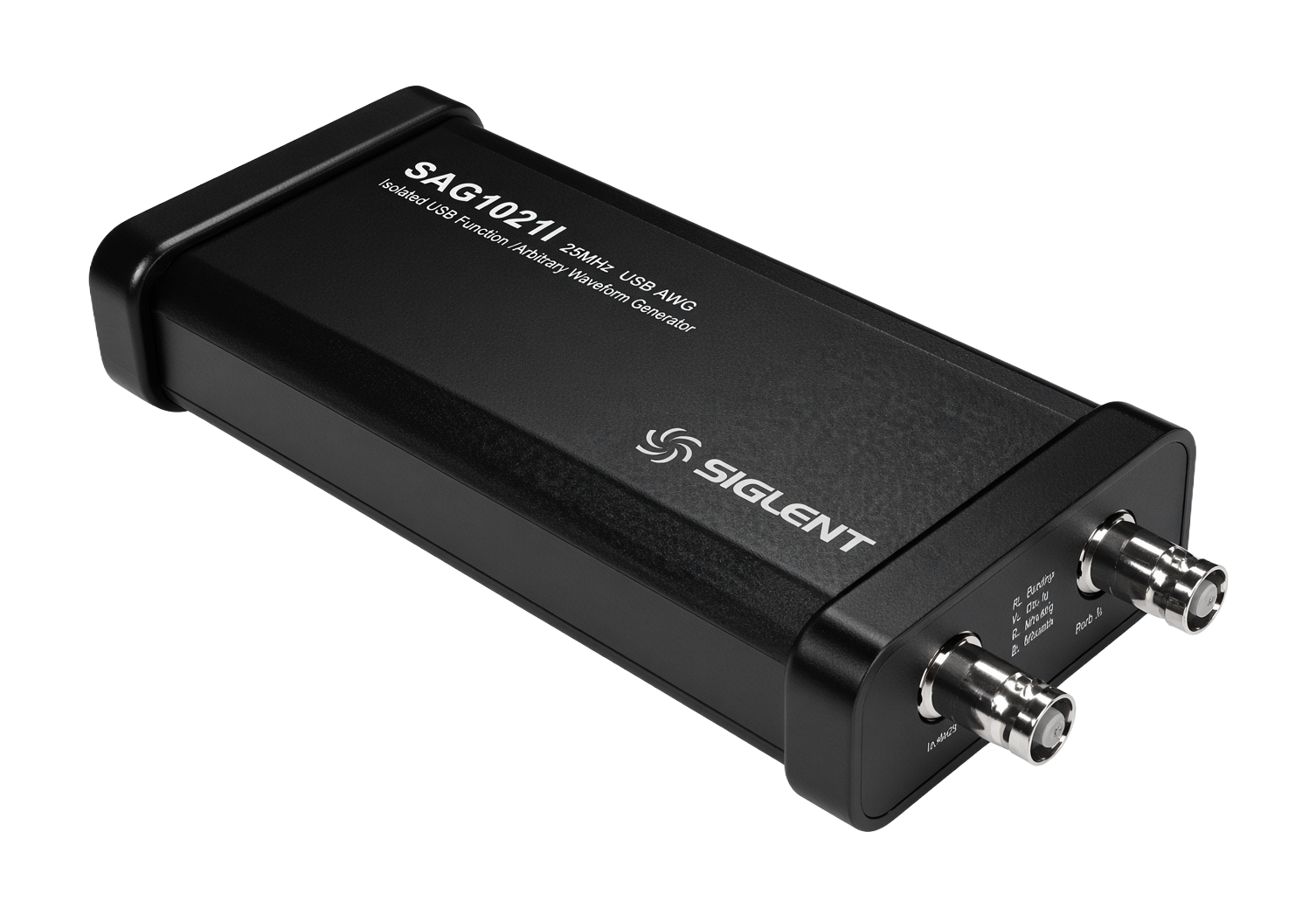
Siglent SAG1021I 25 MHz isolated USB arbitrary waveform generator for Siglent oscilloscopes. 125 MSa/s, 14-bit, 42 Vpk isolation. Adds Bode plot and loop response analysis.
The generator your oscilloscope is missing
Several of the most useful measurements an oscilloscope can make are not passive. To plot the frequency response of a filter you have to sweep a signal through it. To measure the loop response of a power supply you have to inject a disturbance and watch how the control loop answers. The oscilloscope already contains the software for both — what it lacks is a source.
The SAG1021I supplies it. It is a 25 MHz arbitrary waveform generator in a small module that takes its power and its instructions from the oscilloscope over a single USB lead. Once connected, the scope drives it directly: choose Bode plot, set the sweep range, and the instrument steps the generator through the band and plots gain and phase against frequency without any further intervention.
Two details make it more than a convenience. The output is galvanically isolated and rated ±42 Vpk, which is what allows it to be connected across an injection resistor in the feedback path of a live supply — a place where an ordinary earthed generator would short part of the circuit through the mains. And it is a real generator: 14-bit vertical resolution, 125 MSa/s, six standard waveforms, 45 built-in shapes and 16 kpts of arbitrary waveform memory you can load from EasyWave on the PC.
For a great many benches it removes the need for a second instrument altogether. Where a dedicated bench generator is still the right answer — more amplitude, two channels, modulation, higher frequency — the SDG range covers it. Where you simply need a stimulus so the oscilloscope can finish the measurement, this is the smaller and cheaper way to get one.
Powered and driven over one USB lead
No mains adapter, no second instrument on the bench and no extra cable to the mains. The module takes power and commands from the oscilloscope's USB port, and the scope's own interface drives it.
An isolated output
The output is galvanically isolated, rated ±42 Vpk. That is what makes it usable for injecting a disturbance into a live supply, where a mains-earthed generator would put a short across part of the circuit under test.
25 MHz, 14-bit, 125 MSa/s
Sine, square, ramp, pulse, noise and DC as standard, plus 45 built-in waveforms. 14 bits of vertical resolution and 1 µHz of frequency resolution — fine enough to sit exactly on a specified test frequency.
Your own waveforms, 16 kpts deep
Draw or import an arbitrary waveform in EasyWave on the PC and load it into the module — a specific glitch, a modulated burst, or a captured signal you want to replay into a device.
What it unlocks: Bode plot on the oscilloscope
Loop response used to mean a frequency response analyser and an afternoon. With the SAG1021I connected, it is a menu on the oscilloscope. You put a small injection resistor in the feedback path, connect the isolated generator output across it, probe both sides, and the instrument does the rest: it sweeps the stimulus across the range you set, measures the ratio and the phase shift at every point, and draws gain and phase against frequency — reading out phase margin and gain margin directly.
The same measurement characterises a passive filter, an amplifier stage or a transformer. It is the difference between knowing a supply is stable on your bench today and knowing how much margin it actually has.
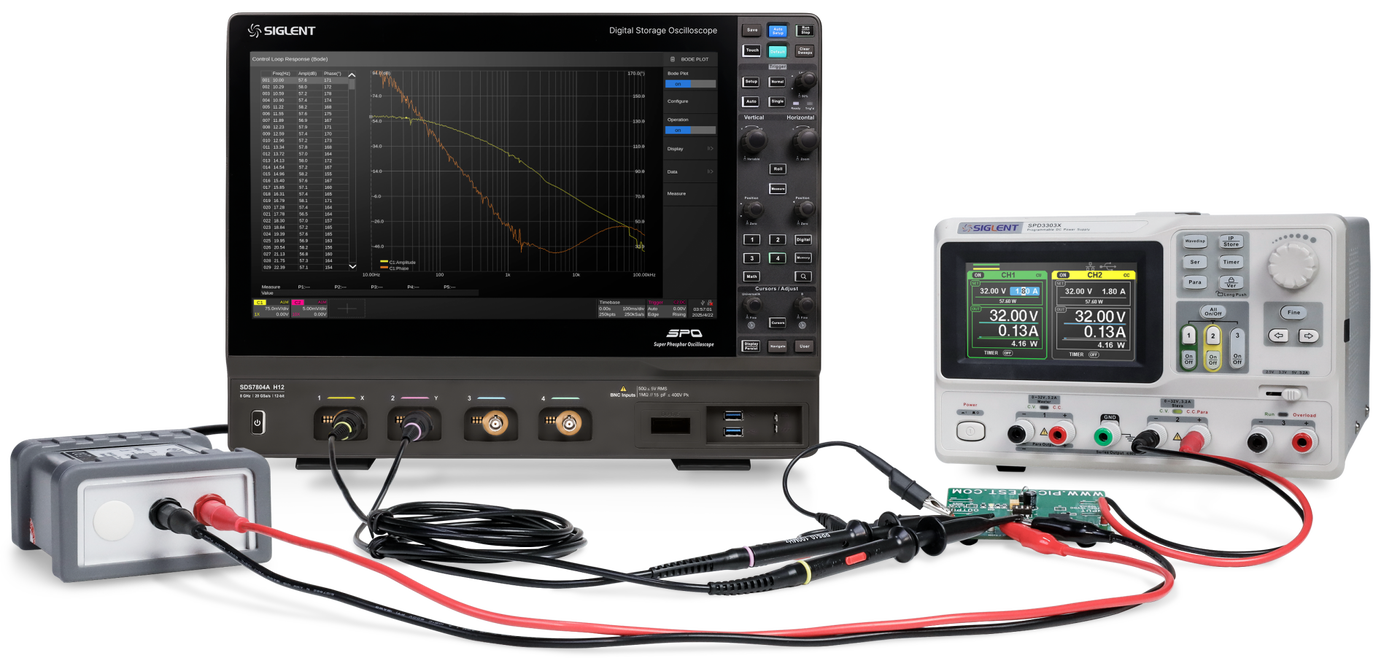
Gain and phase plotted against frequency on the oscilloscope, with the SAG1021I providing the swept stimulus.
Check your oscilloscope first
The module is driven by the oscilloscope, so it only works with the models that know how to talk to it. Two-channel SDS1000X-E oscilloscopes are not supported — only the four-channel versions. If you own an SDS6000A, use the dedicated listing for that series instead of this one: it is supplied with the licence the series requires.
| Oscilloscope series | Note |
|---|---|
| SDS800X HD | All models |
| SDS1000X HD | All models |
| SDS1000X-E | Four-channel models only |
| SDS2000X-E | — |
| SDS3000X HD | — |
| SDS5000X | — |
| SDS6000A | Order the bundle listing |
A closer look at the hardware
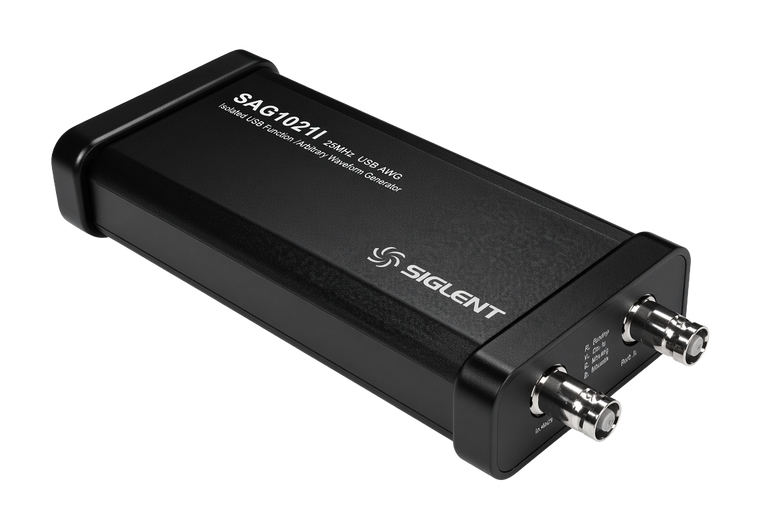
Everything is on two faces of a metal case small enough to sit behind the oscilloscope. One end carries the signal connections and the status lamps; the other carries the single USB socket that powers and drives it. Note that both signal connectors are BNC, which is what the oscilloscopes it works with use — no adaptors needed to get from the module to a scope input or a probe.
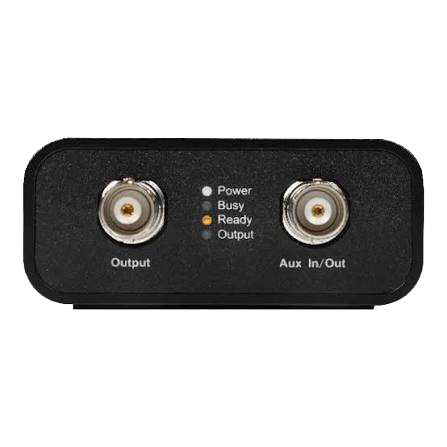
Signal end
Two BNC connectors: Output, the isolated generator output, and Aux In/Out for synchronisation and trigger between the module and the instrument. Four lamps — Power, Busy, Ready and Output — tell you at a glance whether the module is live, armed and driving a signal, without having to read it off the oscilloscope's screen.
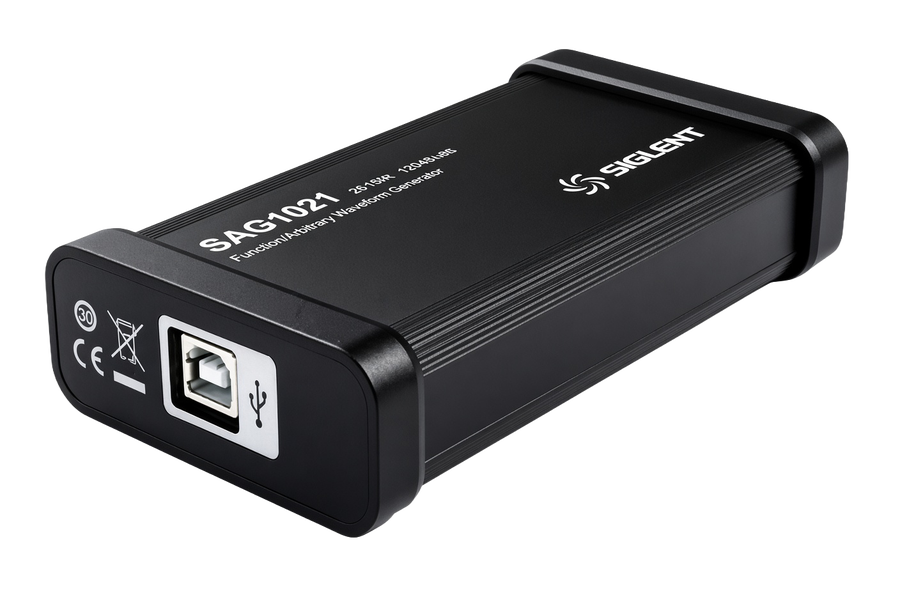
Connection end
A single USB Type-B socket — the same square connector used by the oscilloscope's own device port — carries power, control and waveform data. That is the whole installation: one lead from the module to a USB port on the scope, and nothing else to plug in, switch on or configure.
What is in the box
- SAG1021I generator module — the isolated 25 MHz AWG itself
- USB cable — power and control from the oscilloscope
Order code SAG1021I · supplied by SIGLENT
Specifications
| Output channels | 1 |
| Maximum output frequency | 25 MHz |
| Sampling rate | 125 MSa/s |
| Vertical resolution | 14 bit |
| Frequency resolution | 1 µHz |
| Frequency accuracy | ±50 ppm |
| Amplitude range | −1.5 V to +1.5 V into 50 Ω −3 V to +3 V into high impedance |
| Output impedance | 50 Ω ±2% |
| Insulation voltage | ±42 Vpk (hardware) |
| Standard waveforms | Sine, square, ramp, pulse, noise, DC |
| Built-in waveforms | 45 |
| Arbitrary waveform length | 16 kpts |
| Arbitrary waveform editing | EasyWave PC software |
| Protection | Over-voltage and current limiting |
| Front panel connectors | Output (BNC) · Aux In/Out (BNC) |
| Status indicators | Power · Busy · Ready · Output |
| Computer / scope port | USB Type-B |
| Power and control | USB, from the oscilloscope — no separate supply |
Questions we are asked
Which oscilloscopes does the SAG1021I work with?
Siglent lists the SDS800X HD, SDS1000X HD, SDS1000X-E (four-channel models only), SDS2000X-E, SDS3000X HD, SDS5000X and SDS6000A. Two-channel SDS1000X-E models are not supported. If you have an SDS6000A, order the SDS6000A listing instead of this one — it is supplied with the licence that series needs.
Do I need this to get a Bode plot?
On the supported scopes above, yes — the oscilloscope has the Bode plot software but no source of its own, so it needs a generator to sweep the stimulus. The SAG1021I is the cheapest way to provide one, and the scope drives it automatically. A separate SDG bench generator also works if you already own one. Higher-end scopes with a built-in generator do not need the module at all.
Why does the isolation matter?
For loop-response measurement you inject a small disturbance across a resistor in the feedback path of a live power supply. That injection point is usually not at earth potential. A mains-earthed generator connected there puts a short across part of the circuit; an isolated output, rated ±42 Vpk here, does not.
Is it a replacement for a bench function generator?
For many jobs, yes — 25 MHz, 14-bit and 125 MSa/s covers a great deal of everyday stimulus work. The limits to check are amplitude and channel count: one channel, and ±1.5 V into 50 Ω (±3 V unterminated). If you need more level, more channels, modulation or higher frequency, an SDG bench generator is the right tool.
Can I load my own waveforms?
Yes. EasyWave on the PC lets you draw a waveform, build it from a formula or import captured data, then load it into the module. Arbitrary waveform length is 16 kpts.
Does it need its own power supply?
No. It is powered and controlled entirely over the USB cable supplied with it, which plugs into a USB Type-B socket on the module.
What is the second BNC connector for?
The front panel carries two BNC connectors. Output is the isolated generator output. Aux In/Out handles synchronisation and triggering between the module and the instrument. Four status lamps — Power, Busy, Ready and Output — show the state of the module without looking at the oscilloscope screen.
Often bought with it
Not sure it fits your oscilloscope?
Tell us the exact model and what you want to measure. We are the official Siglent distributor for the EU and we will confirm whether the module is the right answer — or whether your scope already has a generator built in.