

Siglent SAP4000P 4 GHz Power Rail Probe, 1.1:1
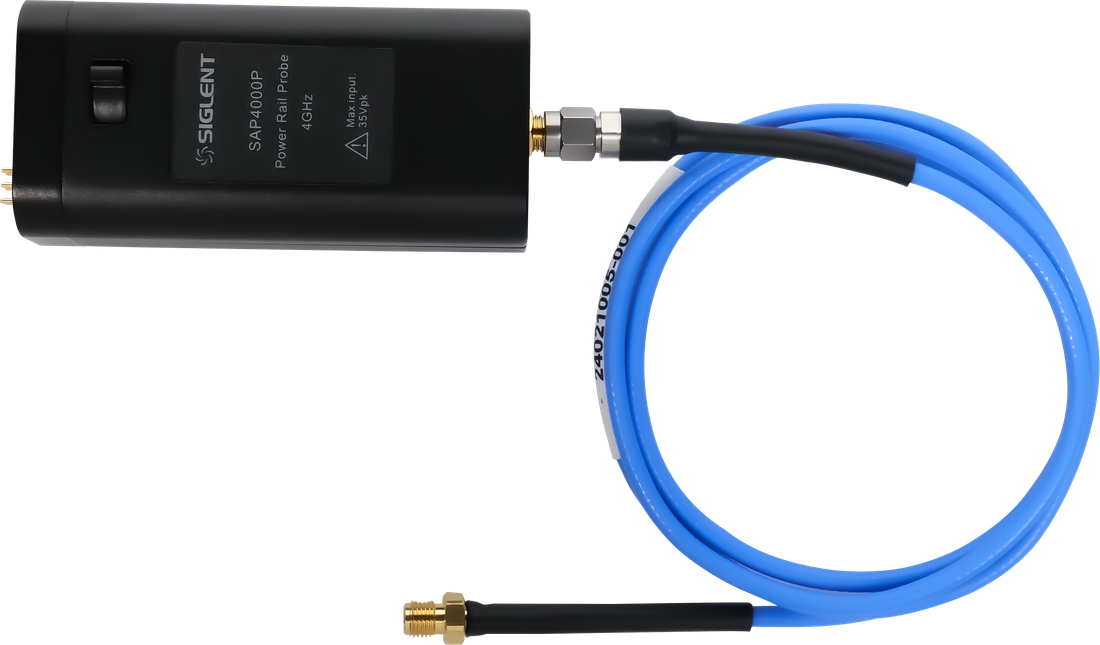
Siglent SAP4000P power rail probe: 4 GHz, 1.1:1, ±24 V offset, ±600 mV range, 20 kΩ LF / 50 Ω HF. For power integrity.
4 GHz power rail probe, 1.1:1
A power rail probe exists to solve one problem an ordinary probe cannot: measuring millivolts of noise sitting on top of a DC rail. The SAP4000P offers ±24 V of offset range, so it subtracts the DC level in hardware and puts the remaining ripple across a ±600 mV dynamic range at 4 GHz.
Attenuation is 1.1:1, so almost nothing is thrown away before the scope sees it, and the loading is designed for rails rather than signals: 20 kΩ at low frequency so the DC operating point is not disturbed, 50 Ω at high frequency so the probe stays matched where the noise actually lives. Trying the same measurement with a 10X passive probe means quantising a 20 mV ripple with a probe that has already divided it by ten.
Before you order
Why not just use a 10X passive probe? Two reasons. It divides your signal by ten before the scope quantises it, so a 20 mV ripple arrives as 2 mV. And it has no offset capability, so the oscilloscope must display the whole DC rail and the ripple together — leaving the ripple a fraction of one division high. The offset range and the 1.1:1 ratio are the entire point.
Key specifications
- 4 GHz bandwidth
- Attenuation ratio 1.1:1 — almost no signal thrown away
- ±24 V offset range — subtracts the rail in hardware
- ±600 mV dynamic range for the ripple that is left
- 20 kΩ low-frequency resistance — does not disturb the DC operating point
- 50 Ω high-frequency resistance — matched where the noise is
- SAP4-AB accessory kit available (€380)
Application examples
Power integrity on DC rails
The core measurement: how much noise rides on a 1.0 V or 3.3 V rail, and at what frequency. This is what the probe is built for.
DDR and SoC supply verification
Rail noise budgets on memory and processor supplies, where the specification is tens of millivolts and the spectrum runs to gigahertz.
PDN and decoupling validation
Confirming that the decoupling network actually does what the simulation predicted, at the frequencies where it matters.
Switching regulator design
Ripple, transient response and high-frequency content on the output of a converter, measured without the attenuation that hides it.
Specifications
| Bandwidth | 4 GHz |
|---|---|
| Attenuation ratio | 1.1:1 |
| Offset voltage range | ±24 V |
| Dynamic range | ±600 mV |
| Low-frequency resistance | 20 kΩ |
| High-frequency resistance | 50 Ω |
| Accessory kit | SAP4-AB — main cable, high-speed probe browser, low-speed probe browser kit and further accessories |
Specifications as published by SIGLENT. Errors and omissions excepted.
Other probes
Not sure this is the right probe?
Tell us what you are measuring, how fast it moves, how far it floats above earth and which oscilloscope you own. We will name the right probe — including when a cheaper one covers it.