

Power rail probe
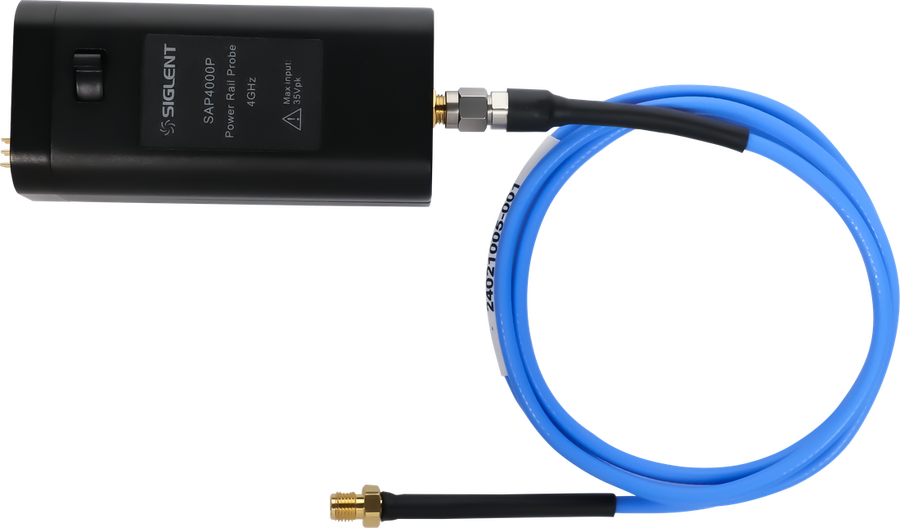
Measuring millivolts of ripple on a multi-volt rail is a dynamic-range problem, not a bandwidth problem. The SAP4000P subtracts up to ±24 V of DC before the signal reaches the amplifier, so the noise you are hunting fills the screen.
Why an ordinary probe cannot see rail noise
Suppose a 12 V rail carries 20 mV of ripple and you want to know its shape. With a 10X passive probe, that 20 mV arrives at the oscilloscope input as 2 mV, sitting on 1.2 V of DC. To see it you need a vertical scale of a few millivolts per division — but the DC component pushes the trace far off screen long before you get there. Turn on the scope's own offset and you quickly reach its limit, usually a volt or two at sensitive settings. Switch to AC coupling and you lose the DC level you were asked to verify, and the coupling capacitor distorts the low-frequency behaviour you care about during a load step.
A power rail probe attacks the problem where it starts. The SAP4000P offsets up to ±24 V at the probe head, before any amplification, so the DC is removed while the rail stays connected. What reaches the oscilloscope is the ripple alone, and it can then be put on the most sensitive vertical setting the instrument has. Attenuation is 1.1:1 rather than 10:1, so almost none of the signal is thrown away, and the input dynamic range of ±600 mV is generous for anything that deserves to be called a rail.
The other half of the problem is noise. If the probe contributes as much noise as the ripple, the measurement is meaningless. The SAP4000P is specified to raise the oscilloscope's own noise floor by only about 1.1× — the trace you see is the rail, not the probe. Its 50 Ω high-frequency input impedance matches the transmission-line environment a fast rail actually lives in, while a 20 kΩ low-frequency resistance keeps DC loading negligible. Bandwidth is 4 GHz, which matters less for the ripple itself than for the fast transients that ride on it when a processor changes state.
Specifications side by side
The full specification at a glance.
| Model | Bandwidth | Ratio | Dynamic range | Offset | Input impedance | Interface | Noise |
|---|---|---|---|---|---|---|---|
| SAP4000P | 4 GHz | 1.1:1 | ±600 mV | ±24 V | 20 kΩ LF / 50 Ω HF | SAPBus | ~1.1× scope noise |
Measurements this probe is built for
Ripple and noise on a DC rail
The core case: read millivolts of ripple on a rail of up to 24 V without AC coupling and without losing the DC reference.
Load-step response
Watch the rail sag and recover when the load changes. DC coupling keeps the absolute level visible throughout, so overshoot and droop can be measured against the specification.
Power integrity at the die
Modern processors specify a tolerance band of a few percent. Verifying it needs a probe whose own noise is well below the budget being checked.
PDN and decoupling work
4 GHz of bandwidth resolves the high-frequency content that decoupling networks are there to control, including transients from fast current steps.
Questions we are asked
Which oscilloscopes support the SAP4000P?
Any Siglent oscilloscope with the SAPBus probe interface — the SDS5000X, SDS6000A, SDS6000L and SDS7000A series. SAPBus carries the power, the probe identification and the offset control, so no external supply is needed.
Can I use a normal probe with the oscilloscope's offset instead?
Up to a point. A scope's channel offset is limited at sensitive vertical settings — often to a volt or two — and a 10X probe has already thrown away 90% of your signal before the offset is applied. The SAP4000P offsets ±24 V at the probe head and attenuates only 1.1:1, which is a different measurement, not a more convenient one.
Why is the input impedance only 50 Ω?
50 Ω at high frequency matches the transmission-line environment and avoids the reflections a high-impedance tip would cause at these speeds. At low frequency the probe presents 20 kΩ, so steady-state DC loading of the rail is negligible.
What is the maximum rail voltage I can measure?
The offset range sets the practical limit: ±24 V. Within that, the probe resolves the AC content on the rail across a ±600 mV input dynamic range.
Not sure which one fits your measurement?
Tell us the instrument, the signal and what you are trying to see. We are the official Siglent distributor for the EU and we will point you at the right part — including when the right answer is a probe from another family, or nothing at all.