

Siglent SRF5030T 300 kHz to 3 GHz Near-Field Probe Set

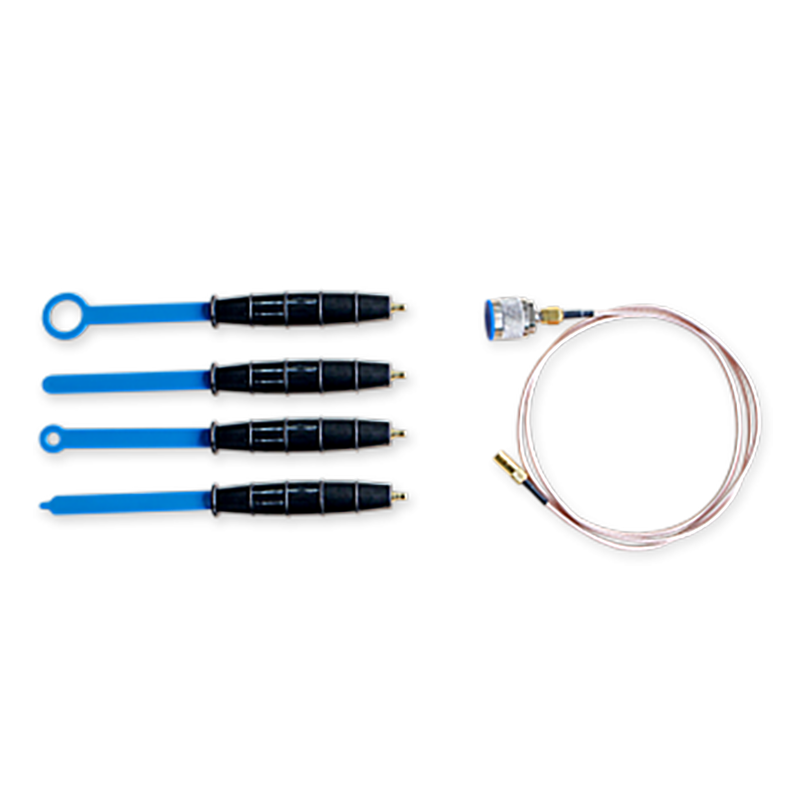
Siglent SRF5030T Near Field Probe Set for EMC Pre-Compliance
The Siglent SRF5030T is a professional near-field probe set for locating EMI and radiated emissions on PCBs and electronic assemblies. Covering 300 kHz to 3 GHz, it includes H-field and E-field probes for fast EMC pre-compliance testing and RF debugging when used with a spectrum analyze
Finds the part of the board that is radiating
An emissions measurement gives you two things: a frequency, and how far over the limit you are. It does not give you the one thing a fix depends on — which part of the board is producing it. That gap is why EMC debugging so often turns into changing components in the hope that one of them was the problem.
A near-field probe closes it. Held a few millimetres above a board and connected to a spectrum analyser, it responds to the field immediately under it, so moving it across the board turns "this product emits at 32 MHz" into "this trace emits at 32 MHz". The SRF5030T is a set of four such probes covering 300 kHz to 3 GHz.
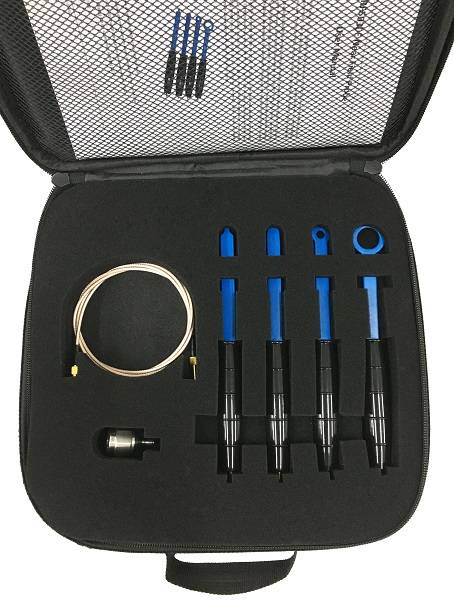
Three of them are magnetic-field loops of 20, 10 and 5 mm, which respond to current. The fourth is an electric-field probe, which responds to voltage. They are passive, they need no power, and the supplied cable and adapter connect them straight to the N-type input of an analyser.
The four probes
Each probe terminates in SMB and connects through the supplied 1 m coaxial cable, so you change probe without disturbing the instrument end.
The one to start with. The largest loop encloses the most area, so it couples to the most current and finds the region of the board a problem lives in.
The middle step, for when the 20 mm loop has narrowed things to a corner of the board but several candidates are still in range.
The one that ends the argument. Small enough to sit over a single trace or a single pin, and to tell a switching node from the transformer next to it.
Responds to the electric field rather than the magnetic one — so it finds high-voltage, high-impedance nodes such as a drain, a heatsink or an unterminated cable end.
Where it fits in an EMC debug
What it connects to
Any 50 Ω analyser input
The set ends in SMA, and the supplied SMA-to-N adapter fits the N-type input on the SSA, SVA and SHA series directly. Nothing else is needed to connect it.
The SVA1000X EMI licence
The probes find where; the EMI licence measures it the way the standard defines — CISPR bandwidths, quasi-peak detector and limit lines. Together they are a pre-compliance bench.
An oscilloscope, at a push
A probe into a 50 Ω scope input shows the waveform of an interference source, which is sometimes the fastest way to recognise it. The analyser is the better instrument for finding it in the first place.
Specifications
| Frequency range | 300 kHz – 3 GHz |
| Probes supplied | H20, H10 and H5 (H-field) plus E5 (E-field) |
| H20 resolution | 20 mm |
| H10 resolution | 10 mm |
| H5 resolution | 5 mm |
| E5 resolution | 5 mm |
| Probe connector | SMB (male) |
| Cable supplied | SMB (female) to SMA (male), 100 cm |
| Adapter supplied | SMA (female) to N (male) |
Near-field probes are comparative instruments: the reading depends on height, angle and what is underneath. They locate a source; they do not measure absolute field strength. Errors & omissions excepted.
Questions we get asked
Does it measure field strength?
No, and no near-field probe does. The reading depends on how close you hold it, at what angle and over what. It is a comparative instrument: it tells you that this spot is hotter than that spot at this frequency, which is what locating a source requires. Absolute field strength is a calibrated far-field measurement in a chamber.
What is the difference between the H probes and the E probe?
A loop responds to the changing magnetic field, which means current — so it finds current loops: supply returns, switching loops, ground paths. The E-field probe responds to the electric field, which means voltage — so it finds high-impedance nodes like a MOSFET drain, a heatsink or a floating cable. A board that is quiet on one can be loud on the other.
Why are three loop sizes supplied instead of one good one?
Because sensitivity and spatial resolution pull in opposite directions. A large loop encloses more area, couples to more current and hears things a small loop misses — but it cannot tell you which of the traces under it is responsible. You sweep with the 20 mm, narrow with the 10 mm and finish with the 5 mm.
Do I need a preamplifier?
Often not, because you are working close to the source and the signals that matter in an EMC debug are usually well above an analyser's noise floor at these bandwidths. If you are chasing something faint, the SSA and SVA series have a 20 dB preamplifier built in — switch it on before buying anything.
Will it work with my analyser?
If it has a 50 Ω input, yes. The set ends in SMA and the supplied SMA-to-N adapter covers the N-type inputs used on the SSA, SVA and SHA series. It is passive, so there is nothing to power and nothing to configure.
Is 3 GHz enough?
For the great majority of EMC debugging, yes — the emissions that fail radiated tests are usually clock harmonics and switching-converter noise well below that. Above 3 GHz you are into work that needs different probes and, realistically, a different measurement setup.
Can I damage the probes, or the analyser?
The probes are passive and robust, but they are meant for near-field sniffing, not for contacting live circuits — keep them off the board. The real risk is the instrument input: hold a loop right on top of a high-power switching node and the level can climb quickly, so start with attenuation in and reduce it as you learn the board.
Goes with
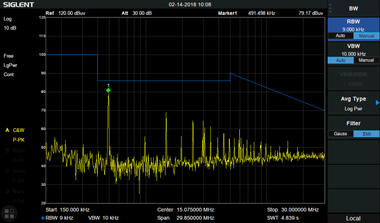
CISPR 16-1-1 bandwidths, quasi-peak detector and limit lines — the measurement half of a pre-compliance bench.
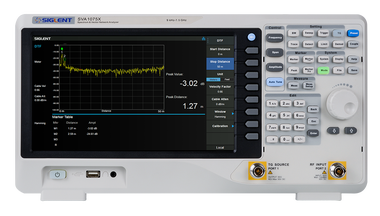
Spectrum analyser with a built-in vector network analyser, tracking generator and 20 dB preamplifier.
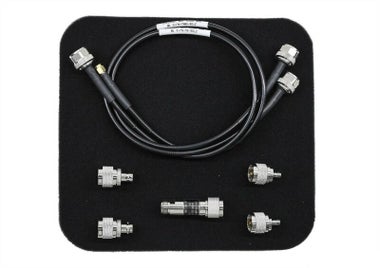
Adaptors, attenuator and cabling for the SSA and SVA series. Its BNC parts are specified only to about 2 GHz.
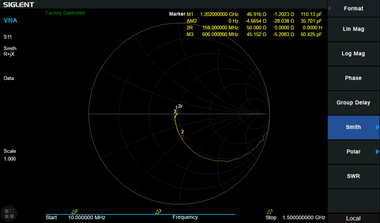
Every software option for the SVA1000X, with what each one is for.
Setting up a pre-compliance bench?
Tell us what you build and what you have to pass. We will say which analyser, which licence and which probes actually earn their place — and which ones you can skip.