

Siglent SNA6000-TDR Enhanced Time-Domain analysis option
VNA-based TDR for the SNA6000A: impedance vs time, eye diagrams with jitter and equalisation, Hot TDR, 16.9 ps rise time at 26.5 GHz. Includes TDA.
SNA6000-TDR — enhanced time-domain analysis
Signal-integrity analysis on the SNA6000A: impedance versus time, TDR and TDT, eye diagrams with jitter, emphasis and equalisation, and Hot TDR on live links. Includes SNA6000-TDA.
A TDR oscilloscope sends a fast step and watches what comes back. This option gets the same answer from a calibrated vector network analyser: the SNA6000A measures S-parameters with its full dynamic range, and the option turns them into step and impulse responses — impedance in ohms or voltage along the line, single-ended or differential. From the same measurement it simulates eye diagrams from a virtual bit pattern, so no pattern generator or sampling scope is needed.
What this option does
What it does
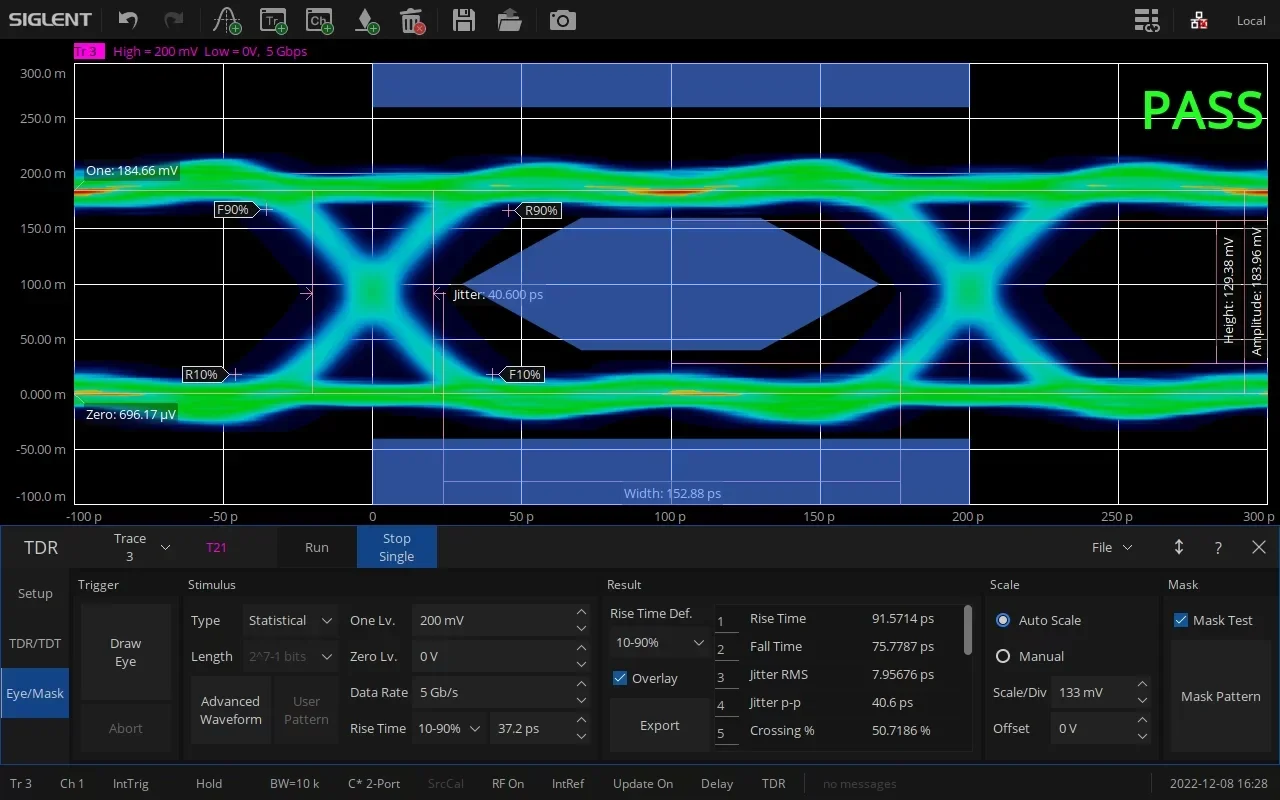
A wizard sets topology, deskew, DUT length and rise time. The result is impedance or voltage versus time, rise-time and delta-time searches, peeling for multiple discontinuities, eye diagrams with mask test and jitter, emphasis, CTLE equalisation, de-embedding and Hot TDR.
What you use it for
Characterising high-speed interconnects — cables, connectors, backplanes, PCB channels and packages — for impedance control, skew and eye opening, and exporting Touchstone files for simulation.
In practice
A 10 Gb/s backplane channel closes its eye at the far connector. The differential impedance trace shows a dip at the via field; simulating de-emphasis on the same measurement shows whether a transmitter setting alone reopens the eye before the board is re-spun.
SNA6000-TDA is included free. A differential 2-port channel has four single-ended ports, so differential work needs a 4-port model (SNA6024A, SNA6034A, SNA6124A, SNA6134A). The 26.5 GHz models reach twice the rise-time and eye-rate performance of the 13.5 GHz models. Deskew needs an open or short; loss compensation also a thru. For PCB traces, see the ASP and ADP TDR probes.
From step response to eye diagram
Set-up wizard
Topology, port extension, DUT length and stimulus rise time in one sequence, with the calibration it needs.
Deskew & loss compensation
Deskew moves the reference to the cable ends; the loss step adds a thru to correct cable loss, with an optional load.
Impedance and voltage
T-parameters as impedance, volts, log/lin magnitude or real, with smoothing and a peeling algorithm for several discontinuities.
Rise-time and Δ-time
Tracking searches for 10–90 % or 20–80 % rise time and the delay between two traces — skew.
Eye diagram and mask
PRBS 2n−1 (n = 3–15), K28.5 or your own pattern; 13 eye measurements; preset or custom masks.
Jitter and statistical eye
Inject random or periodic jitter and see the probability-coloured statistical eye.
Emphasis, CTLE, de-embedding
Pre, post-1 and post-2 cursor emphasis; CTLE by poles and zero or from a CSV response; .snp port de-embedding.
Hot TDR
Measure a powered link: enter its data rate and the analyser retunes the sweep around the link’s own spectral lines.
Specification
From the SNA6000A data sheet and user manual.
| 13.5 GHz models | 26.5 GHz models | |
|---|---|---|
| Bandwidth | 13.5 GHz | 26.5 GHz |
| Minimum step rise time (10–90 %) | 33.1 ps | 16.9 ps |
| Step response resolution in free space (εr = 1) | 5 mm | 2.5 mm |
| Minimum impulse width | 44.7 ps | 22.8 ps |
| Maximum eye-diagram data rate | 10.8 Gb/s | 21.2 Gb/s |
| TDR stimulus | Step, impulse | Step, impulse |
| Step amplitude | 1 mV to 5 V | 1 mV to 5 V |
| Maximum DUT length | 1.25 µs | 1.25 µs |
| Input impedance | 50 Ω | 50 Ω |
| Maximum test-port input, Hot TDR mode | 1.5 Vpp | 1.5 Vpp |
| DC damage level at test port | 35 V | 35 V |
| Eye measurements | Rise and fall time, jitter, crossing, opening factor, SNR, duty-cycle distortion, level one, level zero, mean level, amplitude, height, width | |
| Export | State (.csa), trace data (.csv), Touchstone (.snp), screenshot (.png) | |
Compatibility and activation
Works on all eight models. Differential topologies need a 4-port model; the 26.5 GHz models give 16.9 ps rise time and 21.2 Gb/s eye rate.
Supplied as a licence key issued against the analyser’s serial number — nothing to fit and nothing to return. Enter it under System → Options → License…, or load the .lic file from a USB stick. Ordered together with a new SNA6000A, Siglent activates it at the factory.
Goes with
Questions about SNA6000-TDR
Is SNA6000-TDA included?
Yes. Buying SNA6000-TDR includes SNA6000-TDA at no charge.
Why use a VNA for TDR instead of a TDR oscilloscope?
The VNA brings its calibration and dynamic range to the time domain, so small reflections are visible above the noise; the same measurement gives S-parameters for simulation; and eye diagrams are simulated from it without a pattern generator. A TDR scope remains the tool for single-shot, real-time events.
Do I need a 4-port model?
For differential channels, yes: a differential pair has two single-ended ports at each end. Single-ended 1-port and 2-port work runs on any model.
What calibration is needed?
Deskew needs an open (or short) at the cable ends. Deskew with loss compensation adds a thru between the cables, and optionally a load. The wizard walks through each step.
What is Hot TDR?
Measuring a link that is running. The device’s own data signal would corrupt the time-domain result, so you enter its data rate (within ±0.5 %) and the analyser picks sweep frequencies that avoid it. Keep the port signal within 1.5 Vpp.
Can I simulate equalisation before changing hardware?
Yes. Emphasis with pre, post-1 and post-2 cursors on the transmitter side and a CTLE on the receiver side are applied to the measured channel, and the eye diagram updates.
How is the licence delivered?
Supplied as a licence key issued against the analyser’s serial number — nothing to fit and nothing to return. Enter it under System → Options → License…, or load the .lic file from a USB stick. Ordered together with a new SNA6000A, Siglent activates it at the factory. Add the analyser’s serial number to your order, or send it to us afterwards.
Can I return a licence?
Software licences and activation keys are delivered electronically and are excluded from the 14-day EU return right once the key has been issued. If you are unsure, ask us first.
Planning an SNA6000A measurement?
Tell us the device, the frequency range and what you need to measure. We will confirm the model, the options and the calibration you need before you order.