

Siglent SSG3021X-IQE Plus RF Signal Generator 9 kHz–2.1 GHz with external IQ
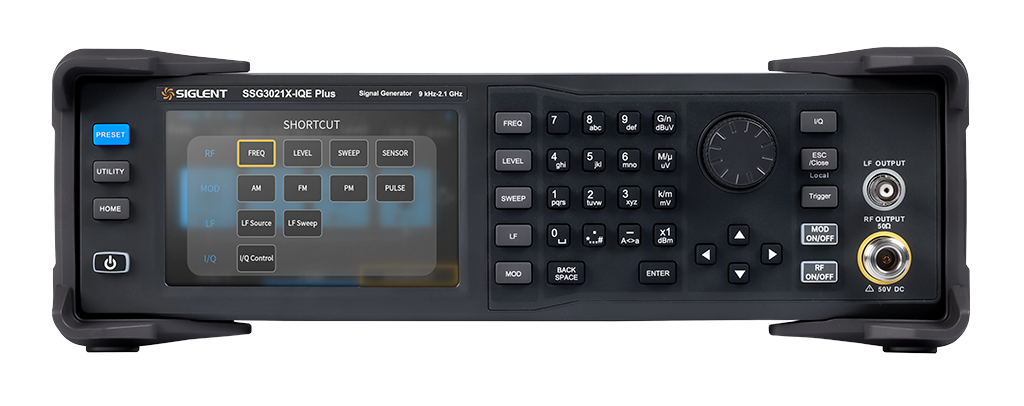
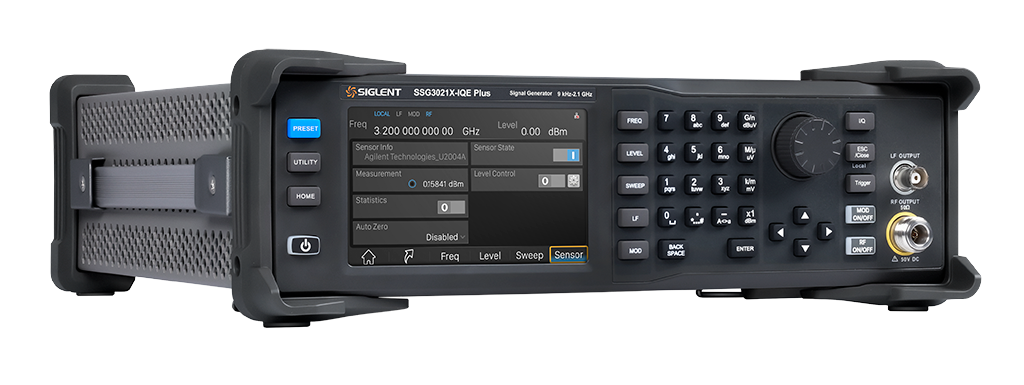
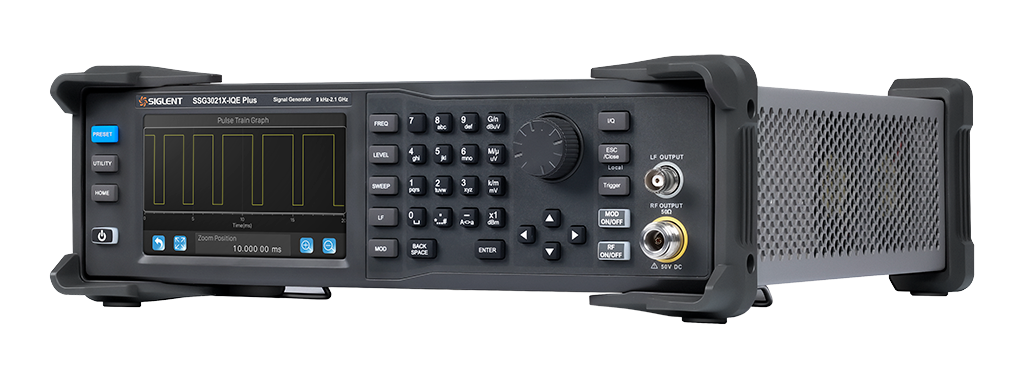
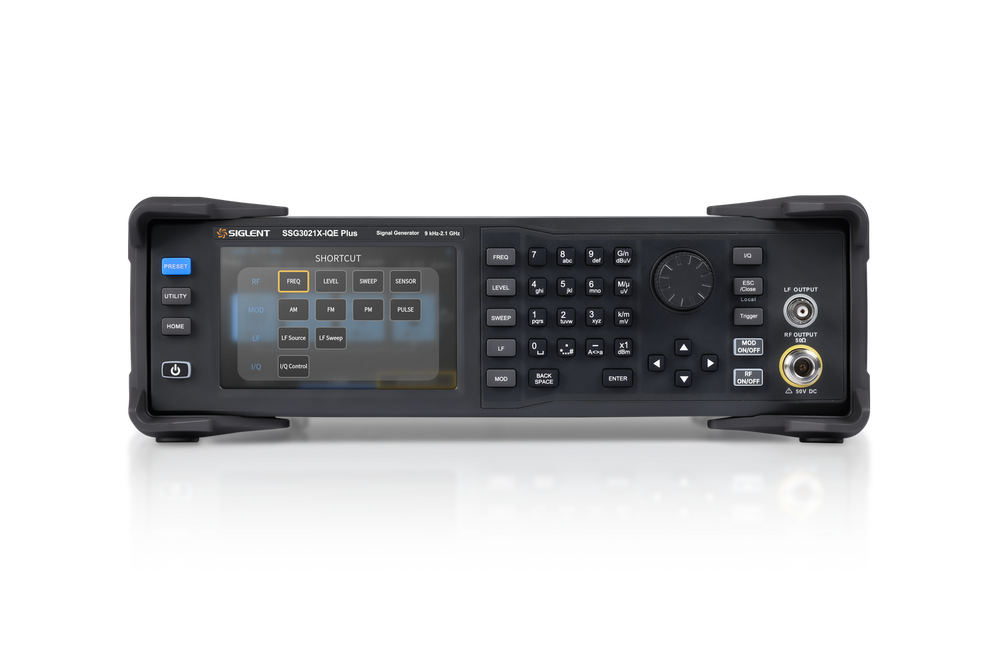
Siglent SSG3021X-IQE Plus: 9 kHz-2.1 GHz RF signal generator with external I/Q modulation (10 MHz-2.1 GHz), -117 dBc/Hz phase noise, OCXO option.
SSG3021X-IQE Plus — vector-capable RF signal generator to 2.1 GHz
An RF signal generator from 9 kHz to 2.1 GHz at up to +20 dBm, with −117 dBc/Hz phase noise at 1 GHz, AM, FM, PM and pulse modulation as standard, and an external I/Q input for vector modulation from 10 MHz to 2.1 GHz.
The SSG3021X-IQE Plus is the successor to the SSG3021X-IQE at the same price: the same frequency coverage, output level and footprint, with phase noise improved by about 7 dB at 1 GHz and, for the first time in the series, an OCXO reference option. With the SDG6000X supplying I and Q, it produces standard-compliant vector-modulated signals — 16QAM at ≤ 0.7 % EVM up to 1.5 GHz — for receiver sensitivity, error-rate and two-tone work.
At 2.1 GHz it covers the sub-2 GHz radio, ISM and general RF bands. A software key lifts it to 3.2 GHz later — but buying the SSG3032X-IQE Plus outright is cheaper than upgrading, see below.
Key figures
In this model
- CW 9 kHz to 2.1 GHz, 0.01 Hz steps; sweep by step or list.
- AM, FM, PM and single/double pulse modulation — standard, not optional.
- External I/Q modulation, 10 MHz to 2.1 GHz, < 200 MHz RF bandwidth.
- LAN, USBTMC and web-browser remote control; GPIB via adapter.
- No internal baseband generator — I and Q come from an SDG6000X or similar.
- 2.1 GHz top frequency; 3.2 GHz is a paid software key.
The instrument at work
What each capability looks like on the bench — from Siglent’s launch photography.
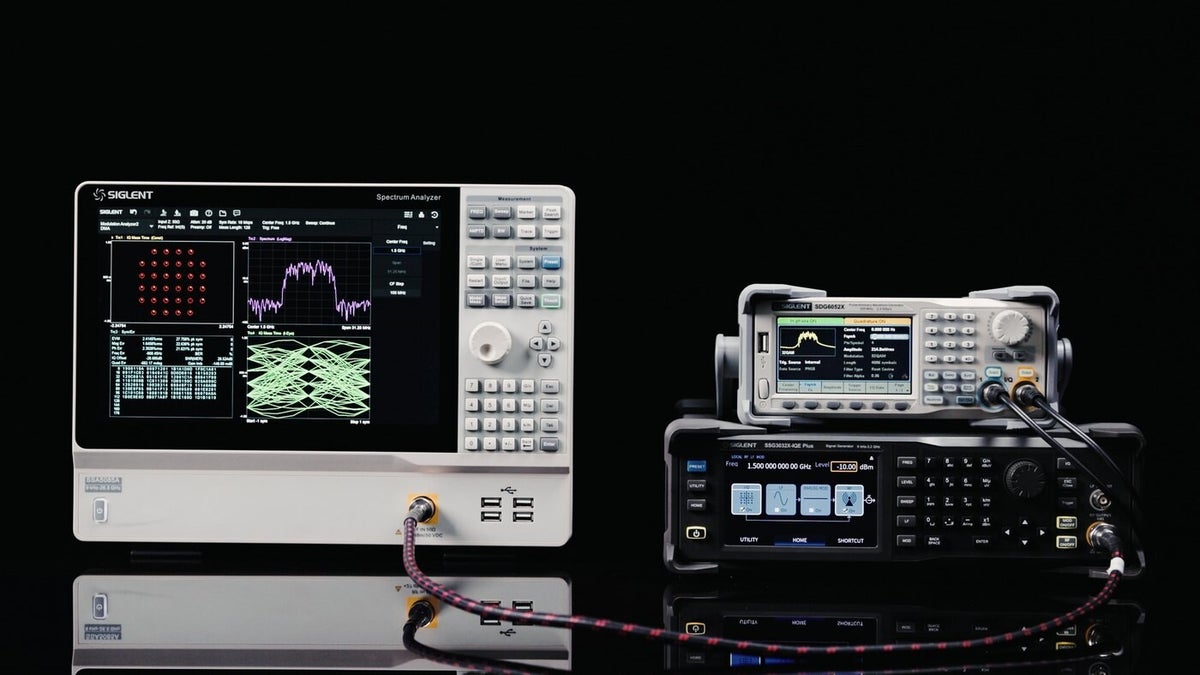
Vector modulation from an external baseband
An SDG6052X supplies I and Q to an SSG3032X-IQE Plus at 1.5 GHz, generating a 32QAM signal with root-raised-cosine filtering. On the analyser: the constellation, the spectrum, the eye and the EVM figures.
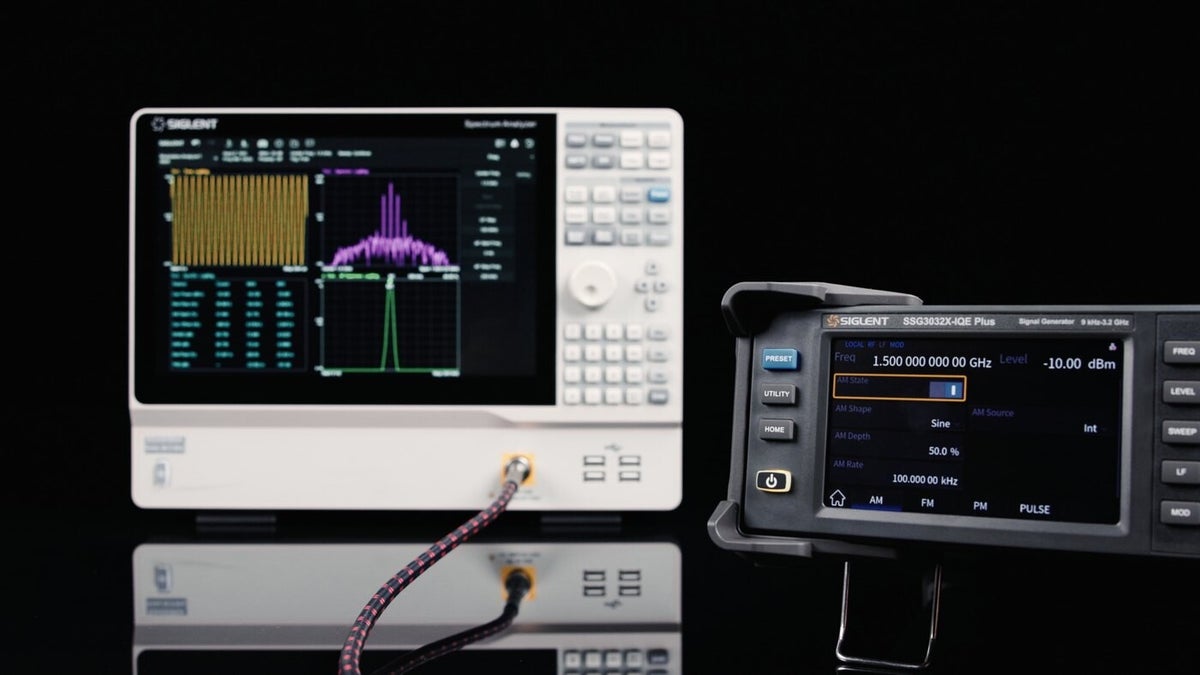
AM, FM and PM as standard
The analog modulation menu with AM switched on — sine, 50 % depth, 100 kHz rate, internal source — and the modulated spectrum on the analyser beside it. FM and PM sit on the same screen.
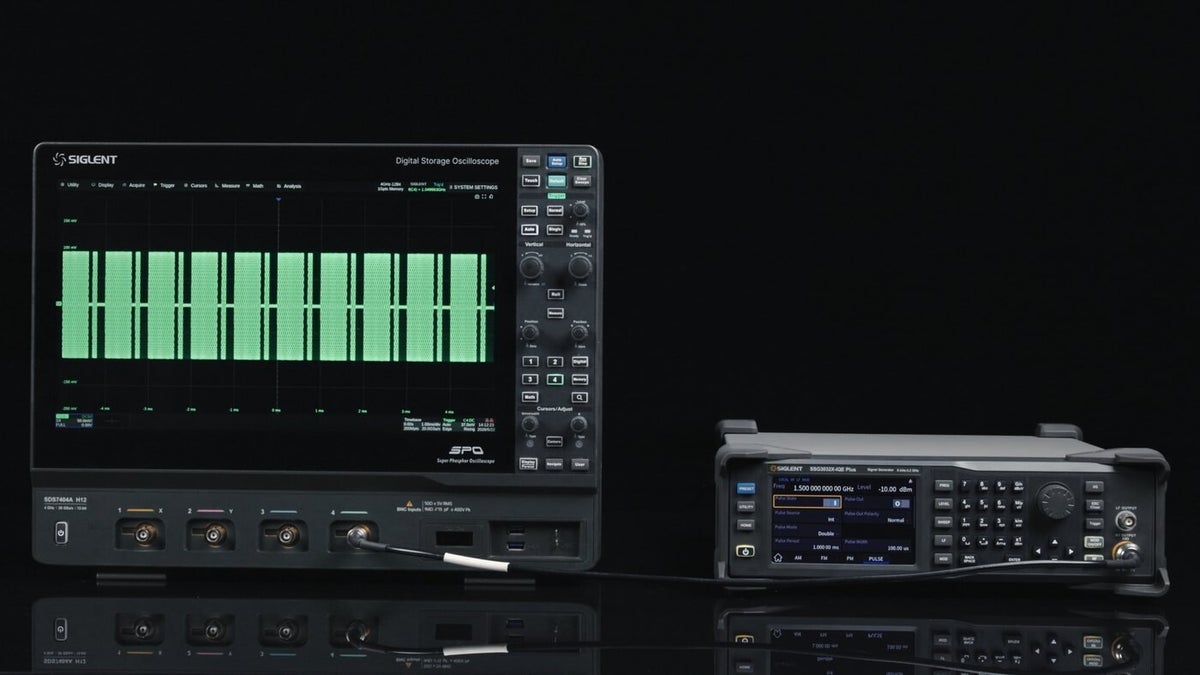
Pulse modulation, built in
A double-pulse pattern at 1.5 GHz — 1 ms period, 100 µs width — captured on an SDS7404A. Single and double pulse are standard; the narrowest pulse is 20 ns.
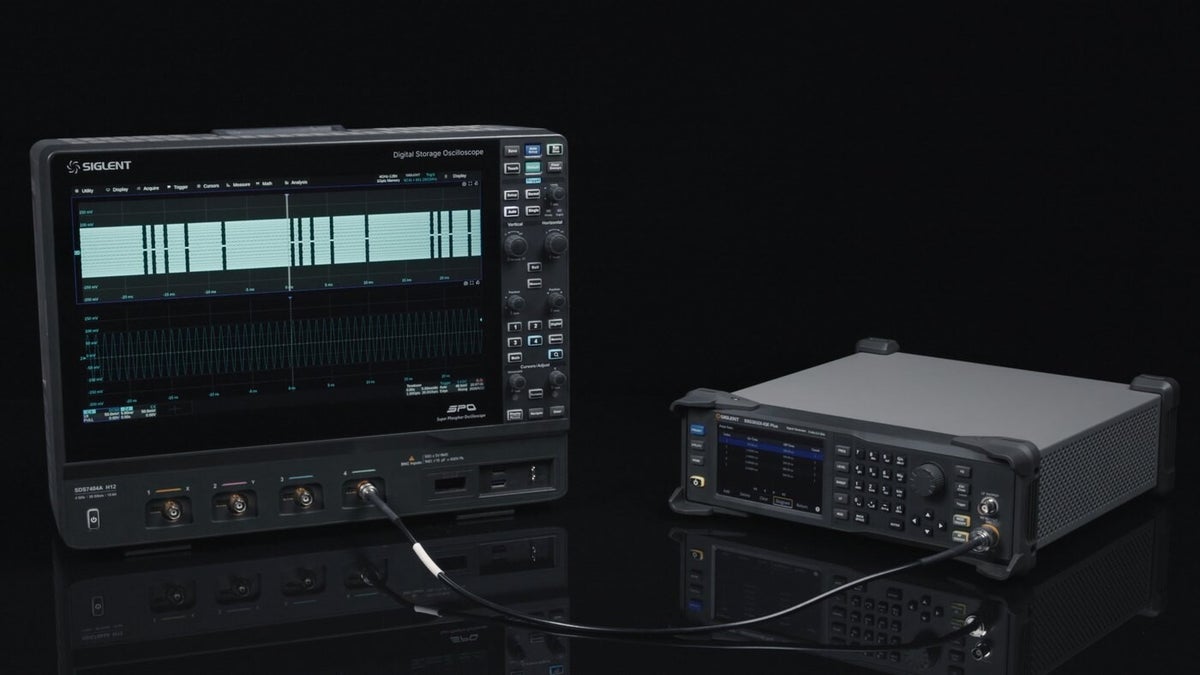
Programmable pulse trains (PT option)
With the PT option the generator plays a list of pulses, each with its own on-time, off-time and repeat count. The burst pattern is captured on the oscilloscope, with a zoom on the carrier underneath.
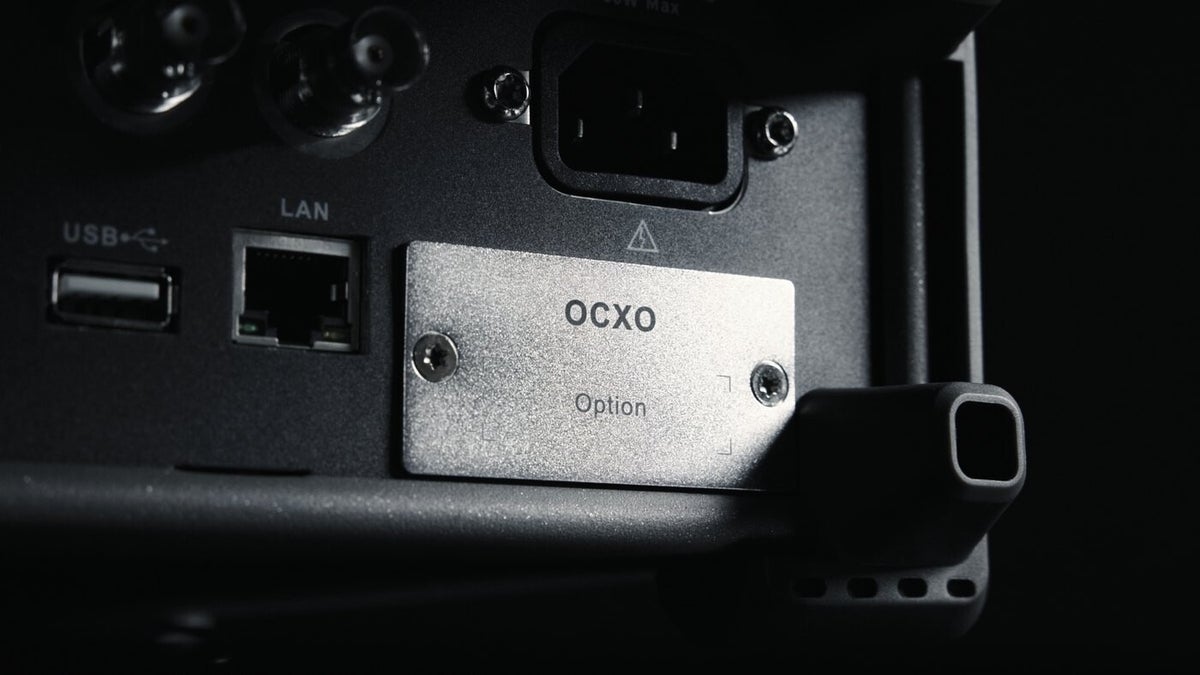
The OCXO bay
The oven-controlled reference is a factory-fitted option in its own bay on the rear panel, beside the USB and LAN ports. Every frequency the instrument produces is referred to that timebase.
The four models
Two frequency ceilings, each with or without the external I/Q interface. Frequency can be upgraded by software key; the I/Q interface cannot be added later. Prices ex VAT.
| Model | CW range | External IQ | Price |
|---|---|---|---|
| SSG3021X Plus | 9 kHz – 2.1 GHz | — | €1,999 |
| SSG3032X Plus | 9 kHz – 3.2 GHz | — | €3,499 |
| SSG3021X-IQE Plus this model | 9 kHz – 2.1 GHz | 10 MHz – 2.1 GHz | €4,299 |
| SSG3032X-IQE Plus | 9 kHz – 3.2 GHz | 10 MHz – 3.2 GHz | €5,699 |
The series page compares them side by side.
Options for the SSG3021X-IQE Plus
Supplied with a quick start guide, USB cable and power cord. Prices ex VAT.
| Order code | Option | Price | What it adds |
|---|---|---|---|
| 10M_OCXO_L | Precision OCXO reference (factory-fitted) | €1,039 | 100 ppb initial accuracy, ±1 ppb over 0–50 °C, 50 ppb/year aging — against 0.2 ppm, ±1 ppm and 0.5 ppm/year for the standard reference. Ordered with the instrument. |
| SSG3000X Plus-PT | Pulse train generator (software) | €819 | Up to 2,047 pulses per train, each repeated up to 65,535 times, on/off times from 20 ns to 300 s in 10 ns steps. |
| SSG3000X-IQE Plus-21BW32 | Upgrade 2.1 GHz → 3.2 GHz, IQE (software) | €1,999 | The same frequency upgrade for the external-IQ model — CW to 3.2 GHz, IQ mode to 3.2 GHz. |
| SSG-RMK | 19-inch rack mount kit, 3U | €159 | Shared with the SSG3000X, SSG5000X, SSG5000A and SDG7000A. |
| USB-GPIB | USB–GPIB adapter | €123 | Adds IEEE-488 control for benches and ATE racks still built around GPIB. |
Upgrading to 3.2 GHz later costs more than buying it now
This model at €4,299 plus the €1,999 frequency key comes to €6,298, against €5,699 for the SSG3032X-IQE Plus outright — €599 more. The key is there for when requirements change, not as a way to spread the cost.
Specifications
From the SSG3000X Plus data sheet EN01A. Specifications apply 5–45 °C after a 40-minute warm-up; “typ.” and “nom.” figures are not warranted. N is the band factor (1 below 1 MHz, 0.5 to 250 MHz, 0.125 to 500 MHz, 0.25 to 1 GHz, 0.5 to 2 GHz, 1 above).
| Frequency | |
| Range | CW 9 kHz – 2.1 GHz · IQ mode 10 MHz – 2.1 GHz |
| Resolution | 0.01 Hz |
| Setting time | < 5 ms (typ.) ALC on · < 10 ms (typ.) ALC off (S&H) |
| Phase offset resolution | 0.1° |
| Sweep | Step (linear or logarithmic, 2–65,535 points) or list (1–500 points); dwell 10 ms–100 s; triangle or saw-tooth; single or continuous; trigger auto, key, external or bus |
| Frequency reference | |
| Standard | 10 MHz · < 0.2 ppm initial · < 1 ppm over 0–50 °C · < 0.5 ppm first year, 3 ppm / 20 years |
| 10M_OCXO_L option | ±100 ppb initial · ±1 ppb over 0–50 °C · 50 ppb / year |
| External reference | 10 MHz in, −5 to +10 dBm · 10 MHz out, > 0 dBm (BNC) |
| Level | |
| Setting range | −110 to +9 dBm (9–100 kHz) · −110 to +15 dBm (100 kHz–1 MHz) · −110 to +20 dBm (1 MHz–2.1 GHz) |
| Specified range | −110 to +5 dBm (9–100 kHz) · −110 to +10 dBm (100 kHz–1 MHz) · −110 to +13 dBm (1 MHz–2.1 GHz) |
| Resolution | 0.01 dB |
| Level error (ALC on, 20–30 °C) | ≤ 0.7 dB, 100 kHz–2.1 GHz, +13 to −90 dBm (≤ 0.5 dB typ.) · ≤ 1.1 dB to −105 dBm · ≤ 1.8 dB to −110 dBm |
| ALC modes | Auto · On · Sample & hold |
| Level sweep | Step (linear, 2–65,535 points) or list (1–500 points), dwell 10 ms–100 s |
| VSWR | ≤ 1.8 (nom.), 1 MHz–2.1 GHz, level ≤ 0 dBm |
| Reverse power | 30 dBm maximum, 1 MHz–2.1 GHz · 50 V DC maximum |
| Spectral purity (CW, level ≤ +13 dBm) | |
| Harmonics | < −30 dBc, 1 MHz–2.1 GHz |
| Sub-harmonics | < −45 dBc, offset > 10 kHz |
| Non-harmonics | < −63 dBc, offset > 10 kHz |
| SSB phase noise, 20 kHz offset | 100 MHz: < −118 dBc/Hz (−121 typ.) · 1 GHz: < −115 dBc/Hz (−117 typ.) · 3 GHz: < −107 dBc/Hz (−110 typ.) |
| Wideband noise (40 MHz offset, +10 dBm) | < −135 dBc (10–250 MHz) · < −148 dBc (250 MHz–2.1 GHz, −153 typ.) · < −150 dBc (2.1–3.2 GHz, −155 typ.) |
| Analog modulation | |
| Sources | Internal, external, internal + external (AM, FM and PM) |
| AM | 0–100 % depth, 0.1 % resolution · depth error < 4 % of setting + 1 % · distortion < 3 % (typ.) · 10 Hz–100 kHz response < 3 dB |
| FM | Maximum deviation N × 1 MHz · deviation error < 2 % of setting + 20 Hz · distortion < 0.5 % (nom.) |
| PM | Maximum deviation N × 5 rad · deviation error < 2 % of setting + 0.05 rad · distortion < 0.5 % (nom.) |
| Simultaneous modulation | AM + FM, AM + PM, FM + pulse, PM + pulse; AM + pulse with limitations; FM and PM not together |
| LF generator | Sine 0.01 Hz–1 MHz; square, triangle, saw-tooth 0.01 Hz–20 kHz; DC · 1 mVpp–3 Vpp into 50 Ω · LF sweep 0.01 Hz–1 MHz |
| Pulse modulation | |
| Sources / modes | Internal or external · single pulse, double pulse · normal or inverted polarity |
| On/off ratio | > 63 dBc (1–250 MHz) · > 68 dBc (250 MHz–2.1 GHz) |
| Rise / fall time | < 50 ns (10–90 %) |
| Period / width | Period 40 ns–300 s · width 20 ns–300 s · double-pulse delay and #2 width 20 ns–300 s · 10 ns resolution |
| Triggering | Auto, key, external, external gate, bus · external trigger delay 140 ns–300 s |
| Pulse train (PT option) | 1–2,047 pulses · 1–65,535 repetitions per pulse · on/off 20 ns–300 s, 10 ns steps |
| External IQ modulation (IQE models) | |
| Source | External I and Q, BNC, 50 Ω · full scale √(I²+Q²) = 0.5 Vrms |
| Bandwidth | Baseband I or Q < 100 MHz (typ.) · RF (I+Q) < 200 MHz (typ.) |
| EVM (SDG6000X baseband, RRC α = 0.22, 5 MSps, ≤ 0 dBm) | 16QAM: ≤ 0.7 % to 1.5 GHz, ≤ 1.2 % to 3.2 GHz (nom.) · QPSK: ≤ 0.7 % to 1.5 GHz, ≤ 1 % to 3.2 GHz (nom.) |
| Connectors | |
| Front | RF out N female 50 Ω · LF out BNC 50 Ω |
| Rear | Trig in/out (100 kΩ, 5 V TTL) · Ext mod in (50 Ω) · Pulse in/out (50 Ω, 3.3 V CMOS) · 10 MHz in / out · Signal valid (3.3 V CMOS) · I in, Q in (BNC, 50 Ω) |
| Interfaces | USB host (USB-A 2.0) · USB device (USB-B 2.0, USBTMC) · LAN 10/100 (VXI-11, socket, telnet) · GPIB via USB-GPIB adapter |
| General | |
| Display | 5-inch capacitive touchscreen, 800 × 480; mouse and keyboard supported; web-browser remote control |
| Storage | 256 MB internal flash, USB storage |
| Power | 100–240 V ±10 %, 50/60 Hz (100–120 V, 400 Hz) · 35 W |
| Environment | 0–50 °C operating, −20 to +70 °C storage |
| Size / weight | 338 × 113 × 369 mm · 4.84 kg |
| Compliance | EN IEC 61326-1:2021, EN 61010-1, RoHS 2011/65/EU |
| Supplied with | Quick start guide, USB cable, power cord · 3-year warranty |
Where it is used
Receiver sensitivity and blocking
A clean carrier at a precisely known level is the whole measurement. −117 dBc/Hz at 1 GHz means less of what you measure belongs to the generator.
Wireless module verification
With an SDG6000X supplying baseband IQ, standard-compliant modulated signals for sensitivity and error-rate work, and two-tone signals for TOI.
Pulsed RF
Single and double pulse are standard, with a 20 ns narrowest pulse and > 68 dBc on/off ratio above 250 MHz; the PT option adds programmable trains.
Teaching and production test
A touchscreen for the bench, and LAN, USBTMC and optional GPIB with browser control for a rack that runs unattended.
Questions about the SSG3021X-IQE Plus
What is the difference between the SSG3021X-IQE Plus and the SSG3021X Plus?
The I/Q input. This model accepts external I and Q from a baseband generator such as the SDG6000X and up-converts them; the SSG3021X Plus has no I/Q path. Everything else — frequency range, level, phase noise, analog and pulse modulation — is the same.
Can I upgrade the frequency range later?
Yes. The SSG3000X-IQE Plus-21BW32 software key lifts it to 3.2 GHz at any time. It costs €1,999, which is more than the difference between the two models bought new — so buy 3.2 GHz now if you already know you need it.
What does the OCXO option change?
The timebase every output frequency is derived from. Standard: < 0.2 ppm initial accuracy and < 1 ppm over 0–50 °C. With the 10M_OCXO_L: ±100 ppb and ±1 ppb, with 50 ppb/year aging. It is fitted at the factory, so order it with the instrument.
Is pulse modulation included?
Yes. Single and double pulse with internal or external source, 20 ns minimum width, > 68 dBc on/off ratio from 250 MHz up. Only the pulse train generator (lists of up to 2,047 pulses) is an option, SSG3000X Plus-PT.
How is it different from the SSG3021X-IQE?
Same frequency range, level, size and price. Phase noise at 1 GHz improves from −110 to −117 dBc/Hz (typ.), and an OCXO reference is available for the first time. Pulse edge and width figures are unchanged.
How do I control it remotely?
LAN (VXI-11, socket or telnet) and USBTMC are standard, GPIB through the USB-GPIB adapter, and there is a built-in web interface so the front panel can be driven from a browser on a PC or a phone.
What is in the box and what is the warranty?
The instrument, a quick start guide, a USB cable and a power cord. Three years’ warranty, supported from the Netherlands by the official Siglent distributor for the EU.
Several units, or a rack of them?
Tell us the quantity and the options, and we will quote the set — including the rack kit and a matching baseband generator where it applies. Official Siglent distributor for the European Union.