

Extreme & isolated probes
Where an ordinary differential probe runs out of margin. A 10 kV divider for ignition and insulation work, and optically isolated probes that break the electrical path completely — ±60 kV of isolation and 160 dB of common-mode rejection.
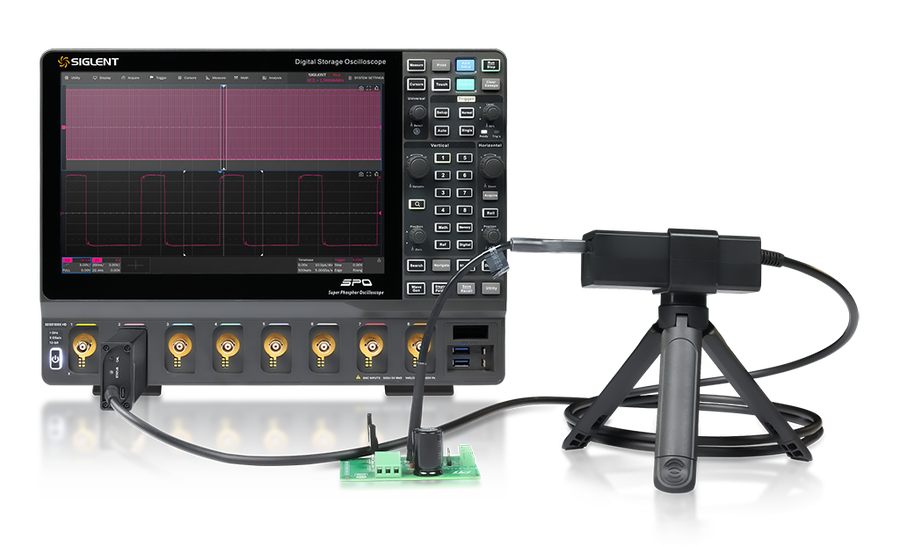
Two different kinds of extreme
A standard 10X passive probe ties its ground clip to the oscilloscope chassis and therefore to mains earth. Put that clip anywhere that is not at earth potential and you short the circuit through the instrument. A differential probe solves the everyday version of this problem — a half-bridge mid-point, a floating rail — up to a few thousand volts. Past that, the answers change shape.
The HPB4010 is the high-voltage answer: a 1:1000 divider rated 10 kV DC, 20 kV peak-to-peak as a pulse, or 7 kV RMS as a sine wave, with a 100 MΩ input so it barely loads what it is measuring. It is still earth-referenced, so it measures a high voltage with respect to earth — ignition systems, insulation tests, electrostatic work, CRT and X-ray supplies. Its 40 MHz bandwidth and 8.8 ns rise time are enough to see the shape of a breakdown event, not just its amplitude.
The ODP6000B probes answer the other question. Instead of dividing the voltage down, they convert the signal to light and send it up a fibre, so there is no conductive path at all between the circuit and the oscilloscope. That gives an isolation rating of ±60 kV and a common-mode rejection of 160 dB from DC to 10 MHz — roughly a factor of 100 million. On a gate drive riding on a fast-switching node, that is the difference between reading the gate signal and reading the switching transient coupled into your measurement. Differential input range is ±25 V, which is what a gate drive needs, and the probe runs from a 5 V adapter or an internal 7.4 V battery.
The models
3 products. Prices exclude VAT.
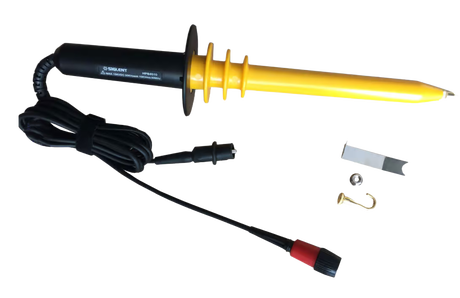
1:1000 high-voltage divider. 10 kV DC, 20 kV peak-to-peak pulse or 7 kV RMS sine, into 100 MΩ ±5% with 3.0 pF of tip capacitance. 2 m cable, 8.8 ns rise time.
Fibre-optic isolated probe, 50X attenuation, ±25 V differential input and ±60 kV of isolation. CMRR 160 dB at DC–10 MHz. Mains adapter or internal 7.4 V battery.
The 1 GHz member of the same family — identical isolation and rejection, twice the bandwidth, for wide-bandgap gate drives where the edge itself is the measurement.
Specifications side by side
Every model in this family, on one row each.
| Model | Bandwidth | Ratio | Input range | Reference | Isolation / rejection | Rise time |
|---|---|---|---|---|---|---|
| HPB4010 | DC–40 MHz | 1:1000 | 10 kV DC / 20 kV p-p / 7 kV RMS | 100 MΩ ±5% · 3.0 pF | Earth-referenced | ≤8.8 ns |
| ODP6050B | 500 MHz | 50X | ±25 V differential (DC + peak AC) | Optically isolated | ±60 kV isolation · CMRR 160 dB | — |
| ODP6100B | 1 GHz | 50X | ±25 V differential (DC + peak AC) | Optically isolated | ±60 kV isolation · CMRR 160 dB | — |
What these probes are for
Gate drive on a floating switch
The high-side gate of a half-bridge swings the whole bus voltage in nanoseconds. Optical isolation rejects that common-mode step so the gate waveform itself stays readable.
SiC and GaN switching
Wide-bandgap devices switch fast enough that the measurement path becomes the problem. 1 GHz and 160 dB of rejection keep the artefact out of the result.
Ignition and insulation testing
The HPB4010's 1:1000 division and 100 MΩ input read kilovolt waveforms without loading the circuit or endangering the oscilloscope input.
Anywhere a ground clip is dangerous
If connecting an earthed probe would short the circuit or energise the instrument chassis, these are the probes that make the measurement possible at all.
Questions we are asked
What is the difference between a differential probe and an optically isolated probe?
A differential probe measures the difference between two points but is still galvanically connected to the oscilloscope, so its common-mode rejection falls away as frequency rises. An optically isolated probe converts the signal to light, so there is no conductive path at all — the rejection stays high into the megahertz and the isolation is rated in tens of kilovolts.
Is the HPB4010 an isolated probe?
No. It is an earth-referenced 1:1000 divider — it measures a high voltage with respect to earth. For a high voltage that is floating, use a differential probe such as the DPB5700A, or an ODP6000B for full isolation.
Can I measure a 400 V DC bus with an ODP6000B?
Not directly — the differential input range is ±25 V. The ±60 kV figure is the isolation between the probe and the oscilloscope, not the measurable voltage. These probes are for small signals sitting on top of a large common-mode voltage, such as a gate drive. To read the bus itself, use a differential high-voltage probe.
How is the ODP6000B powered?
From a DC 5 V adapter, or an internal 7.4 V battery when a mains connection would compromise the isolation you are trying to achieve.
Do these probes need a SAPBus oscilloscope?
No. The HPB4010 and the ODP6000B series both present an ordinary output to the oscilloscope input, so they work with any oscilloscope of adequate bandwidth.
Not sure which one fits your measurement?
Tell us the instrument, the signal and what you are trying to see. We are the official Siglent distributor for the EU and we will point you at the right part — including when the right answer is a probe from another family, or nothing at all.