

Siglent CPL5100 AC/DC Current Probe 100 A, DC–600 kHz
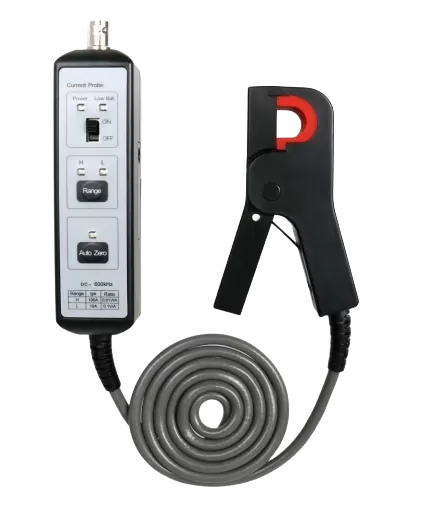
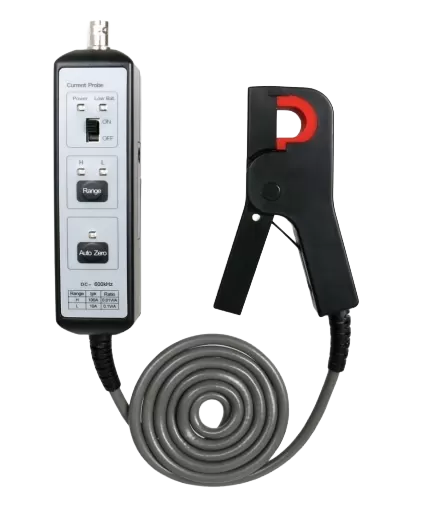
Siglent CPL5100 AC/DC current probe: 100 A peak, DC–600 kHz, 0.1 and 0.01 V/A ranges, auto-zero, battery powered. Fits any oscilloscope.
100 A AC/DC current probe, DC–600 kHz
The CPL5100 is a battery-powered AC/DC clamp that reads up to 100 A peak and holds its bandwidth out to 600 kHz — twice the reach of most handheld clamps in this class, with a 583 ns rise time to match. It splits into a slim clamp head on a 1 m lead and a control box that stays in your hand, so the jaws go into a crowded loom while the range and zero buttons stay where you can see them.
Two ranges cover the span: 0.1 V/A from 50 mA to 10 A peak for fine work, and 0.01 V/A from 1 A to 100 A peak when the current is large. A single Auto Zero button degausses the core and nulls the offset before you measure — the step that decides whether a DC current reading can be trusted at all. Standard BNC output, so it works with any oscilloscope, and with a multimeter through a BNC-banana adapter.
What it does well
The things that decide whether a current measurement can be trusted.
600 kHz, not 300
Twice the bandwidth of the usual handheld clamp, with a rise time of ≤583 ns. That covers the switching fundamentals of most low-frequency SMPS designs, not just mains harmonics.
One-touch Auto Zero
Press once and the probe degausses its core and nulls the residual offset. Earth’s field and temperature drift both bias a Hall sensor; without this step every DC reading carries an unknown error.
It tells you when you overrange
A buzzer sounds the moment the measured current exceeds the selected range, so a clipped waveform gets noticed on the bench rather than in the analysis afterwards.
Clamp head on a lead
The jaws sit on a 1 m cable, separate from the control box. You can reach into a harness or a crowded enclosure and still read the range and battery indicators in your other hand.
15 hours on one 9 V cell
Or run it from the supplied DC 12 V adapter on the bench. The indicator turns red below 6.5 V, before gain error creeps into your measurements.
600 V CAT II, 300 V CAT III
Rated for real mains work, with jaws that close over conductors up to 12 mm — comfortably more than most handheld clamps of this size.
Key specifications
- 100 A peak · 70.7 Arms · 200 A peak-to-peak
- DC to 600 kHz (−3 dB), rise time ≤583 ns
- 0.1 V/A (50 mA–10 A pk) and 0.01 V/A (1 A–100 A pk)
- ±3% ±50 mA typical DC precision on the low range
- Auto Zero degauss button · overload buzzer
- Jaws accept conductors up to 12 mm
- 9 V alkaline, 15 h — or the supplied DC 12 V adapter
- 223 g without battery · 1 m clamp lead + 1 m BNC cable
Application examples
Motor drives and inverters
Clamp the supply lead and see the real pulse shape a drive draws, not the averaged figure a clamp meter reports. At 600 kHz the switching detail survives as well as the envelope.
Switch-mode supply work
Follow inductor and switch-node current while a loop settles. The 583 ns rise time resolves edges that a 300 kHz clamp rounds off.
Inrush and start-up surges
100 A of headroom on the high range covers transformer and capacitor-input inrush, which routinely reaches ten times the steady-state current for a few milliseconds.
Battery, PV and DC-bus current
True DC response makes charge and discharge current directly readable, where an AC-only clamp shows nothing at all.
Standby and leakage hunting
The 0.1 V/A range resolves from 50 mA, so a low-power mode can be confirmed without breaking the circuit to insert a meter.
Specifications
| Current ranges | L: 0.1 V/A (50 mA–10 A peak) · H: 0.01 V/A (1 A–100 A peak) |
|---|---|
| Maximum current | 100 A DC · 100 A AC peak · 200 A peak-to-peak · 70.7 Arms |
| Typical DC precision | L: 3% ±50 mA H: 4% ±50 mA (500 mA–40 A peak) · ±15% max (40–100 A peak) |
| Bandwidth | DC to 600 kHz (−3 dB) |
| Rise time | ≤583 ns |
| Phase shift (DC–65 Hz) | <1.5° on L range · <1° on H range |
| Operating voltage (RMS) | 600 V CAT I · 600 V CAT II · 300 V CAT III |
| Maximum conductor diameter | 12 mm |
| Output | BNC, via the supplied 1 m CK-310 cable |
| Power | 9 V alkaline battery (15 h typical) or DC 12 V / 1.2 A adapter |
| Low-battery indication | Indicator turns red below 6.5 V |
| Overload indication | Buzzer sounds when the selected range is exceeded |
| Clamp dimensions | 100 × 20 × 60 mm · output box 137 × 33 × 35 mm |
| Cable lengths | 1 m clamp-to-box · 1 m BNC output cable |
| Weight | 223 g without battery |
| Operating temperature | 0 °C to +50 °C · storage −20 °C to +80 °C |
| Humidity | 95% RH up to 40 °C · 45% RH from 40 °C to 50 °C |
| Pollution degree | 2 |
Taken from the official Siglent instruction manual. Errors and omissions excepted; specifications may change without notice.
In the box
- Current probe
- 9 V alkaline battery
- DC 12 V / 1.2 A adapter (CK-612)
- BNC output cable, 1 m (CK-310)
- Tool box
- Instruction manual
- Warranty card
Not sure this is the right probe?
Tell us the current you expect, the frequency it moves at, which oscilloscope you own and whether there is DC in the measurement. We will tell you which probe fits — including when a cheaper one covers it.