

Siglent SCP5500 Active Current Probe 750 A, DC–2 MHz
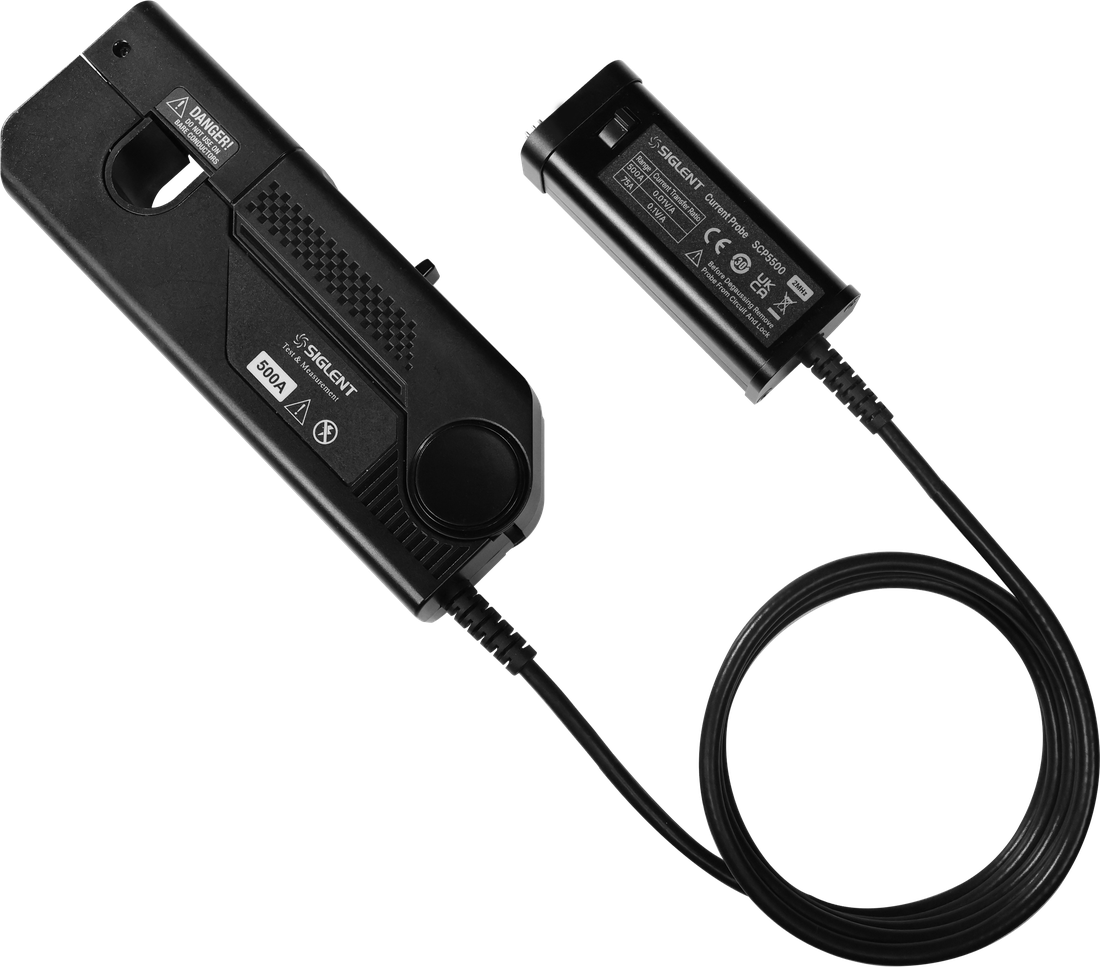
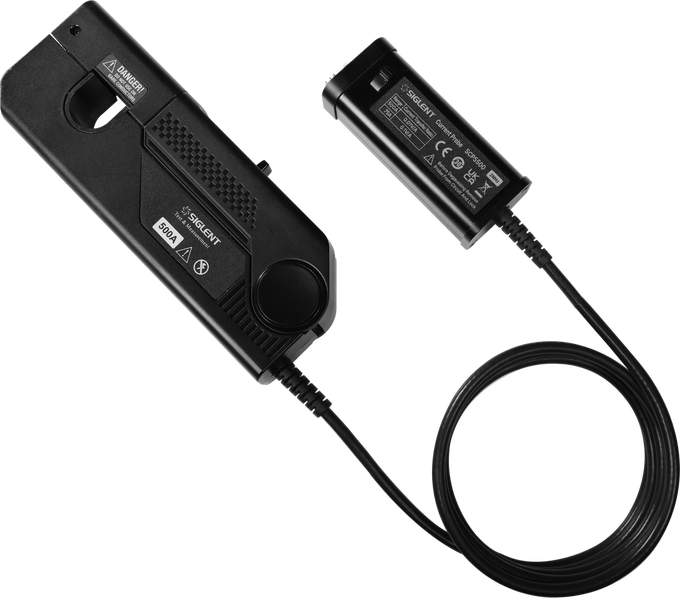
Siglent SCP5500 active current probe: DC–2 MHz, 500 Arms, 750 A peak, 20 mm jaw, ±1% accuracy, SAPBUS powered. For traction and industrial drives.
750 A active current probe, DC–2 MHz
The SCP5500 is an active split-core current probe that takes its power straight from the oscilloscope over SAPBUS — no adapter, no battery, no separate mains lead trailing across the bench. Bandwidth runs to 2 MHz with a rise time of ≤175 ns, and accuracy is ±1%. 750 A peak is the largest current Siglent measure with a clamp, and it still holds ±1% accuracy.
Because the scope powers and identifies the probe, it also configures it. Attenuation, rated current and range appear in the channel dialog automatically, and degauss and auto-zero are buttons on screen rather than a fiddle on the probe body. The channel reads directly in amps. A SAPBUS input is required — see compatibility below.
Check your oscilloscope first
The SCP5500 draws its power and its configuration from the scope over SAPBUS, so it needs a SAPBUS input. That means the SDS7000A, SDS6000A, SDS6000L, SDS5000X and SDS3000X HD series. It will not work on an SDS2000X HD or any older model with plain BNC inputs — for those, use a CP4000 or CP6000 series probe with its own supply, or the battery-powered CPL5100. If you are not sure what your scope has, ask us before ordering.
What it does well
The things that decide whether a current measurement can be trusted.
Powered by the oscilloscope
SAPBUS carries power, identification and control down one connector. Nothing to plug into the mains, nothing to warm up separately, and one less thing to forget in the case.
±1% accuracy
Tighter than any handheld clamp, and the reason these probes are used for efficiency and switching-loss work where the number itself has to stand up.
Degauss and auto-zero from the screen
Residual magnetism in the core biases every later reading. Both corrections are triggered from the channel dialog, so they actually get done.
750 A peak
Traction inverters, industrial drives and grid-tied storage — currents where most probes stop being an option at all. Note the trade: 2 MHz, because a core that carries 500 A cannot also be fast.
Over-current warning on screen
Exceed the range and the oscilloscope raises a pop-up rather than quietly clipping — a saturated core distorts the waveform in ways that are easy to misread as a real signal.
Two ranges, switched in software
75 A (10X) and 500 A (100X), selected from the channel dialog or left in automatic.
Key specifications
- Bandwidth DC to 2 MHz (−3 dB), rise time ≤175 ns
- 500 Arms continuous · 750 A peak
- Ranges 75 A (10X) and 500 A (100X)
- Current transfer ratio 0.1 V/A and 0.01 V/A
- Resolution 10 mA and 100 mA
- Accuracy ±1% ±10 mA and ±1% ±100 mA (DC, 45–66 Hz)
- Propagation delay 42 ns (probe) + 7.5 ns (1.5 m BUS cable)
- Jaw accepts conductors up to 20 mm
Application examples
Switching and linear power design
Switch-node and inductor current with the amplitude accuracy to turn a V×I product into a real loss figure. Pair with the DF2001A to null probe-to-probe skew first.
Semiconductor and gate-drive work
Device current during turn-on and turn-off, where the whole energy is in the transition and bandwidth decides whether you see it.
Inverters, motor drives and EV powertrain
Phase current on a drive or a traction inverter, with enough headroom for the peaks and enough bandwidth for the switching detail on top of them.
New energy — PV, storage, charging
True DC response for string and battery current, and the bandwidth to see the converter working on top of the DC level.
Lighting, appliance and industrial control
LED driver current, frequency-conversion appliances and electronic ballast design, all of which combine a DC level with fast switching.
Specifications
| Bandwidth (−3 dB) | DC to 2 MHz |
|---|---|
| Rise time | ≤175 ns |
| Continuous maximum input | 500 Arms |
| Maximum peak current | 750 A |
| Ranges | 75 A (10X) and 500 A (100X) |
| Current transfer ratio | 0.1 V/A and 0.01 V/A |
| Resolution | 10 mA and 100 mA |
| Accuracy (DC, 45–66 Hz) | ±1% ±10 mA and ±1% ±100 mA |
| Propagation delay | 42 ns probe · 7.5 ns for the 1.5 m BUS cable |
| Maximum conductor diameter | 20 mm |
| Clamp dimensions | 174 × 67.5 × 30 mm |
| Weight | 475 g |
| Power | Directly powered by the oscilloscope through the SAPBUS interface |
| Terminal load requirement | ≥100 kΩ — oscilloscope input set to 1 MΩ |
| Voltage of insulated wire | 600 V CAT II · 300 V CAT III |
| Safety | EN 61010-1:2010+A1:2019 · EN 61010-2-032:2019 |
| EMC | EN 61326-1:2013 · EN 61000-3-2:2014 · EN 61000-3-3:2013 |
| Operating environment | 0–40 °C, 80% RH or less · storage −10–50 °C · altitude 2000 m |
Taken from the official Siglent instruction manual. Errors and omissions excepted; specifications may change without notice.
In the box
- Current probe
- Instruction manual
- Test report
Not sure this is the right probe?
Tell us the current you expect, the frequency it moves at, which oscilloscope you own and whether there is DC in the measurement. We will tell you which probe fits — including when a cheaper one covers it.