

Siglent DPB6150D Differential High-Voltage Probe 400 MHz, ±1500 V
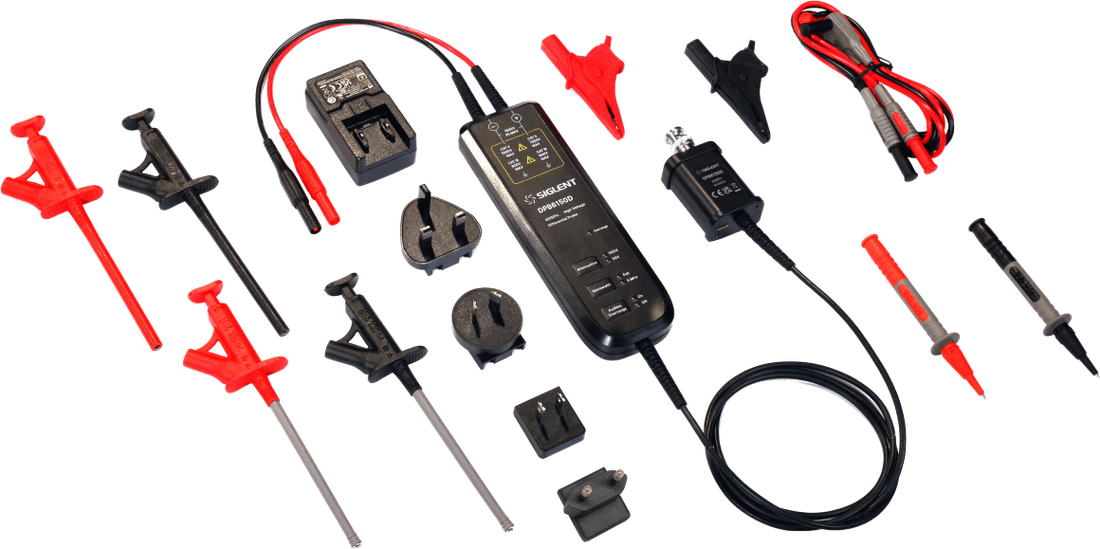
Siglent DPB6150D differential probe: 400 MHz, ±1500 V, 100X/1000X, ±2%, 1000 V CAT III / 600 V CAT IV. USB-C, any oscilloscope.
400 MHz differential high-voltage probe, ±1,500 V
The DPB6150D measures up to ±1,500 V between its two tips with 400 MHz of bandwidth and ±2% DC accuracy. At 400 MHz it is four times the bandwidth of any other differential probe in the range, and it still runs from USB-C into any BNC oscilloscope.
Neither tip is referenced to earth, which is the whole point: you can put it across a floating rail, a high-side gate-source or a mains-referenced switch node without connecting that point to earth through the instrument. It is powered by its own USB-C supply and a plain BNC output. Two attenuation ratios — 100X for the lowest noise and 1000X for the full range — plus a switchable bandwidth limit and an audible over-range alarm.
Works with any oscilloscope
USB-C power and a plain BNC output mean the DPB6150D is not tied to any brand or generation of instrument. If you run a recent Siglent scope and would rather the probe configured itself, the SDP6150D is the SAPBus version — though note it is rated 600 V CAT III where this one is rated 1000 V CAT III.
What it does well
The things that decide whether a high-voltage measurement is both accurate and safe.
No earth reference at the tips
A passive probe’s ground clip is wired to the scope chassis and therefore to mains earth. This one measures the difference between two floating points and sends only that to the oscilloscope, so the circuit never sees an earth connection.
400 MHz bandwidth
Enough to follow the switching edge itself rather than the envelope it sits in — which is where the losses and the ringing actually live.
400 MHz — four times the range
Every other differential probe we sell stops at 100 MHz. If you are chasing gate-drive ringing or a GaN edge with tens of nanoseconds of structure on it, this is the only one that resolves it.
Two ratios, switched on the body
100X keeps noise down on small signals; 1000X takes the full ±1,500 V. Pick the lowest ratio your signal fits inside, because every step up costs resolution.
Audible over-range alarm
A red indicator and a buzzer when the input exceeds the selected range, so a clipped trace gets noticed on the bench. The alarm can be silenced when it becomes a nuisance.
Rated 1000 V CAT III · 600 V CAT IV
The category matters as much as the voltage — it describes the transient energy the installation can deliver, not just the level it sits at.
Key specifications
- Bandwidth 400 MHz (−3 dB)
- Maximum differential input ±1,500 V (DC + AC)
- Attenuation 100X and 1000X
- ±2% DC accuracy
- Maximum measurable: ±150 V at 100X, ±1,500 V at 1000X
- 1000 V CAT III · 600 V CAT IV
- Switchable bandwidth limit
- USB-C powered — any BNC oscilloscope
Application examples
Half-bridge and gate-drive measurement
High-side gate-source voltage on a bridge is floating by definition. This is the measurement that destroys probes and channels when it is attempted with a passive probe and a ground clip.
SiC and GaN converter development
Fast wide-bandgap edges with several hundred volts of swing. Bandwidth decides whether you see the real overshoot and ringing or a rounded approximation of them.
Motor drives and inverters
Phase-to-phase and DC-link voltage on a drive, where nothing in the measurement is at earth potential and the common-mode swing is large.
Mains and power-line work
Directly across a live conductor, safely, with the CAT rating matched to where you are probing.
Power supply design and verification
Switch-node voltage, snubber behaviour and rectifier stress — the measurements that decide component ratings and efficiency.
Specifications
| Bandwidth (−3 dB) | 400 MHz |
|---|---|
| Maximum input differential voltage | ±1,500 V (DC + AC) |
| Attenuation ratios | 100X and 1000X |
| Maximum measurable voltage | ±150 V at 100X · ±1,500 V at 1000X |
| DC accuracy | ±2% |
| Rated voltage to earth | 1000 V CAT III · 600 V CAT IV |
| Bandwidth limit | Switchable, full or limited |
| Over-range indication | Red indicator plus audible alarm (can be silenced) |
| Oscilloscope connection | BNC — any oscilloscope, any brand |
| Power | USB-C adapter (supplied, with international plug adapters) |
Specifications as published by SIGLENT. Errors and omissions excepted; specifications may change without notice. Differential voltage is measured between the two tips; the rated voltage to earth is how far the pair may float. Both limits apply at the same time.
In the box
- Differential probe
- USB-C power adapter with international plug adapters
- Test lead set (red and black)
- Alligator clips
- Hook clips
- Probe tips
- Instruction manual
Tell us where you are probing
The voltage between the two points, how far they float above earth, how fast the signal moves and which oscilloscope you own. Those four answers pick the probe — and we will say plainly when a cheaper one covers it.