

Siglent SSA5000-DMA digital modulation analysis (software license)
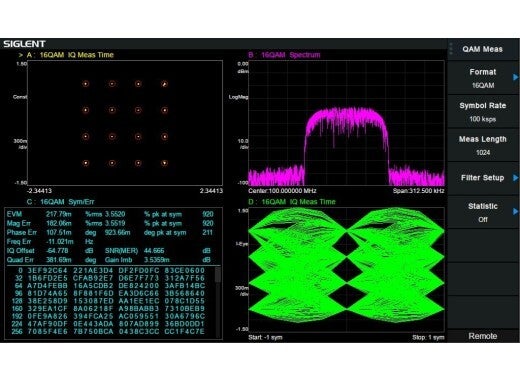
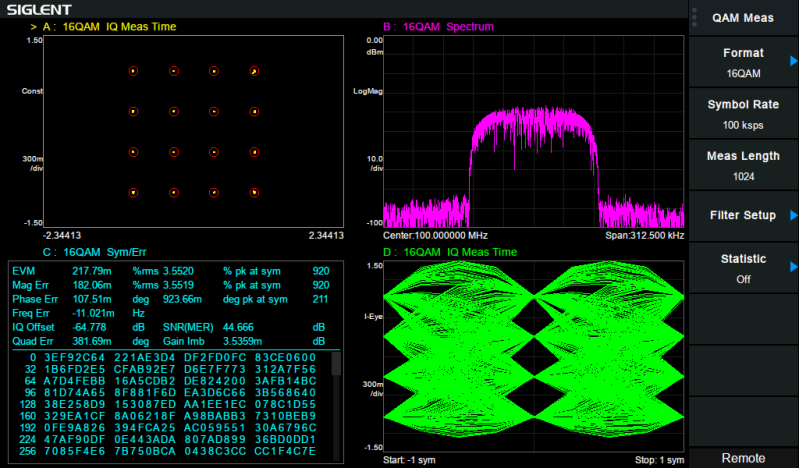
Vector analysis of digitally modulated signals on the SSA5000A: constellation, eye diagram, EVM, magnitude and phase error, frequency error and the symbol table, for ASK, FSK, MSK, PSK, DPSK and QAM up to 256QAM.
SSA5000-DMA — digital modulation analysis
Vector analysis of digitally modulated signals on the SSA5000A: constellation, eye diagram, EVM, magnitude and phase error, frequency error and the symbol table, for ASK, FSK, MSK, PSK, DPSK and QAM up to 256QAM.
Output power and occupied bandwidth can both be right while a link still fails, because the modulation itself is poor. This option demodulates the signal, compares every symbol with its ideal position and shows the difference — as an error vector magnitude, as a constellation that makes the kind of error visible, and as the recovered bits.
What this option does
What it does
Adds the digital modulation analysis measurement: demodulation of single-carrier formats with selectable measurement and reference filters, four trace windows, an error summary, burst and sync-word search, and a bit-error-rate test against a reference pattern.
What you use it for
Transmitter and modulator development, ISM and telemetry links, satellite and microwave backhaul modems, and production checks of modulation quality.
In practice
A QPSK link loses margin after a board revision. The constellation points are stretched along one axis: the summary shows gain imbalance and quadrature error — a problem in the I/Q modulator, not in the power amplifier.
Single-carrier formats. OFDM signals such as WLAN, LTE and 5G NR are not in Siglent’s list. The signal’s occupied bandwidth has to fit the analysis bandwidth — 25 MHz as standard, 40 MHz with SSA5000-B40 — so for symbol rates above about 20 Msps, ask us to confirm your case. You need to know the format, the symbol rate and the filter of the signal to set the demodulator.
From constellation to bits
Constellation and I-Q
Symbol positions against the ideal, with the vector diagram between them.
Eye and trellis
I-eye, Q-eye and trellis diagrams for timing and inter-symbol interference.
EVM
RMS and peak error vector magnitude, magnitude error and phase error.
Modulator errors
IQ offset, quadrature error and gain imbalance; carrier offset and SNR.
Symbol table
The demodulated symbols, and a symbol error chart.
Filters
Nyquist, root Nyquist, Gauss, half-sine or rectangular; alpha 0.01 to 1, BT 0.01 to 10.
Burst and sync search
Find bursts by power, or align on a sync word, before analysing.
Bit error test
Compare the demodulated bits with a stored reference pattern.
Specification
From the SSA5000A data sheet (EN02A) and user manual.
| SSA5083A | SSA5085A | |
|---|---|---|
| Frequency range | 2 MHz to 13.6 GHz | 2 MHz to 26.5 GHz |
| Carrier power range | −30 to +20 dBm (nominal), accuracy ±2 dB (nominal) | |
| ASK | 2ASK | |
| FSK | 2FSK, 4FSK, 8FSK, 16FSK | |
| MSK | GMSK | |
| PSK | BPSK, QPSK, OQPSK, 8PSK | |
| DPSK | DBPSK, DQPSK, D8PSK, π/4-DQPSK, π/8-D8PSK | |
| QAM | 16, 32, 64, 128, 256 | |
| Symbol rate | 1 ksps to 32 Msps; symbol rate × points per symbol ≤ 150 Msps | |
| Measurement length | 16 to 4096 symbols | |
| Points per symbol | 4, 6, 8, 10, 12, 14, 16 | |
| Measurement and reference filter | Nyquist, root Nyquist, Gauss, half-sine, rectangular · length 2 to 128 · alpha 0.01 to 1, BT 0.01 to 10 | |
| Trace data | IQ measured and reference (time, spectrum), time, spectrum, IQ magnitude error, IQ phase error, symbol error chart, error vector (time, spectrum) | |
| Trace formats | Log and linear magnitude, real, imaginary, I-Q, constellation, I-eye, Q-eye, wrapped and unwrapped phase, trellis eye | |
| Results, PSK / DPSK / MSK / QAM | EVM (RMS, peak), magnitude error, phase error, IQ offset, carrier offset, SNR, quadrature error, gain imbalance (not for MSK) | |
| Results, ASK / FSK | ASK error, ASK depth, carrier offset · FSK error, magnitude error, FSK deviation, carrier offset | |
| Burst | Burst power sync, BERT | |
Compatibility and activation
Works on both models; the frequency range follows the model.
Supplied as a licence key issued against the analyser’s serial number — nothing to fit and nothing to return. Enter it under System → System → Load Option, or load the licence file from internal memory or a USB stick; the option is active after a restart.
Questions about SSA5000-DMA
Which modulation formats are supported?
2ASK; 2, 4, 8 and 16FSK; GMSK; BPSK, QPSK, OQPSK and 8PSK; DBPSK, DQPSK, D8PSK, π/4-DQPSK and π/8-D8PSK; and 16, 32, 64, 128 and 256QAM.
Can it analyse WLAN, LTE or 5G signals?
No. Those are OFDM signals and need standard-specific analysis. This option is for single-carrier formats.
What is the highest symbol rate?
The data sheet gives 1 ksps to 32 Msps, with symbol rate times points per symbol up to 150 Msps. The signal must also fit the analysis bandwidth, so ask us about rates above about 20 Msps.
What does EVM tell me that power does not?
How far each symbol lands from where it should be. Phase noise, compression, I/Q imbalance and filtering errors all raise EVM while the power reading stays the same.
Is a Bluetooth measurement part of it?
No. Bluetooth has its own option, SSA5000-BT, with the measurements of the Bluetooth test specifications.
How is the licence delivered?
Supplied as a licence key issued against the analyser’s serial number — nothing to fit and nothing to return. Enter it under System → System → Load Option, or load the licence file from internal memory or a USB stick; the option is active after a restart. Add the analyser’s serial number to your order, or send it to us afterwards.
Can I return a licence?
Software licences and activation keys are delivered electronically and are excluded from the 14-day EU return right once the key has been issued. If you are unsure, ask us first.
Planning an SSA5000A measurement?
Tell us the signal, the frequency range and what you need to measure. We will confirm the model and the options you need before you order.