

Siglent ANT-DA2 Directional Antenna 8 GHz to 26.5 GHz with Amplifier Handle
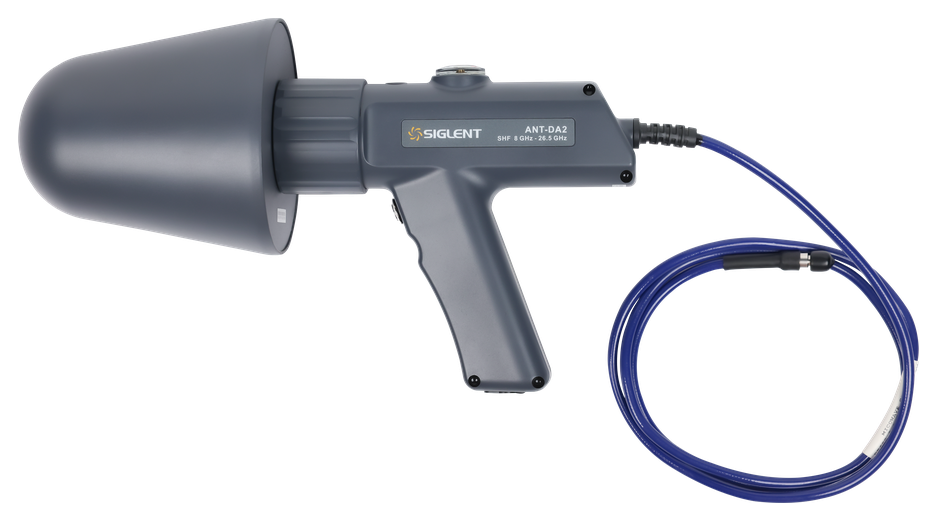
Siglent ANT-DA2: handheld directional antenna 8 GHz to 26.5 GHz with built-in 10 dB amplifier handle and 2.92 mm connector, for the SHA863A, SHA864A and SHA865A.
ANT-DA2 — point at a microwave signal and find where it comes from
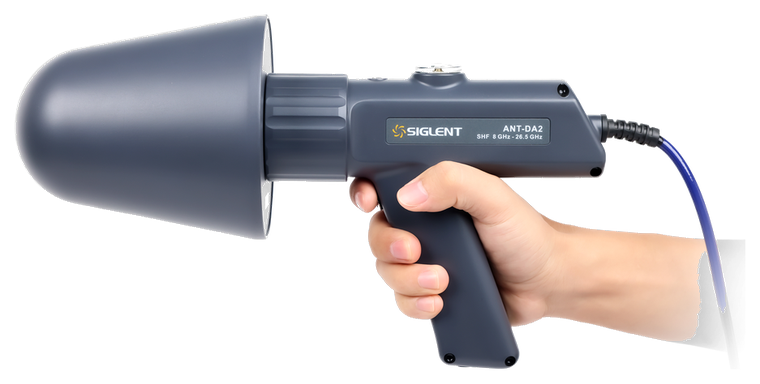
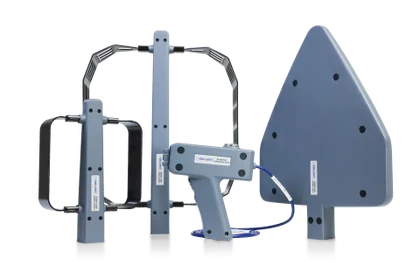
The ANT-DA2 is the handheld directional antenna for the 2.92 mm models of the SHA860A family. One antenna covers 8 GHz to 26.5 GHz and is built together with its handle, which holds a broadband low-noise amplifier (10 dB) and a rechargeable battery. Point it, watch the level on the analyser, and the strongest reading gives the direction of the source.
It is the microwave counterpart of the ANT-DA1 set, which covers 10 MHz to 8 GHz with three plug-in elements. Siglent supplies the ANT-DA2 as a kit in a hard case, with the RF cable attached to the handle.
What you get
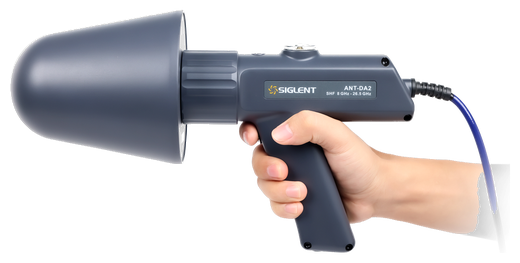
One piece, ready to point
Antenna and amplifier handle are one unit. There is nothing to plug together in the field and no element to choose: the whole 8 GHz to 26.5 GHz range is covered by the one antenna.
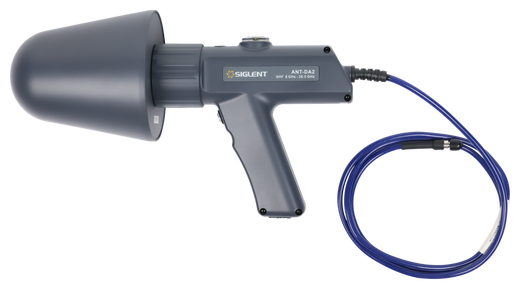
The cable is part of it
A flexible RF cable leaves the handle and ends in a 2.92 mm male connector, the connector family of the SHA863A, SHA864A and SHA865A.
Amplifier and battery in the handle
A broadband low-noise amplifier (10 dB, 8 GHz to 26.5 GHz) lifts weak signals before the cable. It runs from a rechargeable battery in the handle.
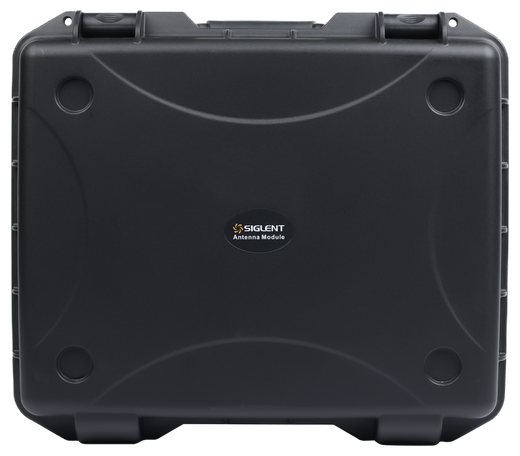
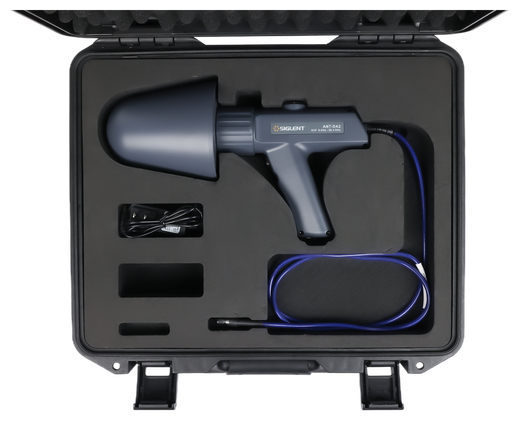
Travels in a hard case
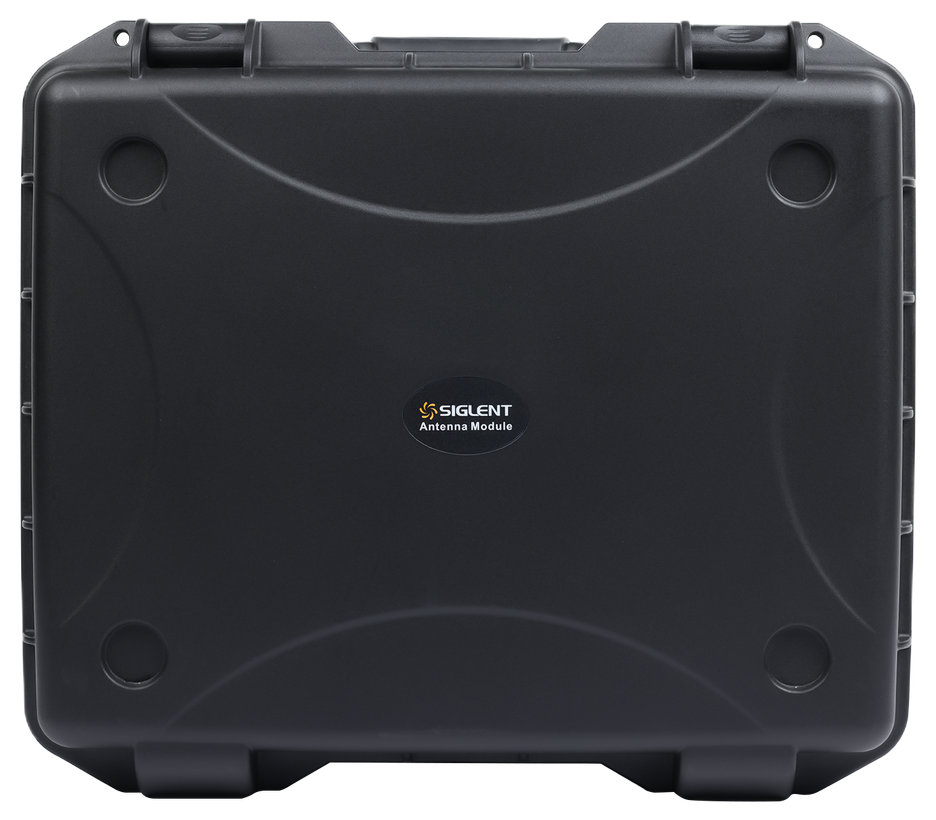
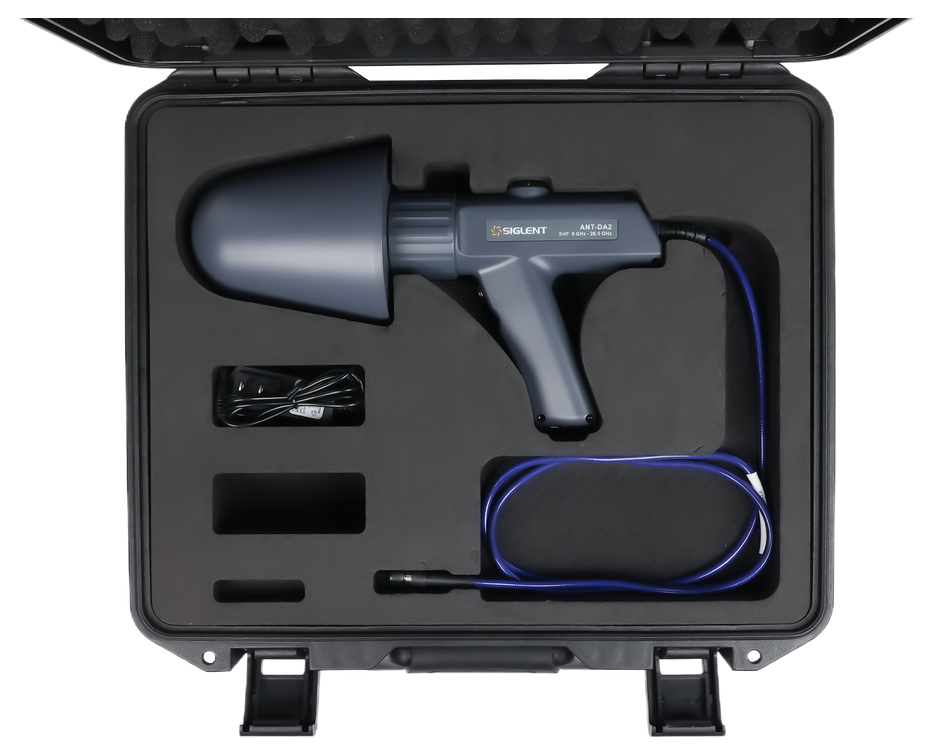
The kit comes in a latched hard case with cut foam for the antenna, its cable and the charger, so it survives the van and the roof.
How it is used
From the source to the trace on the screen: the antenna, its cable, one adaptor and the analyser.
Connect
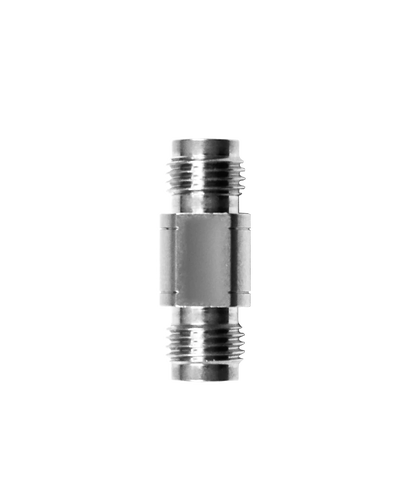
Screw the cable of the handle to the RF input of the analyser through a 2.92 mm female-to-female adaptor. Both ends are 2.92 mm male.
Set the band
Tune the analyser to the frequency range you are looking at, anywhere between 8 GHz and the top of your model (14, 20 or 26.5 GHz).
Sweep
Turn slowly and watch the level. The antenna receives horizontal or vertical polarisation; rotate it a quarter turn about its axis to change.
Take bearings
Note the direction of the strongest reading, move, and repeat. Where the bearings cross is the source.
Finding a source with two bearings
Solid lines: the strongest reading from each position. Dashed lines: other directions tried. Reflections from buildings can give a false peak, so take more than two bearings in built-up areas.
Where it is used
Six situations in which a directional antenna and a handheld analyser answer the question faster than anything else.
Interference hunting
A link drops out or a receiver is blocked. Walk the site with the antenna and the analyser and follow the level to the transmitter that causes it.
Microwave links and satellite terminals
Fixed links at 15, 18 and 23 GHz and satellite terminals in the Ku and K bands lie inside the range. Check that a link is transmitting, on which polarisation and at what level.
Radar and sensors
X-band and K-band radar and 24 GHz sensors: see whether a unit radiates, in which direction and whether a neighbouring one disturbs it.
Radio monitoring and security
Siglent names the security and radio-management services as users: locating transmitters and sources of interference in the field.
EMC and field-strength scanning
A first look for radiated emissions above 8 GHz around a cabinet, a vehicle or an installation, before a formal measurement.
Base stations and installations
Detection and maintenance work on base stations and other installations, another use Siglent lists for the antenna family.
Which antenna kit for which analyser
Who it is for, and what to check first
- Owners of an SHA863A, SHA864A or SHA865A who work in the field
- Radio-monitoring, spectrum-management and security teams
- Installers and maintainers of microwave links and satellite terminals
- EMC engineers who need a first look above 8 GHz on site
- The range starts at 8 GHz. Below that you need the ANT-DA1 set (10 MHz to 8 GHz, N-type).
- Antenna cable and analyser input are both 2.92 mm male: add the 2.92F-2.92F-40A adaptor if you do not have one.
- On an SHA863A the usable range is 8 GHz to 14 GHz, on an SHA864A 8 GHz to 20 GHz. The full 26.5 GHz needs an SHA865A.
- The data sheet gives no antenna-factor table; ask us if you need calibrated field strength.
Specifications
| Type | Handheld directional antenna, antenna and amplifier handle in one unit (DA2, SHF) |
| Frequency range | 8 GHz to 26.5 GHz |
| Amplifier in the handle | Broadband low-noise amplifier, 10 dB, 8 GHz to 26.5 GHz |
| SWR | < 2.5 (2 typical) |
| Polarisation | Horizontal or vertical |
| Field strength | > 10 V/m (as stated in the antenna data sheet) |
| Connector | 2.92 mm male, on the cable attached to the handle |
| Power | Rechargeable battery in the handle |
| Tripod thread | 1/4 inch |
| Net weight | 0.85 kg |
| For | SHA863A, SHA864A and SHA865A |
| In the kit, as shown in Siglent’s kit picture | Antenna with handle and attached cable, charger, hard carry case |
Sources: SHA860A Data Sheet EN02C (ordering information), Siglent Directional Antenna Data Sheet EN03A, the label on the antenna. Errors and omissions excepted.
Compatible analysers
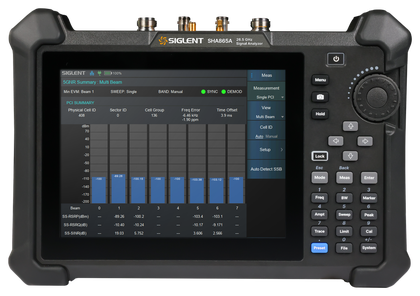
Siglent supplied pictures of the SHA865A only; the three 2.92 mm models share one housing.
Goes with it

Documents
Questions
Which analysers does the ANT-DA2 fit?
Siglent lists it as the directional antenna kit for the SHA863A, SHA864A and SHA865A, the three SHA860A models with 2.92 mm connectors. Its range of 8 GHz to 26.5 GHz matches the upper part of their span; on an SHA863A you use it to 14 GHz and on an SHA864A to 20 GHz.
Do I need anything else to connect it?
Plan a 2.92 mm female-to-female adaptor. The cable from the handle ends in a 2.92 mm male connector and the RF input of the analysers is 2.92 mm male as well, so the 2.92F-2.92F-40A adaptor goes between them.
What about signals below 8 GHz?
That is the range of the ANT-DA1 set: three elements for 10 MHz to 8 GHz with an amplifier handle. It has N-type connectors, so on a 2.92 mm analyser it needs an N to 2.92 mm adaptor or cable.
Can I measure field strength with it?
It shows where a signal comes from and how its level changes. Siglent’s data sheet gives a typical gain chart for the antenna family but no antenna-factor table for the ANT-DA2, so for calibrated field-strength figures ask us before you order.
How is the handle powered?
By a rechargeable battery in the handle, which also holds the broadband low-noise amplifier (10 dB). Siglent’s kit picture shows a charger in the case.
A directional antenna for your SHA863A, SHA864A or SHA865A
Tell us which analyser you have and what you want to find. We check the frequency range, the adaptor and the cables with you.