

Siglent SDS2000HD-1553B MIL-STD-1553B Trigger & Decode Licence for SDS2000X HD Oscilloscopes

Siglent SDS2000HD-1553B: MIL-STD-1553B trigger and decode key for SDS2000X HD oscilloscopes. Trigger on transfer, word, error and timing.
SDS2000HD-1553B — MIL-STD-1553B trigger and decode for the SDS2000X HD
A software key that lets the SDS2000X HD trigger on and decode MIL-STD-1553B, the data bus of military and aerospace avionics: command, status and data words are read out under the waveform and in a table.
MIL-STD-1553B is a 1 Mbit/s, Manchester-coded, transformer-coupled bus. Its signal integrity and its protocol are closely linked: a stub that is too long or a coupler that is failing shows up first as distorted words and only later as protocol errors. An instrument that shows both the waveform and the decoded word is the natural tool for it.
With this key the oscilloscope triggers on a transfer, on a word, on an error or on a timing condition, and decodes what it captured. The bus is read from an analogue channel, at 12-bit resolution, so amplitude, zero-crossing distortion and the decoded content are seen in one acquisition.
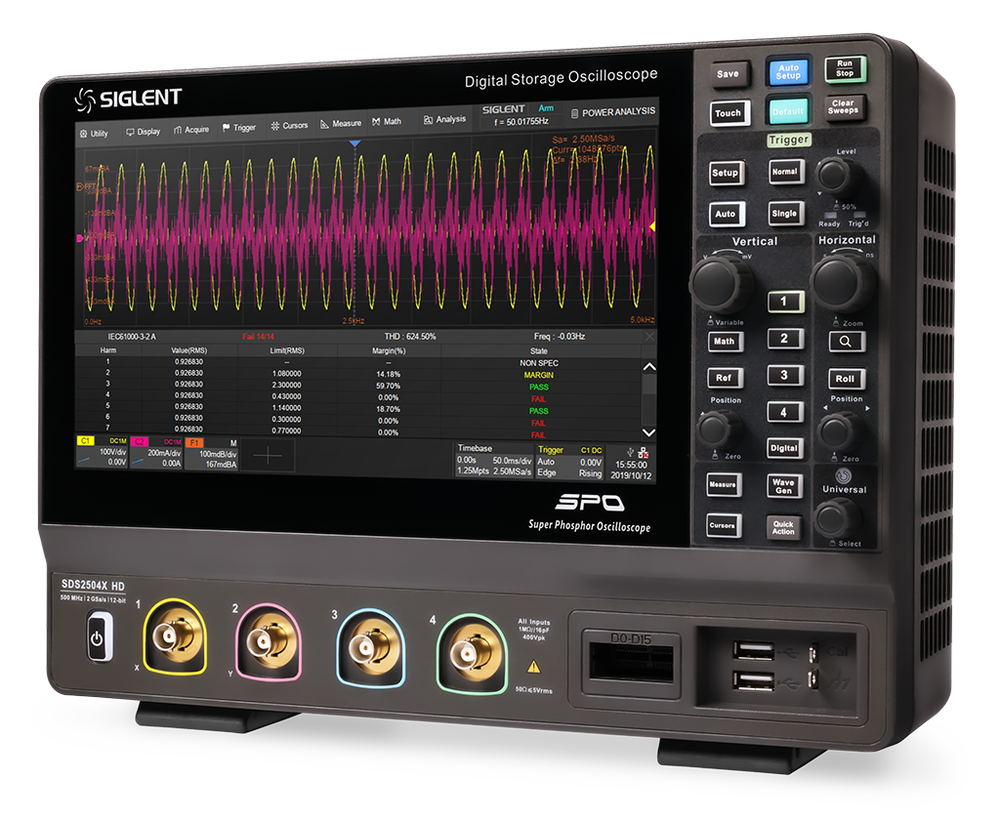
What the key adds
Trigger on transfer, word, error or timing
Stop on the exchange you want, or on the one that violates the standard.
Decoded words
Command, status and data words annotated under the waveform and listed in a table.
Signal and protocol together
The Manchester waveform at 12 bits, with its decode on the same time axis.
For the bench, not just the rack
Avionics bus analysis on a general-purpose oscilloscope of this price class.
Which oscilloscope it is for
Both models of the SDS2000X HD series, and an SDS2104X HD you already own. Keys for other Siglent series have their own order codes and are not interchangeable.
MIL-STD-1553B is a differential, transformer-coupled bus and the decoder takes one analogue channel as its source. Measure across the pair with a differential probe; a single-ended probe on one wire sees half the signal against a ground the bus does not share. Not sure which probe? Ask us.
Specification
| Applies to | SDS2204X HD, SDS2354X HD |
| Function | MIL-STD-1553B trigger and decode |
| Source | C1–C4 (analogue channels) |
| Trigger conditions | Transfer · Word · Error · Timing |
| Decoders at the same time | 2 |
| Decoded list | 1 to 7 lines on screen, with time stamp per entry |
| Delivery | Licence key for the instrument’s serial number |
From the SDS2000X HD data sheet EN02B. I²C, SPI, UART, CAN and LIN trigger and decode are standard on the series; all other protocols are listed on the licences page.
How it is delivered
1 · Send us the serial number
A software key is generated for one instrument. Add the serial number to the order, or mail it afterwards.
2 · Receive the key
The licence key is delivered by e-mail — nothing is shipped and nothing leaves your bench.
3 · Enter it on the oscilloscope
Enter the key in the options menu; the decoder appears in the list of protocols and stays with that unit.
Questions about the SDS2000HD-1553B
Can the oscilloscope trigger on MIL-STD-1553B?
Yes: on a transfer, on a word, on an error and on a timing condition.
Does it work on the digital channels?
No. The source is an analogue channel, C1 to C4; the bus is a bipolar, transformer-coupled signal.
Which bandwidth do I need?
Either model. The bus runs at 1 Mbit/s; what matters here is the 12-bit resolution on the waveform.
What about ARINC 429?
That is a separate key, SDS2000HD-ARINC, which decodes ARINC 429 but does not trigger on it.
Can I decode two buses at once?
Yes. Two decoders run at the same time.
What do you need from me?
The serial number of the oscilloscope. The key is generated for that instrument only.
Decoding MIL-STD-1553B on a new oscilloscope?
Tell us the bus, the bit rate and what else is on the bench. We quote the SDS2000X HD with the keys and probes as one set.