

Siglent SDS2000HD-SENT SENT Trigger & Decode Licence for SDS2000X HD Oscilloscopes

Siglent SDS2000HD-SENT: SENT (SAE J2716) trigger and decode key for SDS2000X HD oscilloscopes. Fast and slow channel, trigger on start and errors.
SDS2000HD-SENT — SENT trigger and decode for the SDS2000X HD
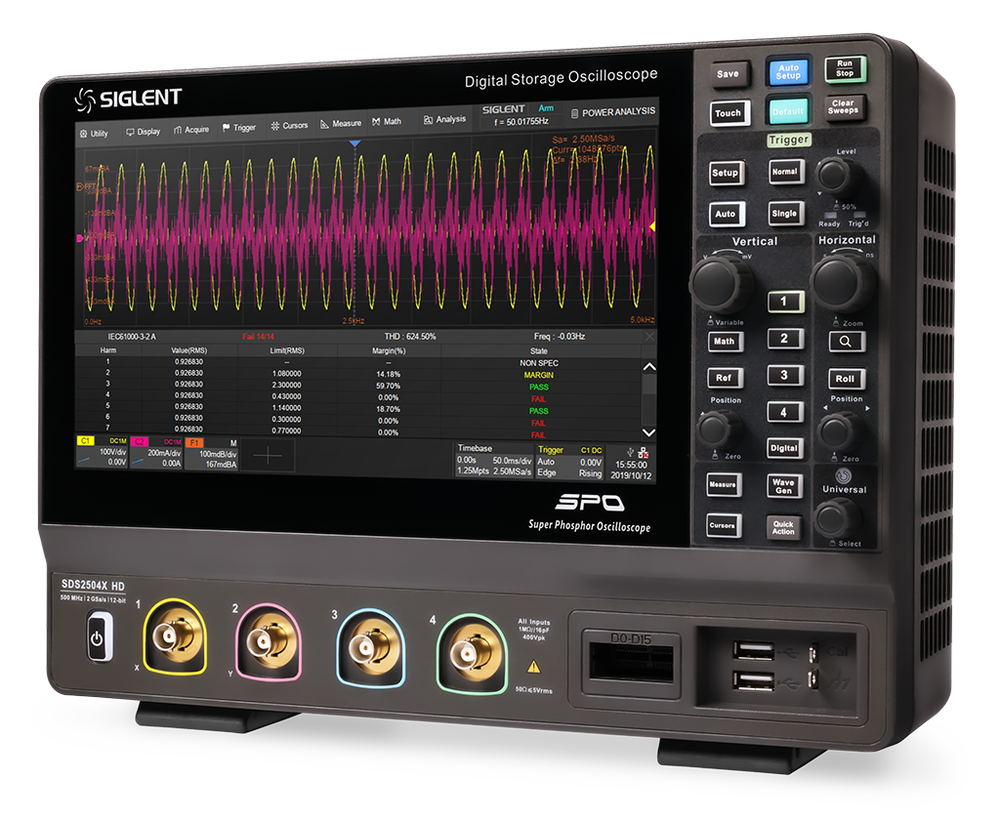
A software key that lets the SDS2000X HD trigger on and decode SENT, the one-wire protocol of automotive sensors: fast and slow channel are read out under the waveform and in a table.
SENT (SAE J2716) sends sensor data as a train of pulses in which the time between falling edges carries the value. There is no clock and no level to read: a throttle position or a pressure is the length of a pulse, counted in ticks. That makes SENT cheap to build and nearly impossible to read by eye on a plain oscilloscope.
With this key the oscilloscope measures the pulses, converts them to nibbles and shows the fast-channel data and the slow-channel messages. It can trigger on the start of a message, on the slow channel, on the fast channel or on an error — so a sensor that glitches once an hour is caught with the signal that caused it.
What the key adds
Trigger on start, slow channel, fast channel or error
Stop on the message you want, or on the one that is wrong.
Decoded messages
Annotated under the waveform and listed in a table with a time stamp per entry.
Timing you can trust
The data is in the edge timing; the oscilloscope measures it at up to 2 GSa/s.
Analogue or digital source
Any of C1–C4, or D0–D15 with the SPL2016 logic probe.
Which oscilloscope it is for
Both models of the SDS2000X HD series, and an SDS2104X HD you already own. Keys for other Siglent series have their own order codes and are not interchangeable.
A SENT line carries a fast channel with the measured value in every message and a slow channel that is spread over many messages (sensor identity, diagnostics, temperature). The decoder shows both; pick the trigger that matches the one you are investigating.
Specification
| Applies to | SDS2204X HD, SDS2354X HD |
| Function | SENT trigger and decode |
| Source | C1–C4 or D0–D15 |
| Trigger conditions | Start · Slow channel · Fast channel · Error |
| Decoders at the same time | 2 |
| Decoded list | 1 to 7 lines on screen, with time stamp per entry |
| Delivery | Licence key for the instrument’s serial number |
From the SDS2000X HD data sheet EN02B. I²C, SPI, UART, CAN and LIN trigger and decode are standard on the series; all other protocols are listed on the licences page.
How it is delivered
1 · Send us the serial number
A software key is generated for one instrument. Add the serial number to the order, or mail it afterwards.
2 · Receive the key
The licence key is delivered by e-mail — nothing is shipped and nothing leaves your bench.
3 · Enter it on the oscilloscope
Enter the key in the options menu; the decoder appears in the list of protocols and stays with that unit.
Questions about the SDS2000HD-SENT
Can the oscilloscope trigger on SENT?
Yes: on the start of a message, on the slow channel, on the fast channel and on errors.
Does it show the slow channel as well?
Yes. Slow-channel messages are decoded alongside the fast-channel data.
Which bandwidth do I need?
Either model. SENT pulses are tens of microseconds long; what matters is timing accuracy and memory, both of which the series has in plenty.
Can I use the digital channels?
Yes. D0–D15 of the SPL2016 logic probe are valid sources, at 500 MSa/s, which leaves the four analogue channels free for the signals around the bus.
Can I decode SENT next to CAN or LIN?
Yes. Two decoders run at once, and CAN and LIN are standard on the series.
What do you need from me?
The serial number of the oscilloscope. The key is generated for that instrument only.
Decoding SENT on a new oscilloscope?
Tell us the bus, the bit rate and what else is on the bench. We quote the SDS2000X HD with the keys and probes as one set.