

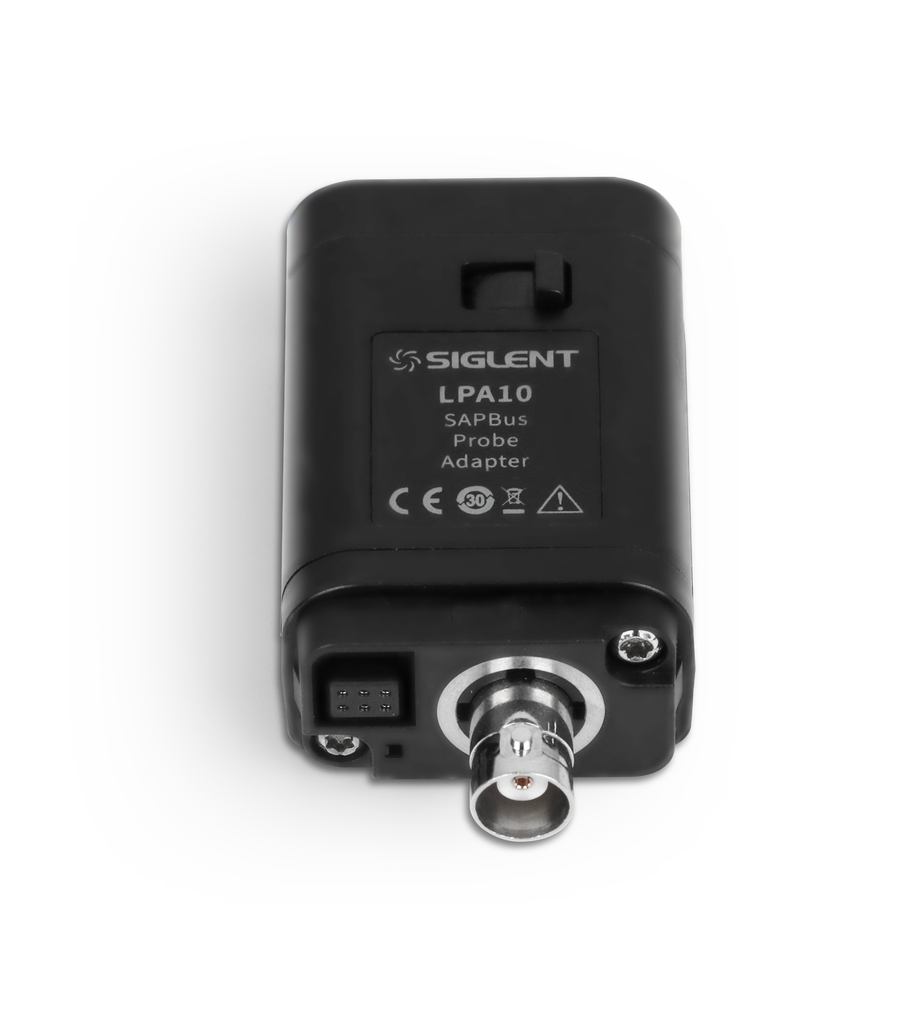
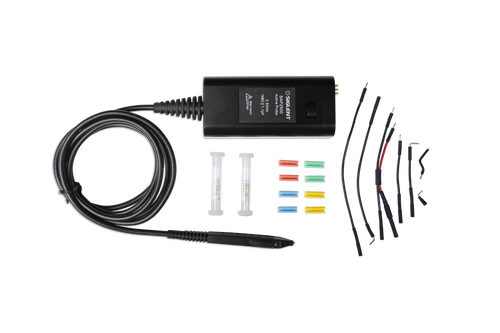
Siglent LPA10 Active Probe Adapter — LeCroy ProBus to SAPBus, 4 GHz


Runs Teledyne LeCroy ProBus active probes (ZD1000, ZD1500, AP033, AP034, CP030) on a Siglent SDS5000X or SDS6000A. 4 GHz, ±12 V supplied by the oscilloscope, probe detected automatically.
Siglent has discontinued the LPA10. Its successor is the TPA10 active probe adapter, which takes Tektronix TekProbe Level II probes. Owners of LeCroy ProBus probes: this page stays online as a reference, and we will gladly tell you what is still obtainable and what the native Siglent alternative costs.
LPA10 — LeCroy active probes on a Siglent oscilloscope
The LPA10 put a Teledyne LeCroy ProBus probe on the SAPBus input of a Siglent SDS5000X or SDS6000A. The oscilloscope powers the adapter, the adapter powers the probe, and the probe is recognised and scaled automatically.
Active probes carry their amplifier in the head, so they need supply rails and a way to tell the oscilloscope what they are. Every manufacturer does that over its own connector — ProBus at LeCroy, TekProbe at Tektronix, SAPBus at Siglent — which is why a probe set normally dies with the oscilloscope it was bought for. The LPA10 was the bridge for the LeCroy side: it generates the ±12 V a ProBus probe expects and passes its identification through, with no external power supply.
Siglent tested it with five probes — the ZD1000 and ZD1500, the AP033 and AP034, and the CP030 current probe — and specified it to 4 GHz, above any of them. Everything below is kept as it was published, for owners who still run one. For TekProbe probes, the current product is the TPA10.
How it works
Three things happen when a ProBus probe goes on a Siglent oscilloscope through the LPA10 — and none of them needs a setting.
Plug in
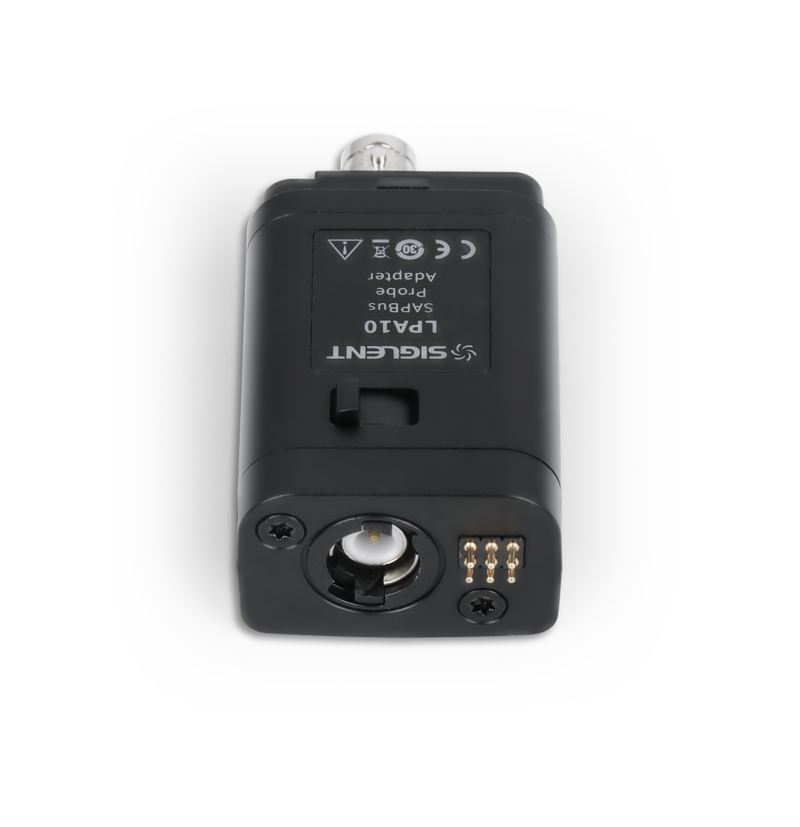
The LPA10 clicks into a SAPBus channel input on the oscilloscope like one of Siglent’s own active probes. The LeCroy probe plugs into the other end of the adapter, ProBus to ProBus.
Powered by the scope
The adapter takes its supply from the SAPBus interface and generates the +12 V and −12 V rails (±2%) that the ProBus probe expects. No mains brick, no extra cable on the bench.
Recognised, scaled, ready
For the five probes Siglent has tested, the oscilloscope detects the probe through the adapter and sets the attenuation factor itself, so the readout is in the right volts or amps from the first trace.
Why a plain BNC adapter would not do
A passive probe is a divider and a cable; any BNC input will take it. An active probe is an amplifier that needs ±12 V, a defined load, and a channel that knows whether it is looking at ÷1, ÷10 or ÷100. Without the rails the probe is silent; without the identification every reading is off by the attenuation factor until somebody notices.
The LPA10 supplied both. That is the whole product — and the reason an adapter costs more than a connector and much less than replacing the probes. The TPA10 does the same job for TekProbe probes today.
Tested probes
Siglent’s data sheet lists five Teledyne LeCroy probes and the oscilloscope firmware that added each of them. Everything downloadable today is later than these versions.
| Probe | Type | Key figures (LeCroy) | SDS5000X firmware | SDS6000A firmware |
|---|---|---|---|---|
| ZD1000 Teledyne LeCroy | Differential active probe | 1 GHz · <1.0 pF differential · ±8 V differential, ±10 V common mode | 0.9.3R3 | 1.3.9.0 |
| ZD1500 Teledyne LeCroy | Differential active probe | 1.5 GHz · <1.0 pF differential · ±8 V differential, ±10 V common mode | 0.9.3R3 | 1.3.9.0 |
| AP033 Teledyne LeCroy | Differential active probe | 500 MHz · ÷1 or ÷10 head, ×1 or ×10 amplifier | 0.9.1B2 | 1.3.9.0 |
| AP034 Teledyne LeCroy | Differential active probe | DC–1 GHz · ±400 mV / ±4 V / ±8 V at ÷1 / ÷10 / ÷100 · <0.85 pF between inputs | 0.9.1B2 | 1.3.9.0 |
| CP030 Teledyne LeCroy | AC/DC current probe | 50 MHz · 30 A rms, 50 A peak · Hall + transformer | 0.9.7R2 | 1.4.3.3 |
Firmware versions from Siglent’s LPA10/TPA10 data sheet (“and later”). Probe figures from Teledyne LeCroy’s data sheets and manuals. ProBus probes not in the list have not been tested by Siglent; set their attenuation factor manually.
Oscilloscopes
Two series in the data sheet. Each card links to the series page.
SDS5000X
SDS5034X · SDS5054X · SDS5104X
350 MHz to 1 GHz, 5 GSa/s. Probe support arrived with firmware 0.9.1B2 (AP033/AP034), 0.9.3R3 (ZD1000/ZD1500) and 0.9.7R2 (CP030) — any current firmware is later than all three.
SDS6000A
SDS6054A · SDS6104A · SDS6204A
500 MHz to 2 GHz, 12-bit. Probe support arrived with firmware 1.3.9.0 (AP033/AP034/ZD1000/ZD1500) and 1.4.3.3 (CP030) — any current firmware is later than both.
The SDS3000X HD, SDS5000X HD, SDS6000L and SDS7000A also have SAPBus probe inputs, but the LPA10 data sheet does not name them. We would rather check with Siglent than guess — tell us the model before you order.
When an adapter earns its price
The probe outlives the oscilloscope
A ZD1500 costs several times what an adapter does, and the AP033 has been in service in labs for two decades. When the oscilloscope changes brand, an adapter is what keeps that inventory on the bench rather than on a shelf — today that is the TPA10 for TekProbe probes.
Cross-checking a legacy result
Measure the same node with the probe that produced the original data and with its Siglent equivalent. If the two traces disagree, the difference sits in the probe, not in the instrument — a useful thing to know before arguing about a spec.
A probe with no direct replacement
The CP030’s small jaw and 30 A range, or a differential head with a geometry that fits a particular fixture, may have no one-to-one successor. The adapter keeps them usable on a current 12-bit oscilloscope.
Not the bottleneck
The adapter is specified to 4 GHz. The fastest probe on its list is the 1.5 GHz ZD1500, so the chain is limited by the probe and the oscilloscope, never by the LPA10.
Specification
| Status | End of life — discontinued by Siglent. Successor: the TPA10 active probe adapter (Tektronix TekProbe Level II) |
| Function | Active probe adapter: LeCroy ProBus probe on the probe side, Siglent SAPBus on the oscilloscope side |
| Bandwidth | 4 GHz |
| Power supplied to the probe | +12 V (±2%) and −12 V (±2%), generated from the SAPBus interface — no external supply |
| Probe detection | Automatic for the ZD1000, ZD1500, AP033, AP034 and CP030 with the firmware listed above; the oscilloscope then sets the attenuation factor |
| Other ProBus probes | Not tested by Siglent; set the attenuation factor manually in the channel menu |
| Offset control | The data sheet states the adapters “provide all necessary power and offset control” but gives an offset range only for the TPA10 (±1.2 V); none is specified for the LPA10 |
| Oscilloscopes | SDS5000X and SDS6000A (data sheet). Other SAPBus oscilloscopes: ask us |
| Label | “SIGLENT LPA10 SAPBus Probe Adapter”; CE marked |
From Siglent’s LPA10/TPA10 Active Probe Adapter data sheet (EN01B) and the SIGLENT Probe Data Sheet (EN01D). Siglent publishes no dimensions or weight for the adapter.
Before you decide
Five things worth knowing, because an adapter that almost fits is worse than none.
Discontinued
The LPA10 has reached end of life and is no longer produced. Siglent’s current active probe adapter is the TPA10. If you need a ProBus adapter specifically, ask us — we will tell you honestly what is still obtainable.
ProBus only
The LPA10 took Teledyne LeCroy ProBus probes. The TPA10 takes Tektronix TekProbe Level II probes — a different connector and different supply rails, so it is not a drop-in for LeCroy probes. Siglent’s own SAP probes plug into the SAPBus input directly and need no adapter.
Five probes tested
Siglent’s list is the ZD1000, ZD1500, AP033, AP034 and CP030. Any other ProBus probe is untested: it may work with the attenuation set by hand, but nobody has promised that it does. Tell us the model before you order.
Two oscilloscope series named
The data sheet names the SDS5000X and SDS6000A. The SDS3000X HD, SDS5000X HD, SDS6000L and SDS7000A also have SAPBus inputs, but Siglent has not published LPA10 support for them — ask us and we will check with Siglent.
The chain sets the bandwidth
4 GHz for the adapter means nothing on its own. A ZD1000 on an SDS5034X is a 350 MHz measurement; the slowest of probe, adapter and oscilloscope is what you get.
The successor, and the native probes
The TPA10 is what Siglent sells now for foreign active probes. If you are starting a probe set from scratch rather than carrying one over, the SAP probes plug straight into the SAPBus input.
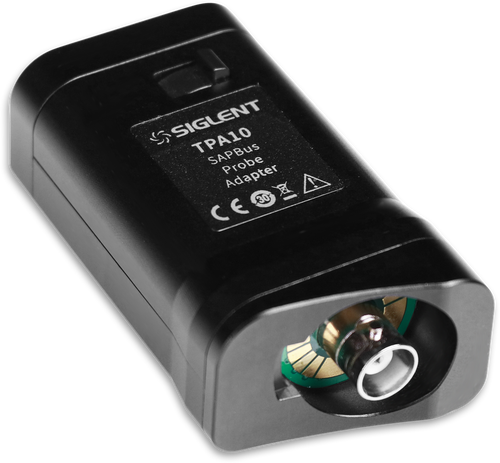
Siglent’s current active probe adapter: Tektronix TekProbe Level II probes, 4 GHz, ±15 V / ±5 V rails, ±1.2 V offset pass-through.
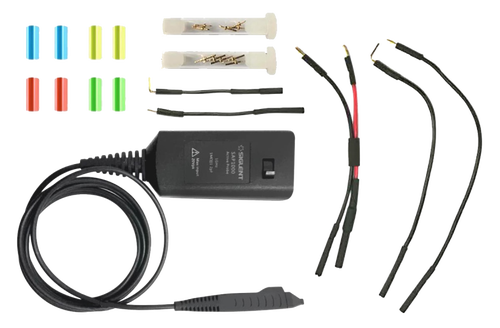
Siglent’s own 1 GHz single-ended active probe, 1.2 pF ‖ 1 MΩ, SAPBus — the native alternative to an AP033/AP034 on a single-ended node.
2.5 GHz single-ended active probe, 1.1 pF ‖ 1 MΩ, SAPBus.
2.5 GHz differential active probe, 1 pF ‖ 200 kΩ, ±4 V — the native counterpart of a ZD1000/ZD1500.
Prices ex VAT. All active probes · Probe adapters
Questions about the LPA10
Is the LPA10 still available?
No. The LPA10 has reached end of life and Siglent has replaced it with the TPA10 active probe adapter. This page stays online as a reference for owners and for anyone deciding what to do with a set of LeCroy ProBus probes.
Can I use the TPA10 for my LeCroy probes instead?
Not directly. Siglent’s data sheet specifies the TPA10 for Tektronix TekProbe Level II probes; the ProBus connector and the ±12 V rails of a LeCroy probe are different. If you own ZD, AP or CP030 probes, tell us which ones and which oscilloscope — we will check what is still obtainable and quote the native SAP alternative.
Which probes did the LPA10 support?
Siglent has tested five Teledyne LeCroy ProBus probes: the ZD1000 and ZD1500 differential probes, the AP033 and AP034 differential probes and the CP030 current probe. Those are detected automatically. Other ProBus probes are untested; they may work with the attenuation factor set manually.
Which oscilloscopes does it work with?
The data sheet names the SDS5000X and SDS6000A series and lists the firmware that added each probe. Any firmware you can download today is later than those versions. Other Siglent oscilloscopes with a SAPBus input are not in the data sheet — ask us and we will check with Siglent before you order.
Does the adapter need its own power supply?
No. It draws power from the oscilloscope’s SAPBus interface and generates the ±12 V that the ProBus probe needs. There is nothing else to plug in.
Will the oscilloscope show the correct scale?
For the five tested probes, yes: the probe is recognised through the adapter and the attenuation factor is set automatically, so voltage probes read in volts and the CP030 in amps. For an untested probe, set the factor in the channel menu and check it against a known signal before trusting an absolute reading.
Can I control the probe’s offset from the oscilloscope?
The data sheet says the adapters provide “all necessary power and offset control”, but it specifies an offset range only for the TPA10. If scope-side offset matters for your measurement, tell us which probe you use and we will confirm with Siglent.
Does the LPA10 limit the bandwidth?
It is specified to 4 GHz, well above the 1.5 GHz of the fastest probe on its list. The measurement bandwidth is set by the probe and the oscilloscope, whichever is lower.
What about TekProbe probes?
Those take the TPA10, Siglent’s current TekProbe Level II adapter, which is in production and in our shop.
Own LeCroy ProBus probes? Tell us which
Send us the probe models and the Siglent oscilloscope they should go on. We will tell you what is still obtainable, and quote the native SAP probe that covers the same measurement.