

Siglent SVA1000X-DTF Measurement license option

Siglent SVA1000X-DTF licence: locate cable and antenna faults by distance in metres, with return loss and VSWR from the same connection.
What the SVA1000X-DTF licence adds
A feeder that is failing rarely announces where. VSWR at the bottom of the run tells you the system is reflecting power; it says nothing about whether the problem is the first connector, a crushed section halfway up, water in a joint, or the antenna itself. Without that, fault-finding becomes a sequence of substitutions — and on a mast, each substitution is a climb.
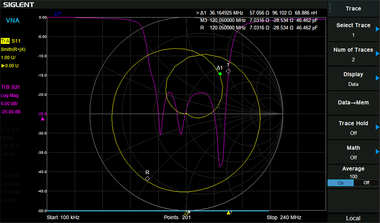
The SVA1000X-DTF licence turns the instrument into a frequency-domain reflectometer. It sweeps the cable through the tracking generator, measures the reflection, transforms it into the time domain and plots return loss against physical distance. You enter the cable type — its velocity factor and loss per metre — and the horizontal axis becomes metres of that cable.
The same connection also gives return loss and VSWR against frequency, so one visit answers both questions that matter: how bad is it, and where is it. It is a software key; the instrument does not leave your bench to gain the capability.
What it puts on the instrument
Reflection against distance
The fault plotted in metres along the cable, not as a number you have to interpret. Markers read off the distance directly.
A built-in cable library
Velocity factor and attenuation for common feeder types, so the distance axis is correct for the cable you actually have — and editable when it is not in the list.
Return loss and VSWR
The frequency-domain view of the same connection, which is what an acceptance report asks for.
Windowing control
Rectangular through to heavier windows, trading distance resolution against sidelobes so two nearby discontinuities can be separated.
A base station reports a VSWR alarm. Measured from the shelter, the run is clean and a strong reflection appears at about 23 m — which is the jumper connector at the top of the mast, not the antenna behind it. That is one climb with the right part already in the bag, instead of replacing the antenna first and finding the fault still there afterwards.
What you need alongside it
The licence is the software half of the job. These are the parts of the measurement it assumes you have.
Which instruments it fits
The licence is keyed to the series, so it runs on every SVA1000X model — each up to its own top frequency. Quote your instrument’s serial number when ordering and the key is issued against it.
| Model | Spectrum range | Tracking generator / VNA | This licence |
|---|---|---|---|
| SVA1015X | 9 kHz – 1.5 GHz | 100 kHz – 1.5 GHz | Supported |
| SVA1032X | 9 kHz – 3.2 GHz | 100 kHz – 3.2 GHz | Supported |
| SVA1075X | 9 kHz – 7.5 GHz | 100 kHz – 7.5 GHz | Supported |
Spectrum analysis, the vector network analyser, the tracking generator and the 20 dB preamplifier are standard on the SVA1000X. Errors & omissions excepted.
Questions we get asked
How accurate is the distance reading?
It is as accurate as the velocity factor you give it. Distance is derived from propagation time, so a velocity factor that is 2 % wrong puts a fault at 20 m about 40 cm out. Take the figure from the cable datasheet rather than from memory, and the reading will put you at the right connector.
What is the maximum distance it can measure?
That is set by the number of sweep points and the frequency span, and in practice by cable loss: the reflection has to travel out and back, so it is attenuated twice. A long lossy run will show near faults clearly and far ones faintly, which is a physical limit rather than an instrument one.
Do I need the tracking generator option as well?
No. The tracking generator is standard on the SVA1000X, which is why distance-to-fault is a licence rather than a hardware upgrade.
Will it find water ingress or only broken connectors?
Both, because both change the impedance. Water in a connector shows as a reflection at that distance in the same way a bad crimp does. What the plot gives you is the position; what it is when you get there is still yours to judge.
Can I add this after buying the instrument?
Yes. It is a software key issued against the serial number — no hardware, no return to the factory, no recalibration.
The other SVA1000X options
All five sit on the same instrument and can be added at any time. See all licences and accessories.
Not sure this is the licence you need?
Send us your serial number and what you are trying to measure. We will confirm which option covers it — and tell you if your instrument already can.