

TekBox TBAS4 6GHz 2W N RF ATTENUATOR SET

TekBox TBAS4: 3, 6, 10 and 20 dB N attenuators, DC to 6 GHz, 2 W, VSWR under 1.2, in a beech-wood box. Protects and levels your Siglent analyser input.
TBAS4 — 3, 6, 10 and 20 dB N attenuators to 6 GHz, in a beech-wood box
Four fixed N-type attenuators, 2 W, VSWR below 1.2 and within ±0.3 dB of nominal from DC to 6 GHz. Singly they are the four values a bench needs most; stacked they give fifteen values from 3 to 39 dB.
On a Siglent bench an attenuator does three jobs. It protects the spectrum analyser input when the level of a signal is not yet known. It sets the level into a device under test from a generator that cannot go low enough on its own. And, as a 6 or 10 dB pad between two ports that do not match well, it stops the mismatch turning into ripple in the measurement — each dB of pad improves the return loss both sides see by two dB.
The attenuators are N-male to N-female and bidirectional, so a pad screws straight onto the N-female input of any Siglent SSA, SVA or SNA and the cable goes on top. The 2 W rating holds from −55 to 40 °C and derates to 1 W at 70 °C.
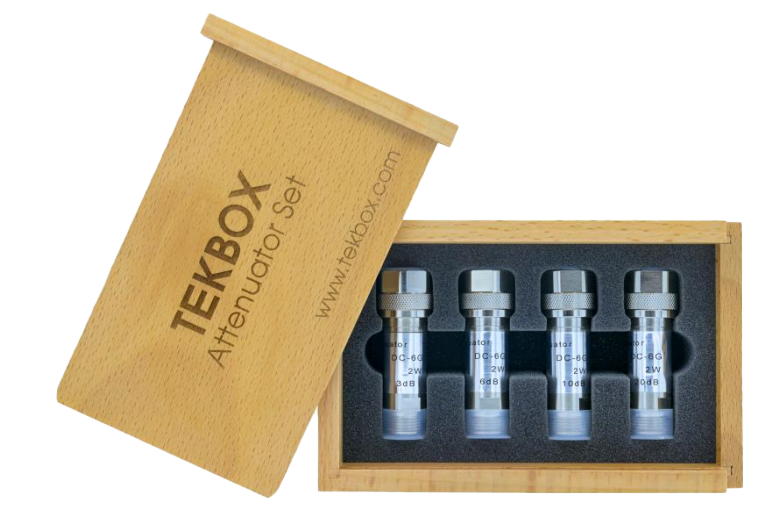
The four attenuators
Each attenuator is marked with its value; every one is N-male on one side and N-female on the other, DC to 6 GHz, 2 W.
| Value | Power ratio | Voltage ratio | What it is for |
|---|---|---|---|
| 3 dB | ½ | 0.71 | A light pad between a source and a load that do not match well; the smallest step when stacking. |
| 6 dB | ¼ | 0.50 | The classic matching pad: 6 dB in the line improves the return loss seen by either side by 12 dB. |
| 10 dB | 1/10 | 0.32 | One decade down: brings a 0 dBm generator to −10 dBm, or an amplifier output back into an analyser’s comfortable range. |
| 20 dB | 1/100 | 0.10 | Two decades: the one to put in front of the analyser input when the level of the signal is unknown. |
Four jobs it does on a Siglent bench
Protect the analyser input
A 20 dB pad in front of the N input turns a +20 dBm surprise into 0 dBm. Set the analyser’s reference level offset to +20 dB and the screen still reads true.
Tame a mismatch
A 6 dB pad between a generator and a filter, or between the TBWA2 amplifier and a long cable, improves the return loss each side sees by 12 dB and flattens the ripple.
Set the level into a DUT
Receiver sensitivity, an LNA at its 1 dB compression point, an ADC front end: a 10 or 20 dB pad on the generator output gets the level where the generator alone cannot.
Fifteen values from four parts
3, 6, 10 and 20 dB stack in every combination: 3 to 39 dB in steps of 3 or 4 dB. The chips below list them.
Stacking the four
Screw two or three together and the values add. The first attenuator in the chain takes the full input power, so the 2 W limit applies to the input of the stack, not to its sum.
Attenuators are resistive: the power they remove becomes heat in the first pad of the chain. Keep the input of the stack at or below 2 W (1 W above 40 °C) whatever the total attenuation. For an amplifier output above 2 W use a power attenuator, not this set.
A pad does not block a DC offset. If the circuit under test carries DC on its RF line, put a DC block in front of the analyser as well — the TBTC1 TEM cell ships with one.
Specification
| Order code | TBAS4 (TekBox) |
| Contents | 4 fixed attenuators: 3 dB, 6 dB, 10 dB, 20 dB |
| Frequency range | DC to 6 GHz |
| VSWR | < 1.2 (all four values) |
| Tolerance | ±0.3 dB (all four values) |
| Power rating | 2 W at −55 to 40 °C; up to 70 °C with 50 % derating |
| Connectors | N-male / N-female, bidirectional |
| Packaging | Beech-wood box, 150 × 95 × 45 mm · 490 g |
| Documentation | Manual with S21 and VSWR plots to 6 GHz for each attenuator |
From the TekBox TBAS4 manual V1.0. Power and voltage ratios are the nominal values for the marked attenuation.
The other TekBox products we stock
Everything from TekBox on siglent.eu, chosen to work with Siglent spectrum analysers. The TekBox category page explains how they fit together.
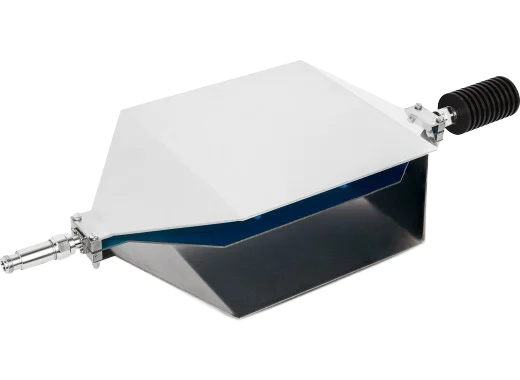
Radiated emissions and immunity on the bench. 50 mm septum, room for a 19 × 13 × 5 cm board, usable to 3 GHz. 25 W termination and DC block included.
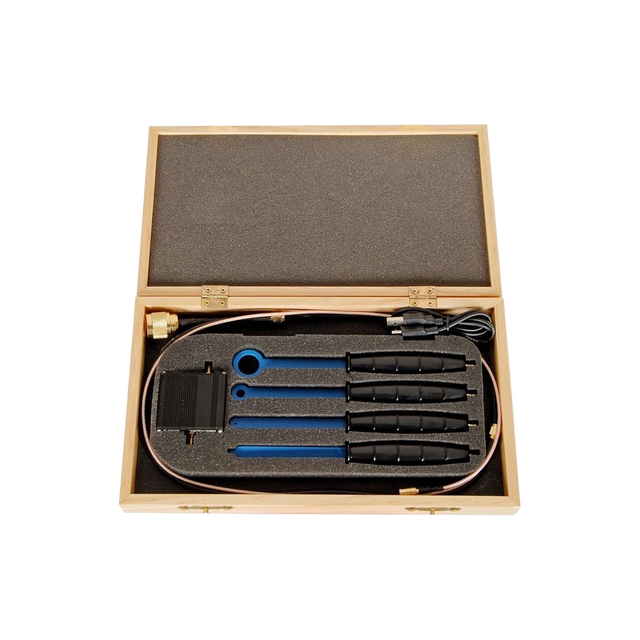
Three H-field loops (20, 10, 5 mm) and an E-field probe, with a 20 dB or 40 dB preamplifier powered from the analyser’s USB port. 2 MHz to 6 GHz.
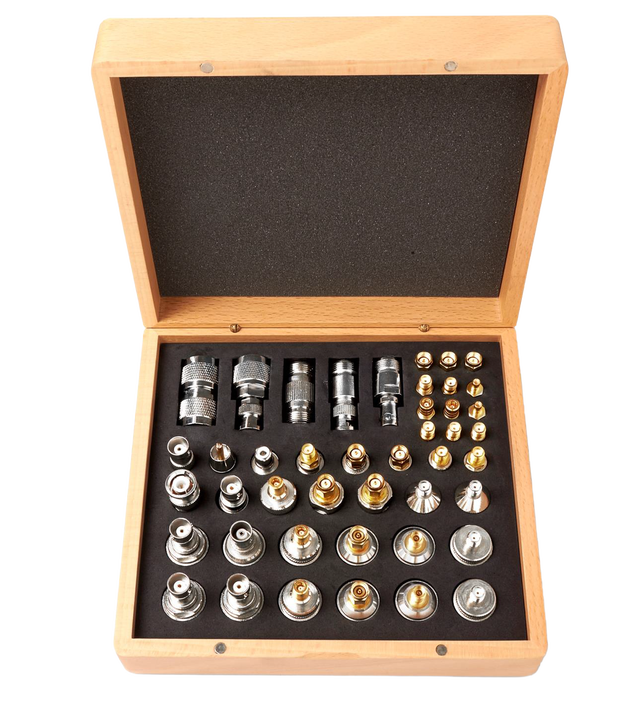
44 adaptors in 25 types between N, SMA, BNC, SMB and RCA, all 50 Ω, N and SMA rated to 6 GHz, in a beech-wood box.
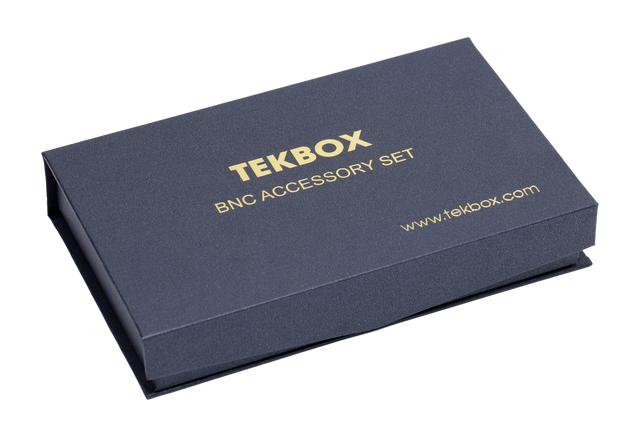
Seven pieces: BNC to 4 mm banana plugs and jacks, BNC to screw terminal block, and a 50 Ω feed-through termination.
Prices ex VAT.
Questions about the TBAS4
Can I put 2 W through a stack of all four?
Yes, as long as the power into the first pad is at or below 2 W. The first attenuator dissipates most of it: at 2 W into a 20 dB pad, 1.98 W becomes heat in that pad and 20 mW goes on. Above 40 °C ambient the limit is 1 W.
Why N connectors and not SMA or BNC?
Because the RF input of every Siglent spectrum analyser and vector network analyser is N-female, and so is the tracking-generator output. An N-male attenuator goes straight on the instrument with no adaptor. For an SMA cable on the far side use an N-female to SMA-female adaptor from the TBCAS1 set.
Does a 20 dB pad protect the analyser from anything?
From too much RF, within the pad’s own 2 W rating. It does not protect against DC — attenuators pass DC — and it does not protect against a transient above 2 W, where the pad itself is the part that fails. For circuits with DC on the line add a DC block.
Are the attenuators calibrated?
TekBox supplies measured S21 and VSWR plots for each of the four, DC to 6 GHz, but not a traceable calibration certificate. For a result that depends on the exact attenuation, measure the pad on your VNA or note the plot value at the frequency of interest.
Can I use them on a signal generator output?
Yes. They are 50 Ω both ways and bidirectional, so they go on the N output of an SSG RF generator or the tracking-generator output of an SSA just as well as on an input.
What does the ±0.3 dB tolerance mean in practice?
The marked value holds within 0.3 dB over the whole DC to 6 GHz range. A measurement made through a 20 dB pad is therefore good to about ±0.3 dB before the analyser’s own level uncertainty is counted; where that matters, read the attenuation off the supplied plot at your frequency.
Need a different value, or more power?
Tell us the frequency, the power and the connector. TekBox makes other sets and single attenuators, and we can quote a power attenuator for amplifier outputs.