

Siglent SSA5000-NF Noise Figure Measurement Option for SSA5000A (software licence)

SSA5000-NF: Y-factor noise-figure and gain measurement on the Siglent SSA5000A. Amplifiers and converters, ENR table, calibration. Needs the NSD28 driver.
SSA5000-NF — noise figure and gain, measured on the spectrum analyser you already have
Noise figure is the number that sets a receiver’s sensitivity: how much a stage degrades the signal-to-noise ratio passing through it. The SSA5000-NF licence gives the SSA5083A and SSA5085A a dedicated noise-figure mode using the Y-factor method: it switches a calibrated noise source between hot and cold at the input of the device, compares the two output powers, applies the source’s ENR table, removes the analyser’s own noise by calibration and shows noise figure and gain against frequency.
The mode measures amplifiers, up-converters and down-converters, reports seven results per frequency point, compensates input and output line loss and displays as graph, table or meter. It needs two more things: the NSD28 driver, which supplies the switched +28 V the noise source expects, and a noise source with its ENR table, which Siglent does not sell.
What the licence adds to the analyser
Calibration with second-stage correction
Measure the noise source directly first; the analyser stores its own noise figure and removes it from every later result. A calibrated system without a device reads 0 dB.
ENR table
Enter the excess noise ratio of your noise source against frequency once, from its calibration sheet, and save it with the set-up.
Seven results per point
Noise figure, gain, noise factor, effective temperature Te, Y-factor, Phot and Pcold, as traces, a table or a meter.
Amplifiers and converters
Device types: amplifier, up-converter and down-converter, so a mixer stage or a receiver front end can be measured, not only a gain block.
Loss compensation
Input and output line loss entered separately, so the cables and adaptors between source, device and analyser do not end up in the figure.
Set-up on the touchscreen
Start, stop and number of points, RBW from 1 Hz to 3 MHz, averaging. Entering the mode switches the preamplifier on and fixes the attenuator at 0 dB.
How the measurement works
Two connections. During calibration the noise source feeds the analyser directly, so the analyser learns its own noise figure. During the measurement the device goes in between. In both the analyser toggles the source through the NSD28, reads the noise power hot and cold, forms the Y-factor and solves for the noise figure of what is in front of it, with its own contribution subtracted.
Hot and cold
With +28 V applied the source is hot and emits a known excess noise; with the drive off it is cold, a 50 Ω termination at room temperature. The analyser measures the output noise power in both states.
ENR and the Y-factor
Y is the ratio of the hot and cold powers. With the excess noise ratio of the source at that frequency, NF = ENR − 10·log10(Y − 1). Gain follows from the same two readings once the calibration is known.
Second-stage correction
The calibration measures the analyser’s own noise figure. With the device in line that contribution, divided by the device gain, is removed, so the result describes the device alone. That is also why low-gain devices are the hardest case.
Three parts, one measurement
Order the licence and the driver together; choose the noise source for the frequency range and ENR your devices need.
The noise-figure mode: calibration, ENR table, averaging, loss compensation, seven results, graph, table and meter. Key issued against the serial number, nothing shipped.
USB-A on the analyser side, switched +28 V on a BNC on the noise source side; the mode toggles it during calibration and measurement. Without it nothing switches the source.
Any source switched by +28 V on a BNC input and supplied with a calibrated ENR table; Siglent names the Keysight 346 family. Typical ENR 6 to 15 dB. Pick the frequency range to cover your devices.
The mode switches the analyser’s preamplifier on; Siglent lists the preamplifier as a separate licence (P3 for the SSA5083A, P5 for the SSA5085A), so check your configuration with us if you are not sure it is present. Siglent publishes no measurement uncertainty for noise figure: the ENR uncertainty of your noise source and the device’s gain decide it. Software licences are excluded from the 14-day return right once the key has been issued.
The measurement, step by step
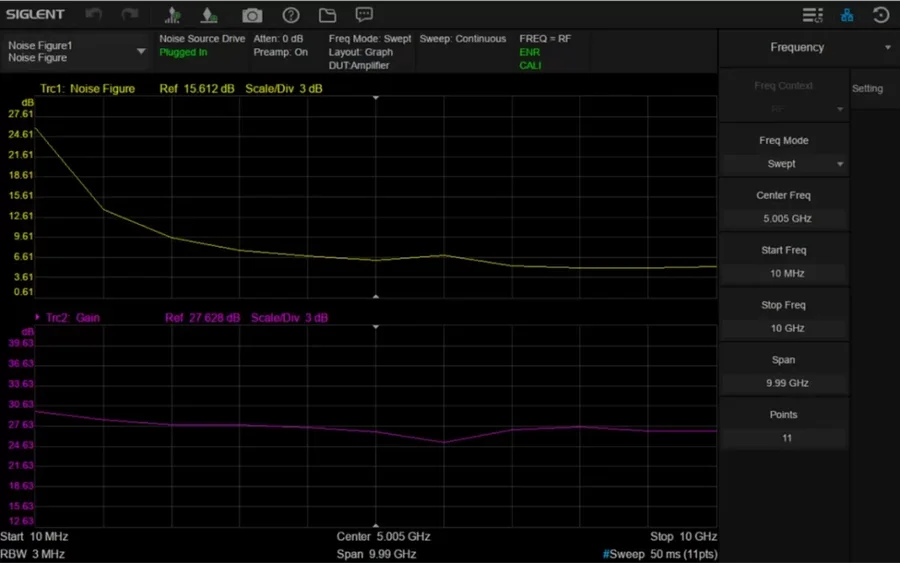
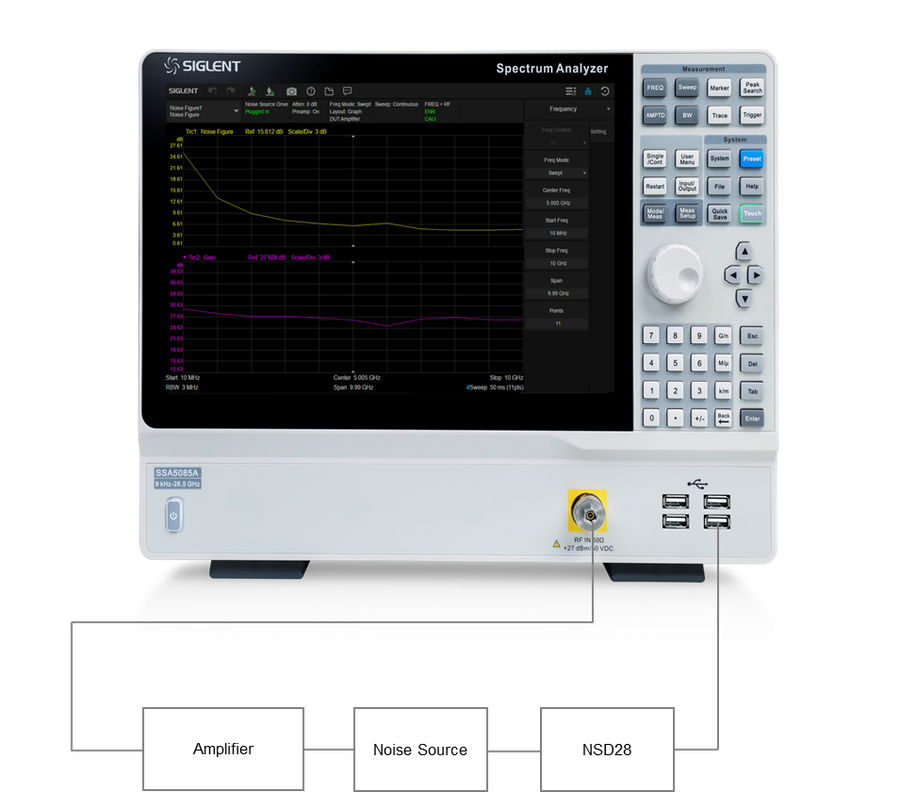
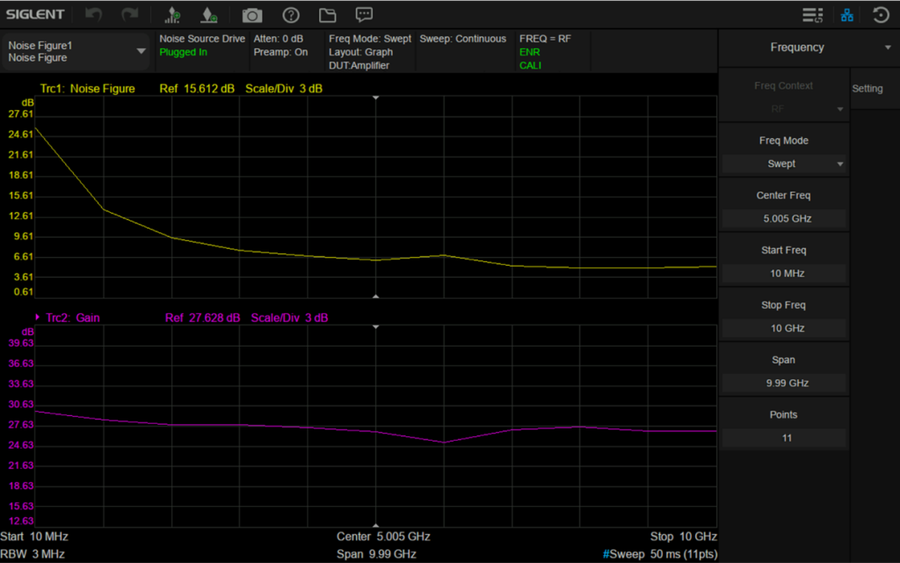
The sequence from Siglent’s application note, measuring a DC–10 GHz low-noise amplifier specified at 26 dB gain and 6 dB noise figure. Result: 26.69 dB and 6.12 dB.
- 1Warm up and open the mode
After 30 minutes of warm-up, add a Noise Figure window from the window manager. The status line shows the noise source drive as plugged in once the NSD28 is connected.
- 2Connect for calibration
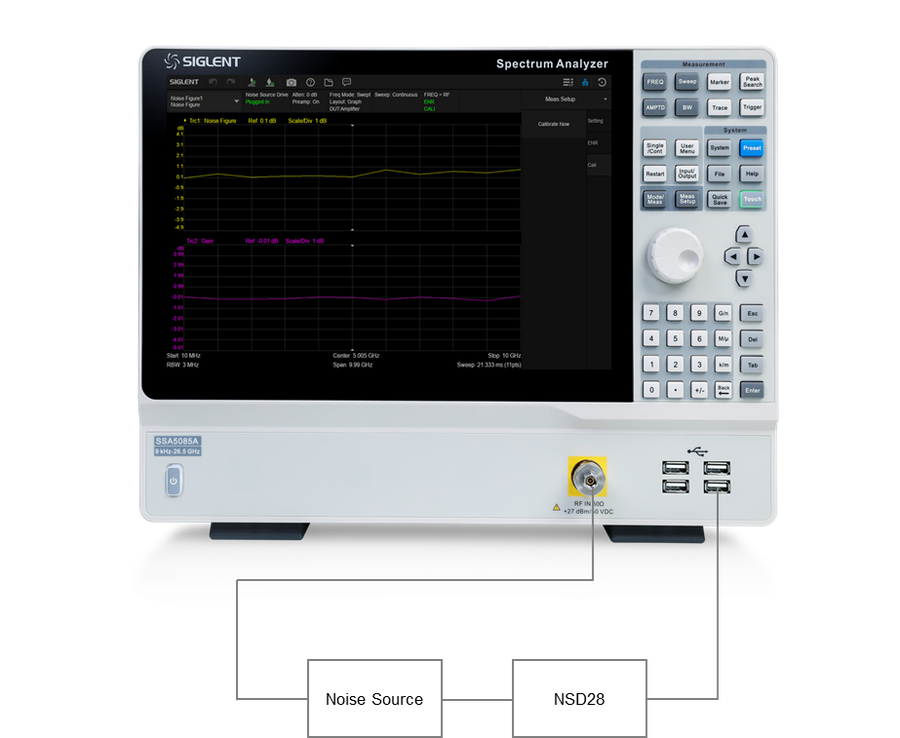
NSD28 into a USB port of the analyser, its BNC to the drive input of the noise source, noise source output straight into the RF input.
- 3Amplitude
The mode switches the internal preamplifier on and fixes the input attenuation at 0 dB in automatic mode.
- 4Frequency
Set start, stop and points. Siglent’s example: 10 MHz to 10 GHz in 11 points for a DC–10 GHz amplifier.
- 5ENR table
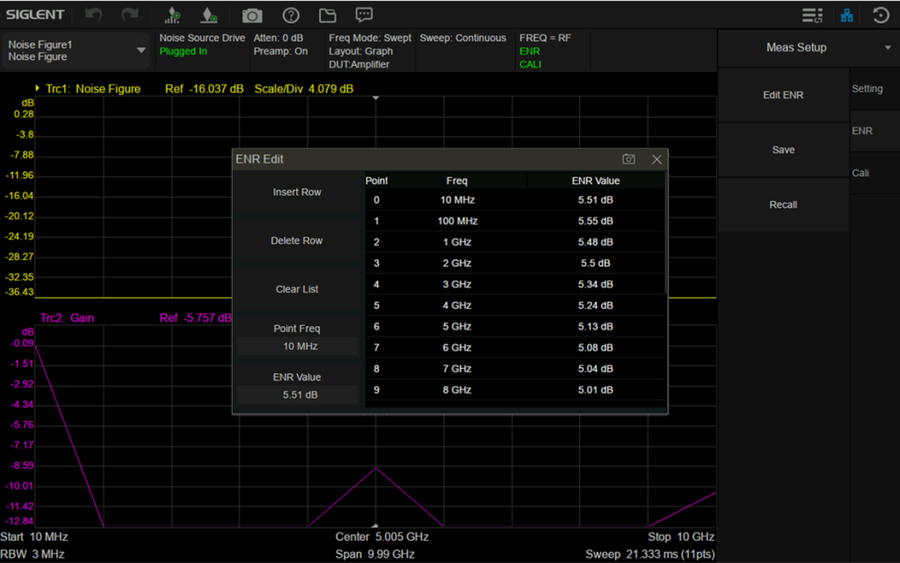
Meas Setup → ENR → Edit ENR: frequency and ENR pairs from the noise source’s calibration sheet; save the table.
- 6Averaging
Meas Setup → Setting: averaging on, 10 averages in the example.
- 7Calibrate
Meas Setup → Cal → Calibrate now. The analyser measures its own noise figure hot and cold and stores the correction.
- 8Check the zero
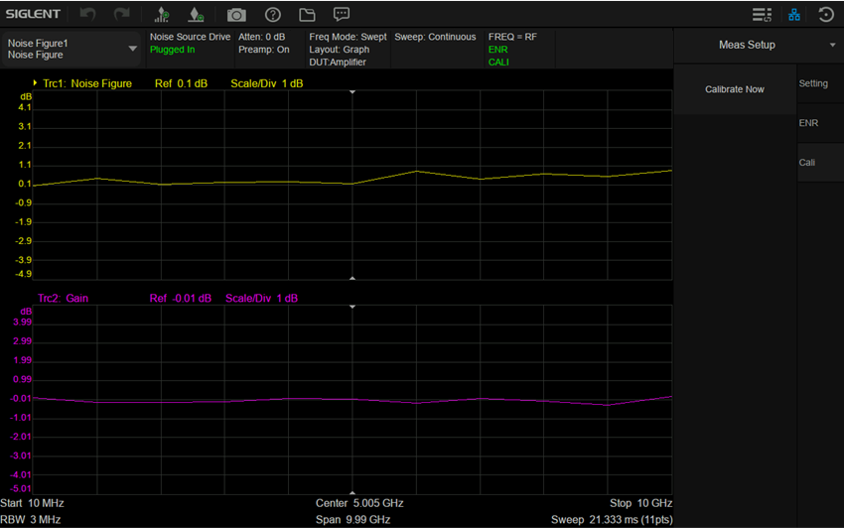
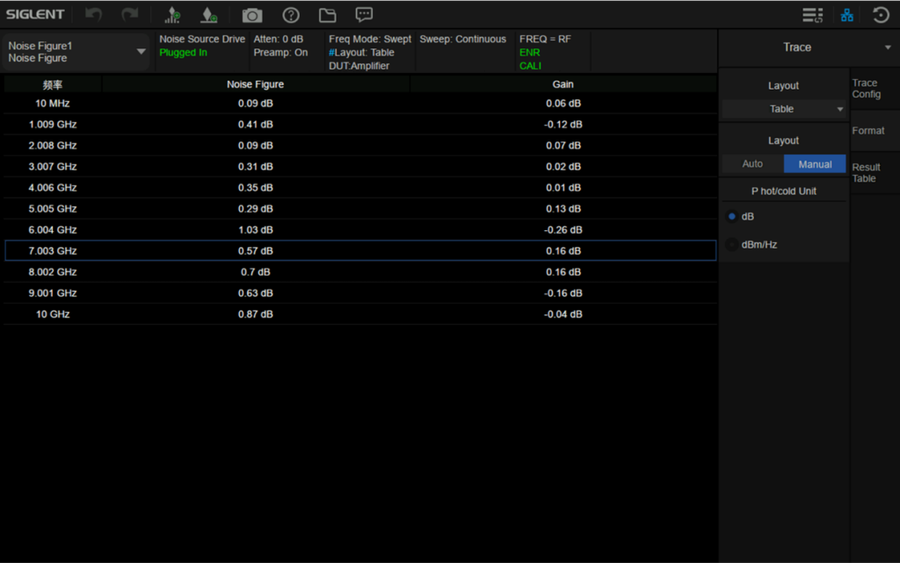
In the table layout a calibrated system reads close to 0 dB noise figure and 0 dB gain at every point.
- 9Insert the device and read
Noise source output to the DUT input, DUT output to the RF input. Noise figure and gain appear per frequency, as traces or a table.
On the bench and on the screen
Connection photographs and screens from the application note, in the order of the procedure.
Where it is used
Low-noise amplifiers and gain blocks
Noise figure and gain across the band, with the analyser’s own noise removed. The classic use, and the one in Siglent’s example.
Receiver front ends and converters
Up- and down-converter device types for mixer stages, LNBs and complete front ends, with the ENR applied at the input frequency.
Cascaded stages
Measure each stage and the chain: the first stage’s noise figure and gain decide the sensitivity of everything behind it.
Production and incoming inspection
A saved ENR table and a calibrated set-up make noise figure a repeatable reading on the analyser already on the bench, no dedicated noise-figure meter.
Design verification
Compare a prototype with its simulation, and watch how bias, matching and temperature move the figure, point by point.
Teaching
Hot and cold states, ENR, Y-factor and second-stage correction, with every intermediate value (Phot, Pcold, Y) available in the table.
Specification
From the SSA5000A data sheet EN02A (noise-figure option table, page 17) and Siglent’s application note.
| Option | SSA5000-NF noise-figure measurement, software licence activated by key on the analyser |
| Method | Y-factor: NF = ENR − 10·log10(Y − 1), Y = Phot / Pcold; calibration stores the analyser’s own noise figure as second-stage correction |
| Supported device types | Amplifier, up-converter, down-converter |
| Results | Noise figure, gain, noise factor, effective temperature, Y-factor, Phot, Pcold |
| Result display | Graph, table, meter |
| RBW range | 1 Hz to 3 MHz |
| Loss compensation | Input line loss and output line loss |
| Analyser settings in the mode | Preamplifier on, input attenuation 0 dB (automatic); start, stop, points, averaging user-set |
| Noise source interface | USB-A host to BNC (+28 V) via the NSD28 driver |
| Noise source | Not included: a +28 V switched source with a calibrated ENR table (Siglent names the Keysight 346 family); typical ENR 6 to 15 dB |
| Frequency range | The overlap of the analyser (9 kHz to 13.6 or 26.5 GHz) and the noise source |
| Analysers | SSA5083A and SSA5085A |
| Measurement uncertainty | Not published by Siglent; it depends on the ENR uncertainty of the source, the match and the gain of the device |
Documents and reading
Questions about SSA5000-NF
What else do I need?
The NSD28 noise source driver, which turns a USB port of the analyser into the switched +28 V the noise source needs, and a noise source with a calibrated ENR table. The licence, the driver and the source are three separate items; the source is not a Siglent product.
Which noise sources work?
Any source switched by +28 V on a BNC input and supplied with an ENR table. Siglent’s support centre names the Keysight 346 family; sources from Noisecom and others built to the same convention behave the same way. Tell us which one you have and we check.
How accurate is the result?
Siglent publishes no uncertainty figure. The dominant terms are the ENR uncertainty of the noise source, mismatch, and the gain of the device: a low-gain device leaves more of the analyser’s own noise in the result even after correction.
Why calibrate first, and how often?
The calibration measures the analyser’s own noise figure with the source connected directly and subtracts it later. Repeat it when the frequency list, the ENR table or the analyser settings change, or after the instrument has warmed up further.
Can it measure mixers and converters?
Yes. Up-converter and down-converter are supported device types next to amplifier. Ask us about the LO arrangement for your converter before you set it up.
Is the preamplifier needed?
Entering the mode switches the preamplifier on. Siglent lists the preamplifier separately as licence P3 / P5 for the two models; if your analyser does not have it, check with us before ordering NF.
How is it activated?
By licence key, issued against the analyser’s serial number and entered in the options menu; nothing is shipped. Software licences are delivered electronically and are excluded from the 14-day return right once the key has been issued.
Is there a cheaper way to estimate noise figure?
For a high-gain, high-NF device Siglent’s application note shows a gain-method estimate from the noise marker and DANL. It is a sanity check with the amplitude accuracy of the analyser; the Y-factor measurement with this option is the one to report.
Noise figure on your SSA5000A
Tell us the devices and frequencies. We confirm the licence, the NSD28 and a suitable noise source, and quote the set as one order.