

Siglent SDS1202X-E 200 MHz Dual-Channel Oscilloscope — ex-demo unit
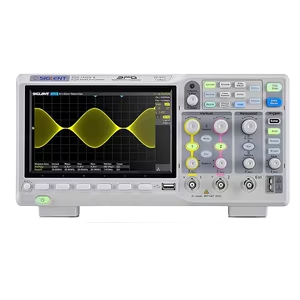
Our demonstration SDS1202X-E at €70 below list. 200 MHz across two channels, 1 GSa/s, 14 Mpts,
400,000 wfm/s in sequence mode — and I²C, SPI, UART, RS232, CAN and LIN triggering and decoding
included, with nothing to license. Both 200 MHz probes supplied. Two-year warranty. There is one.
The scope that made free serial decoding normal
The SDS1202X-E is 200 MHz across two channels at 1 GSa/s, with 14 Mpts of memory and a 400,000 wfm/s capture rate in sequence mode. What made it the scope people recommend, though, is what it does not charge for: I²C, SPI, UART, RS232, CAN and LIN triggering and decoding are all included, on an instrument that costs less than most probes.
Add 500 µV/div sensitivity, a 1 Mpts FFT that runs on the full memory, 38 automatic measurements with statistics, an 80,000-frame history buffer and a 256-level intensity-graded display, and the specification stops looking like an entry-level one.
This particular one was a demonstration unit. It comes with both 200 MHz probes and the rest of the standard accessories, and it is €70 below the price of the same scope new. There is one of it.
- Two 200 MHz probes included
- Serial decode free, nothing to license
- Two-year warranty · still a current model
- Ships from the Netherlands
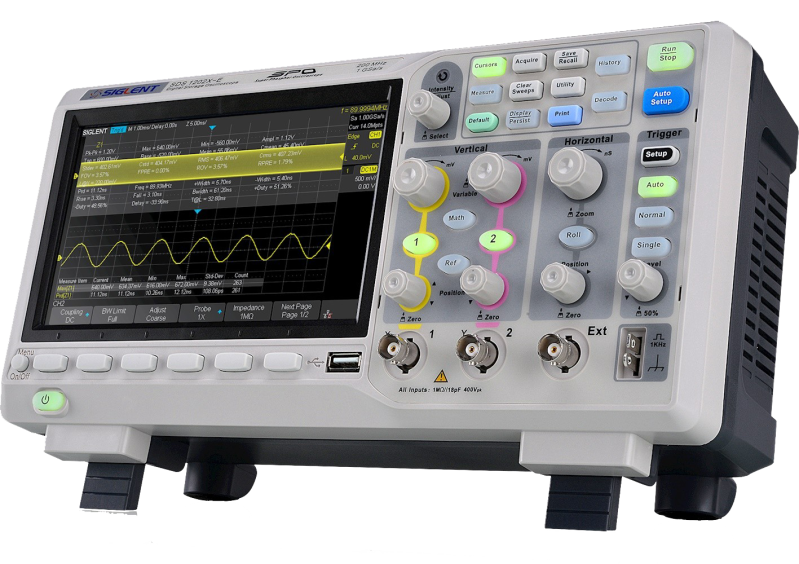
This particular unit
What you are actually buying, before the specification.
Why it is discounted
It was a demonstration unit rather than a sale. Nothing is wrong with it — it is discounted because we cannot sell it as new.
The condition
Working and complete. Ask us for photographs of the actual instrument before you order and we will send them, including anything a photograph would show that a description would not.
What comes with it
The two 200 MHz probes, power cord, USB cable and quick start guide — the standard set. The probes alone are a meaningful part of what you are buying at this price.
Warranty and support
Two years, against three on a new one — the single difference between this and buying it new. Firmware, the software tools and our technical support are identical.
Seeing the signal, not just a line
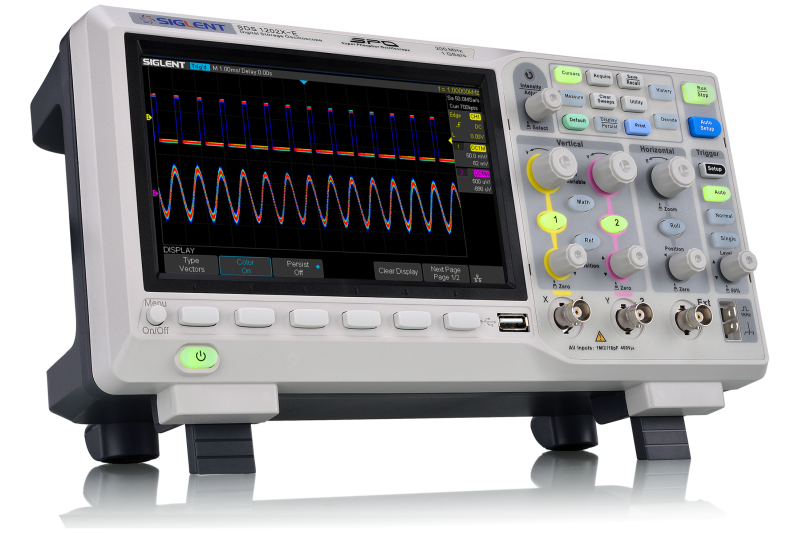
In sequence mode the SDS1202X-E draws up to 400,000 waveforms a second and grades them across 256 intensity levels, so a rare event shows up as a faint trace rather than not showing up at all. Colour temperature mode maps how often each point is hit onto a colour scale, which turns jitter and modulation into something you can see at a glance instead of something you have to hunt for.
Underneath that, the noise floor is low enough to use the 500 µV/div range meaningfully, and the digital trigger has the sensitivity and low jitter to lock onto a small signal rather than chase it.
The history buffer holds up to 80,000 frames, and sequence mode splits the memory into as many as 80,000 segments with very little dead time between them — so an event that happens once an hour is still there when you come back to look for it.
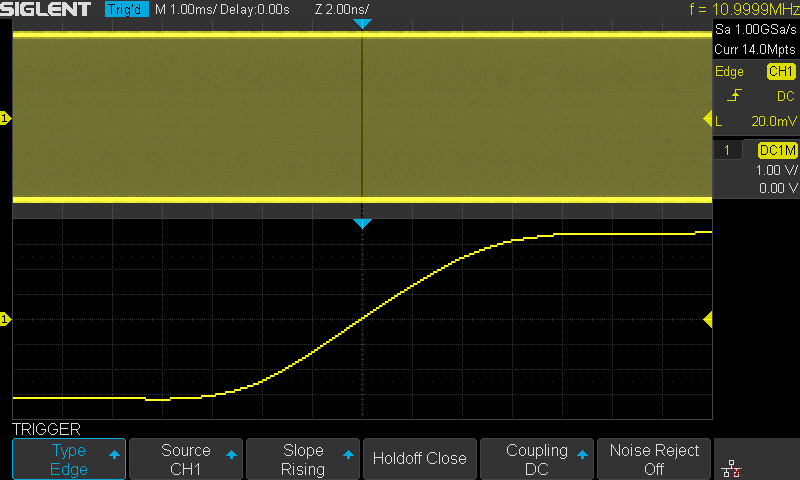
What 14 Mpts is actually for
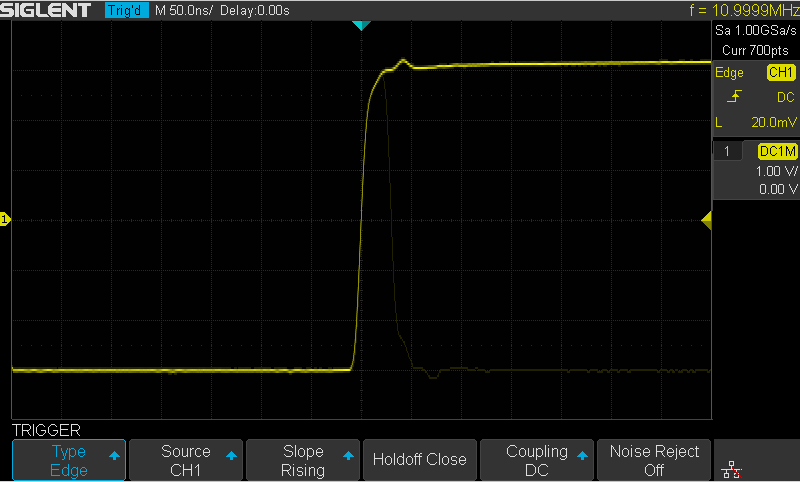
Deep memory is easy to quote and hard to picture. These two screenshots are the same instrument and the same 11 MHz signal — the difference is how much memory was behind the acquisition.
Triggering and decoding, all included
Nothing here is a licence. On most instruments at any price, serial decode is the option you discover you need after you have bought it.
Trigger and decode, standard.
Beyond edge, which is where the useful ones start.
The SDS1000X-E feature list is written for the whole family, and two entries on it apply to the four-channel models only: browser-based web control and the Bode plot function that drives an external generator. This is the two-channel model, so it has neither. It does have LAN with VXI-11 and the complete SCPI command set, so it automates perfectly well — just not from a browser. We would rather you knew that now than found out afterwards.
Specification
From the SDS1000X-E data sheet. Being ex-demo changes the price, not the instrument.
| Bandwidth | 200 MHz (−3 dB) |
| Channels | 2 analogue, plus an external trigger input |
| Sample rate | 1 GSa/s on one channel · 500 MSa/s with both channels on |
| Record length | 14 Mpts on one channel · 7 Mpts with both channels on |
| Vertical resolution | 8-bit |
| Vertical scale | 500 µV/div to 10 V/div (1-2-5), probe 1× |
| Waveform capture rate | 100,000 wfm/s normal · 400,000 wfm/s in sequence mode |
| Sequence mode | up to 80,000 segments |
| History | up to 80,000 frames of recorded waveforms |
| Display | 7-inch TFT-LCD, 800 × 480, 256-level intensity grading and colour temperature |
| Maths | 1 Mpts FFT — measurement and maths use all 14 Mpts |
| Measurements | 38 automatic parameters, with statistics, gating, maths, history and reference |
| Interfaces | USB host · USB device (USB-TMC) · LAN (VXI-11) · pass/fail and trigger out |
| Remote control | SCPI commands |
| Power | 100–240 V 50/60 Hz or 100–120 V 400 Hz · 25 W max |
The two-channel model has one 1 GSa/s converter and one 14 Mpts memory module, so those figures apply to a single active channel. With both channels on, each gets 500 MSa/s and 7 Mpts.
On the back
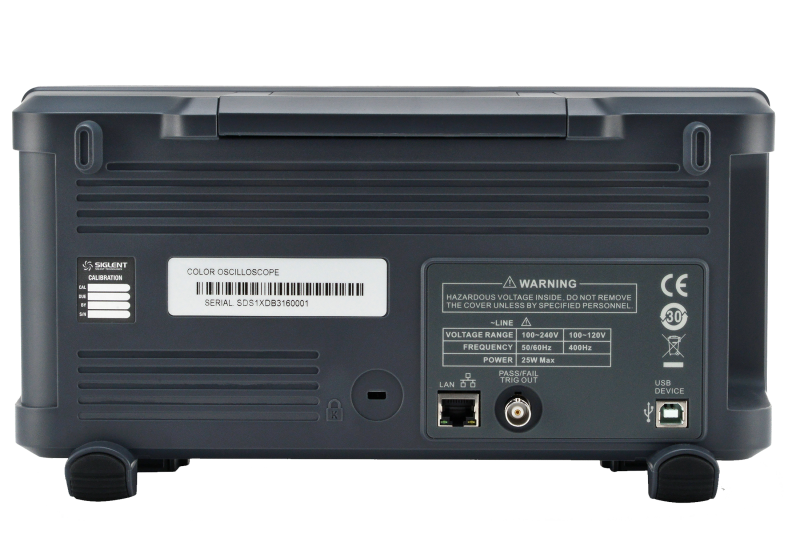
The pass/fail output is the one people forget is there. Set a mask, connect that BNC to whatever needs to know, and the scope becomes a go/no-go tester on a production bench rather than something an engineer has to watch. It is hardware-based, so it keeps up.
LAN gives you VXI-11, and the USB device port is USB-TMC — both driven by the same SCPI command set, which is documented in the programming guide below. The USB host port on the front takes a memory stick for screenshots and waveform data.
There is a security erase mode as well, which matters more than it sounds if the instrument ever leaves a controlled site.
In the box
The full standard set. Note the two probes — a pair of 200 MHz passive probes is a real part of what this costs.
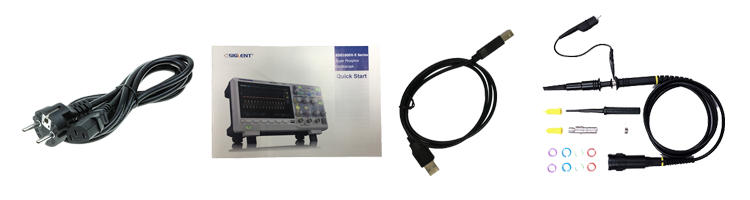
- 2 × 200 MHz passive probes, with tips, ground clips, colour rings and a trimmer
- Power cord (EU)
- USB cable for the USB-TMC device port
- Quick start guide — the full manual and data sheet are below
- Guarantee card
Worth adding
| Accessory | What it is | Price |
|---|---|---|
| BAG-S1 | Soft carry case, fits the whole SDS1000X-E family | €59 |
| DPB1300 | 50 MHz differential high-voltage probe | €399 |
| BNC-BNC 1 m | 50 Ω BNC cable | €12 |
| BNC to banana | Adaptor for bench-supply and meter leads | €4.50 |
Accessory prices ex VAT, as listed on the shop.
Manuals and data sheet
The same documentation as a new unit.
The full specification, including the two- versus four-channel differences.
Operation, triggering, serial decode, measurement and the maths functions.
Block diagrams, disassembly and the performance verification procedure.
The SCPI command set, for driving it from a test script.
Questions we are asked
What is wrong with it?
Nothing. It is discounted because it was a demonstration unit and cannot be sold as new. If there were a fault, this listing would say what it was — that is the rule on every unit we sell this way.
Does it really do 1 GSa/s and 14 Mpts?
On one channel, yes. This is worth understanding because most listings gloss over it: the two-channel SDS1202X-E has a single 1 GSa/s converter and a single 14 Mpts memory module. Turn both channels on and each gets 500 MSa/s and 7 Mpts. That is the datasheet talking, not us being cautious — and at 200 MHz bandwidth, 500 MSa/s is still comfortably enough for real work.
Is serial decoding an extra?
No. I²C, SPI, UART, RS232, CAN and LIN triggering and decoding are all included, with nothing to license. At this price that is unusual and it is the main reason the model has stayed popular.
Can I do Bode plots or control it from a browser?
No, and be careful here because the catalogue listing is loose about it. Both the web control page and the Bode plot function are four-channel models only. This is the two-channel model, so it has neither. It does have LAN with VXI-11 and the full SCPI command set, so it automates perfectly well — just not from a browser.
Are the probes included?
Yes, two 200 MHz passive probes, along with the power cord, USB cable and quick start guide. On a scope at this price the probes are a real part of the value.
What warranty does it have?
Two years, where a new one carries three. That is the only thing you give up, and it is worth setting against the €70 you save. It is handled by us in the Netherlands, the same as any other instrument you buy from us.
Is it still a current model?
Yes. The SDS1202X-E is still in the catalogue and still sold new at €339, which is what the saving here is measured against. This is not old stock being cleared.
What if it has already gone?
There is one. If you are too late, tell us what you were after — we usually know what is coming back before it is listed.
There is one of these
Ask for photographs of the actual instrument, or for anything the listing does not answer, before you order. JRSE B.V. is the official Siglent distributor for the European Union.