

Pintek PA-622 AC/DC Current Probe 100 A, DC–300 kHz
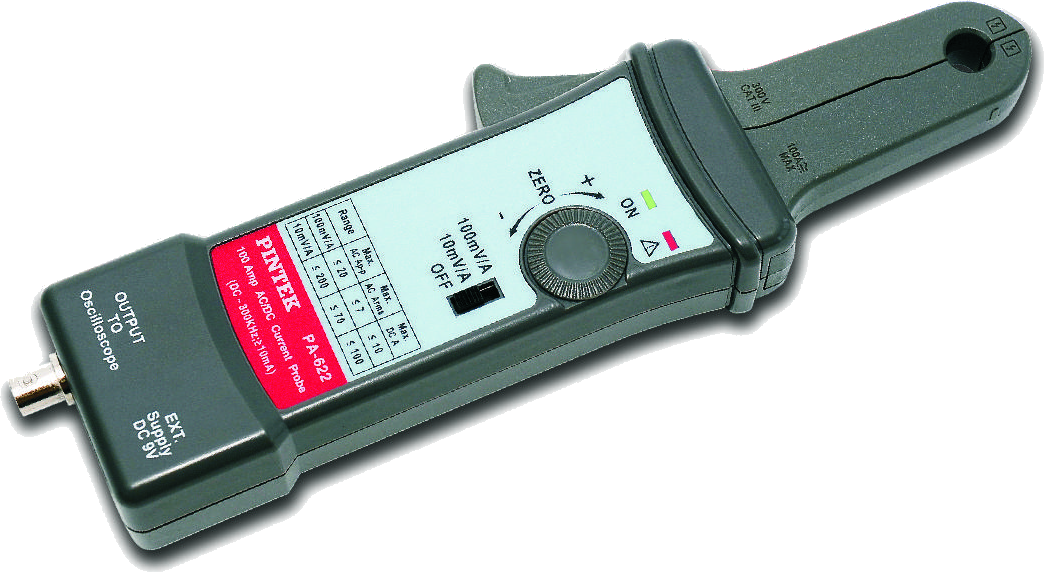
Pintek PA-622 AC/DC current probe: 100 A peak, DC–300 kHz, 10 mV/A and 100 mV/A ranges, BNC out. Fits any oscilloscope.
Current, on the same screen as the voltage
The Pintek PA-622 puts 100 amps of AC and DC current on any oscilloscope, through one BNC. An oscilloscope measures volts; to see amps you either break the circuit and insert a shunt — which changes the thing you are trying to measure — or you clamp a probe around the wire and leave the circuit alone. The PA-622 does the second, and it does it for direct current as well as alternating, which the clamp meter in most toolboxes cannot.
Its Hall-effect core turns the field around a conductor into a voltage on a BNC: 100 mV per amp on the sensitive range, 10 mV per amp when you need all 100 amps. Set your scope channel to 100 mV/div and a division is an amp — no maths, no conversion table. Any brand of oscilloscope will do, and with the supplied adapter it reads on a multimeter too.
Bandwidth runs from DC to 300 kHz with 10 mA of resolution and a 300 V CAT III rating — enough for motor drives, inrush testing, switch-mode supply development, battery and PV work, and hunting the milliamps a product draws in standby.
Why the waveform matters more than the number
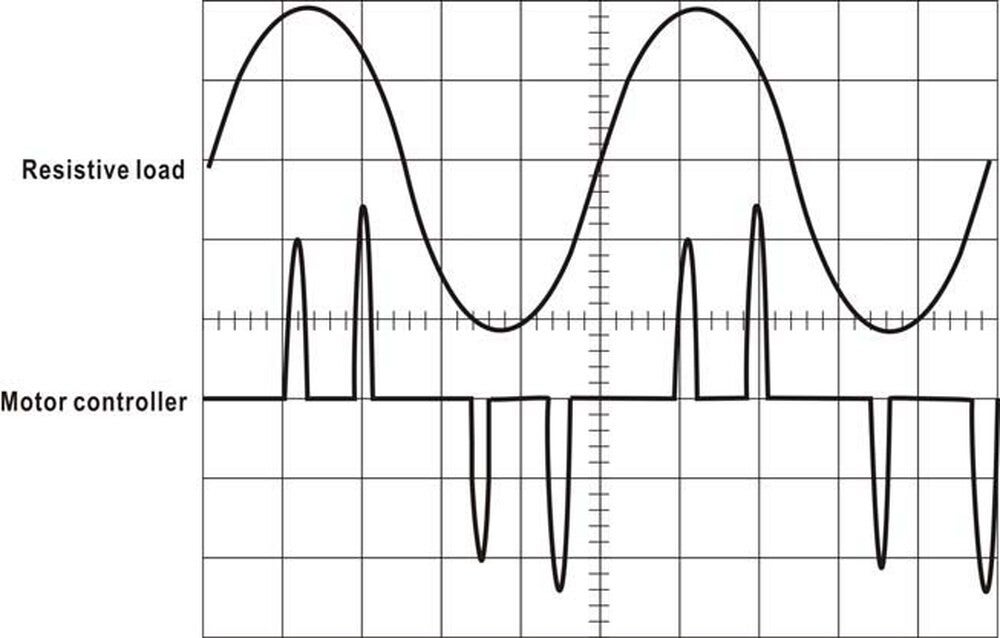
The trace above is the point of owning a current probe rather than a clamp meter. Both loads draw a similar RMS current, so a meter would report much the same figure for each. On the scope they are nothing alike: the resistive load is a clean sine, while the motor controller draws two narrow spikes per half cycle whose peaks run far above anything the meter suggested. Fuse ratings, shunt sizing, EMC behaviour and capacitor lifetime all follow the peaks — and only a probe with real bandwidth shows them.
Built for bench work
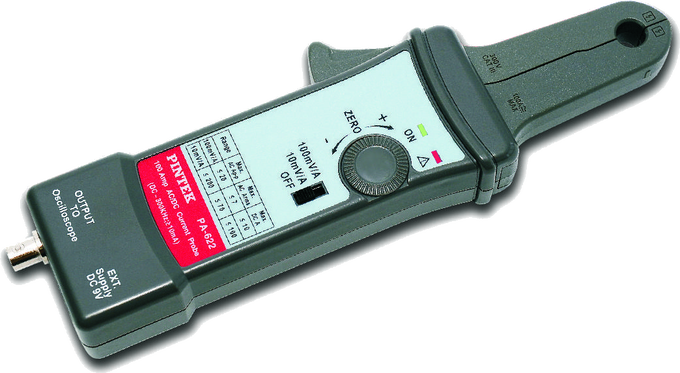
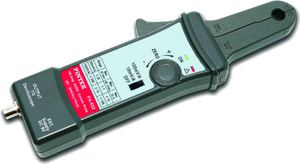
Everything on the probe has one job, and it is reachable with the hand that is not holding the wire.
True AC and DC
A Hall-effect core reads direct current as well as alternating — so a DC bus, a battery discharge or the standing current in a supply rail shows up as a real level on screen, not a signal that a plain AC clamp would simply miss.
Straight into any oscilloscope
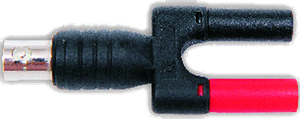
The output is a voltage proportional to current on a standard BNC: 100 mV/A or 10 mV/A. Set the channel to 100 mV/div and one division is one amp. It works with any brand of scope, and with a multimeter through the supplied BNC-to-banana adapter.
Two ranges, one switch
100 mV/A for fine work down to 10 mA resolution, 10 mV/A when you need the full 100 A peak. The same slide switch powers the probe on, so there is no separate power button to leave running.
Zero the residual magnetism
Clamping around iron leaves a small remanent field that offsets every later DC reading. The ZERO knob nulls it in a second, which is what makes trustworthy DC current measurement possible at all.
Battery or mains, no compromise
A single 9 V alkaline runs it for at least 13 hours; the supplied adapter takes over for bench work. The external supply has priority in the circuit, so you can pull the adapter mid-measurement without a glitch on the waveform.
Rated for real mains work
300 V CAT III (600 V CAT II), double-insulated, jaws that close over conductors up to 11 mm. Certified to EN 61010-1 and EN 61010-2-032, the standard written specifically for hand-held current clamps.
Key specifications
- 100 A peak / 70.7 Arms on the 10 mV/A range
- 10 A peak / 7.07 Arms on the 100 mV/A range
- DC to 300 kHz (−3 dB), 1.2 µs rise time
- ±3% typical DC accuracy at 100 mV/A
- 10 mA resolution — small standby currents stay visible
- Jaws accept conductors up to 11 mm diameter
- Green LED doubles as power and battery-health indicator
- 260 g without battery — light enough to hang on the wire
Application examples
Motor drives and inverters
The current a motor controller draws looks nothing like the smooth sine of a resistive load — it is a train of narrow, tall pulses. Clamp the PA-622 around the supply lead and those pulses appear on the scope at their true amplitude, which is the only way to size a fuse or a shunt honestly.
Inrush and start-up surges
Switch-on current in a transformer or capacitor-input supply can be ten times the steady-state figure for a few milliseconds. With 100 A of headroom and single-shot capture on the scope, you see the whole first cycle instead of a clipped flat top.
Switch-mode supply development
Follow the current in the primary switch, the inductor or the output rail while the loop settles. The 300 kHz bandwidth covers the fundamental and the first harmonics of most mains-frequency and low-frequency SMPS designs.
Battery, solar and DC-bus current
True DC response makes charge and discharge current directly readable — useful on battery packs, PV strings and 48 V distribution, where an AC-only clamp shows nothing at all.
Standby and leakage hunting
On the 100 mV/A range the 10 mA resolution resolves the milliamps a product draws asleep, so you can confirm a low-power mode without breaking the circuit to insert a meter.
Where the limits actually are
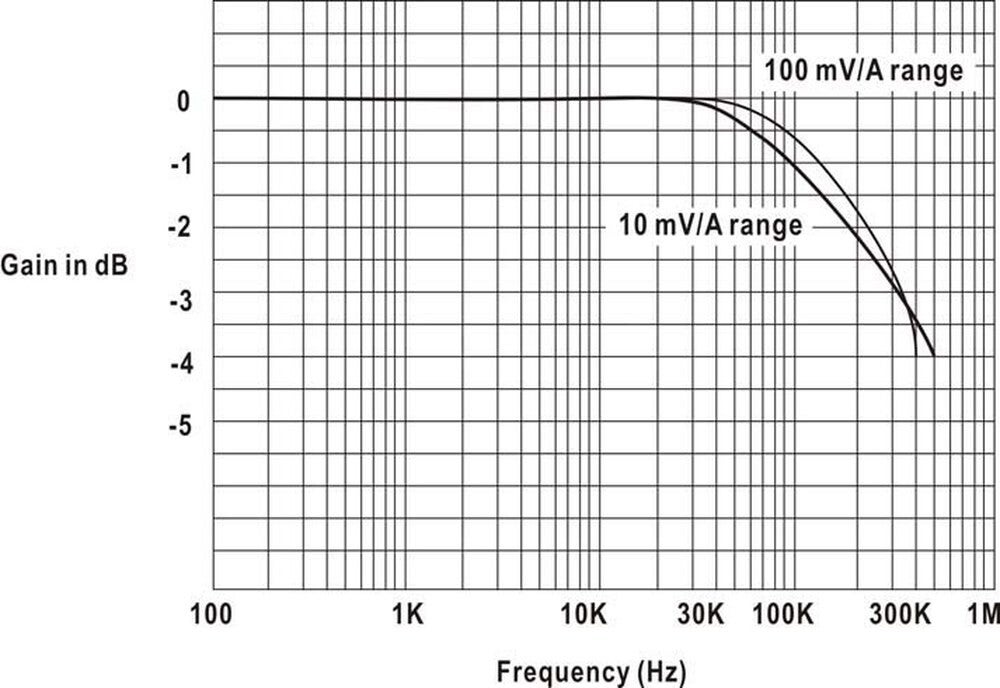
Two curves worth reading before you buy any current probe — both are from the manufacturer’s own manual.
Gain versus frequency
Flat from DC to roughly 30 kHz on both ranges, reaching the −3 dB point at 300 kHz. Below about 20 kHz you can trust the amplitude without correction.
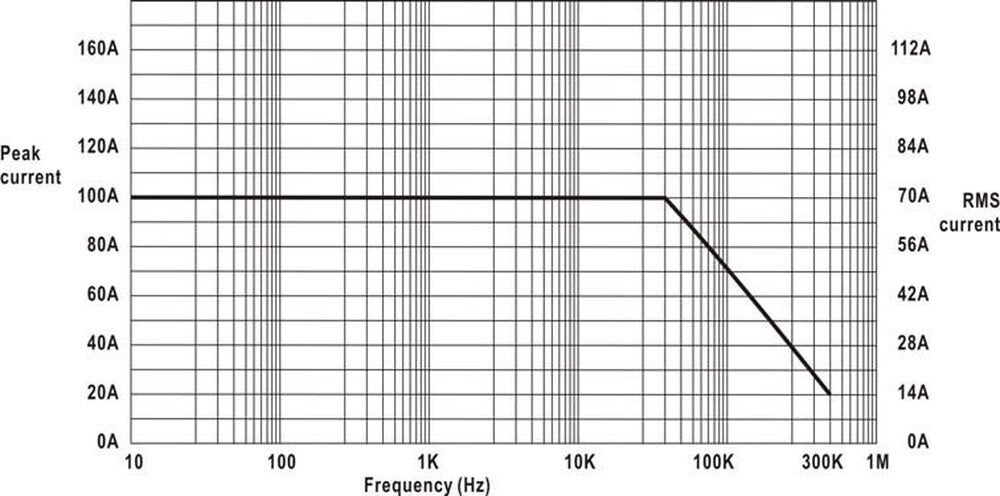
Maximum current versus frequency
The full 100 A peak is available up to about 40 kHz, after which it derates to roughly 20 A peak at 300 kHz. High current and high frequency are not available at the same time — true of every clamp of this type, and rarely printed this plainly.
Bench tip: buy yourself more sensitivity
Sensitivity multiplies by the number of turns you pass through the jaws. Loop the conductor four times and the 10 mV/A range becomes 40 mV/A; on the 100 mV/A range four turns give 400 mV/A. It costs nothing, and it is the difference between guessing at a small standby current and actually measuring it. Divide the reading by the same number of turns.
Specifications
| Current ranges | 10 mV/A and 100 mV/A, selected by slide switch |
|---|---|
| Maximum current, 10 mV/A range | 100 A DC · 100 A AC peak · 200 A peak-to-peak · 70.7 Arms |
| Maximum current, 100 mV/A range | 10 A DC · 10 A AC peak · 20 A peak-to-peak · 7.07 Arms |
| DC accuracy (typical) | ±3% ±50 mA at 100 mV/A (50 mA–10 A peak) ±4% ±50 mA at 10 mV/A (500 mA–40 A peak) ±15% max at 10 mV/A (40 A–100 A peak) |
| Resolution | 10 mA |
| Frequency range | DC to 300 kHz (−3 dB) |
| Rise time (typical) | 1.2 µs |
| Maximum working voltage | 300 Vrms CAT III · 600 Vrms CAT II / CAT I · 600 V DC |
| Maximum conductor size | 11 mm (0.43 in) diameter |
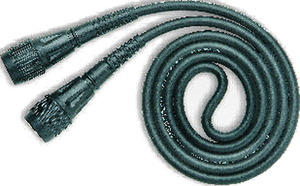
| Output | BNC, into the supplied BP-250 1 m coaxial cable |
| Power | One 9 V alkaline (NEDA 1604A / IEC 6LR61) or the supplied 9 V DC adapter |
| Battery life (typical) | 13 hours minimum · green LED stays lit until 6.5 V |
| Operating temperature | 0 °C to +50 °C · storage −20 °C to +80 °C |
| Humidity | 95% up to 40 °C · 45% from 40 °C to 50 °C |
| Pollution degree | 2 |
| Dimensions | 280 × 70 × 32 mm |
| Weight | 260 g without battery |
| Safety | EN 61010-1 / EN 61010-2-032, IEC 61010-1 / IEC 61010-2-032; double insulated |
Specifications taken from the Pintek PA-622 instruction manual. Errors and omissions excepted; specifications may change without notice.
In the box
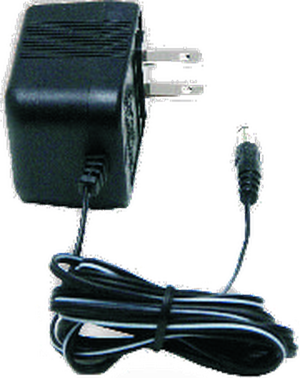
Supplied complete — the probe works out of the box with a scope or a multimeter. A 9 V alkaline battery is not included.
Other current probes
Need more bandwidth, or tighter DC accuracy? The Siglent active probes go further up the frequency range; the PA-622 is the one to reach for when the current is large and the frequency is not.
Not sure which current probe you need?
Tell us the current you expect, the frequency it moves at and whether there is DC in it — we will tell you honestly whether this probe covers it or whether an active Siglent probe is the better answer. EU stock and support.