

Siglent SDS2000HD-CANFD CAN FD Trigger & Decode Licence for SDS2000X HD Oscilloscopes
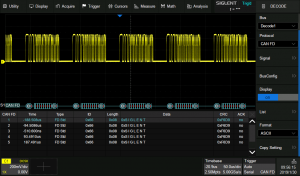
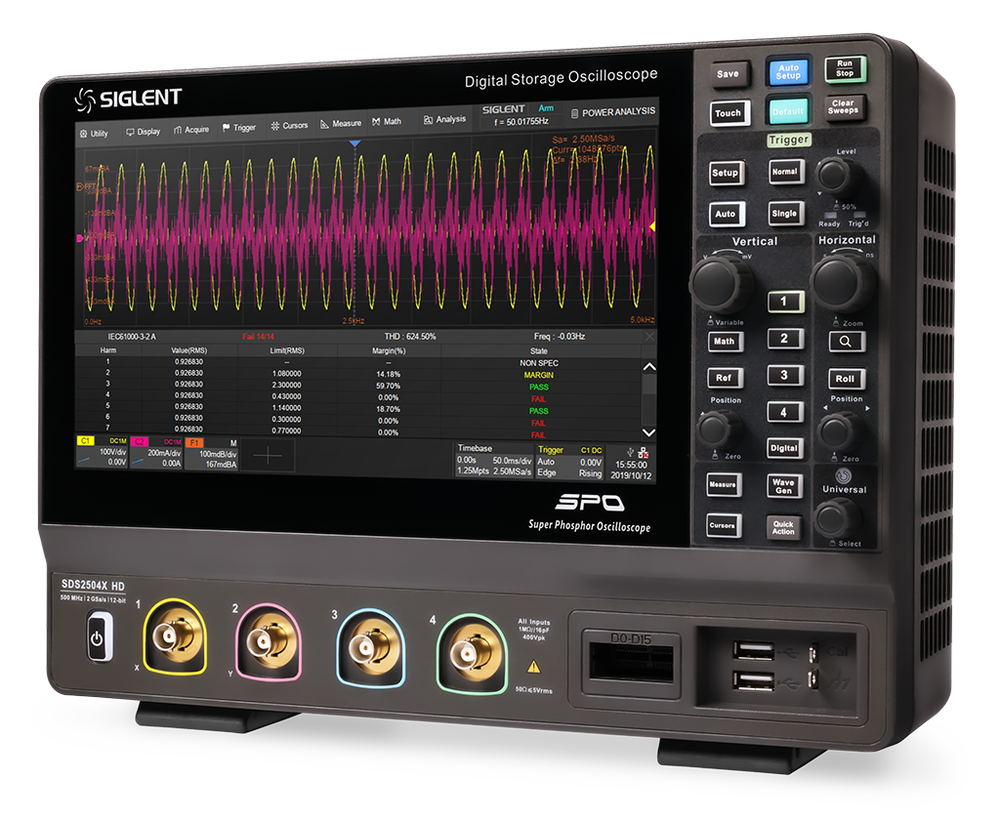
Siglent SDS2000HD-CANFD: CAN FD trigger and decode key for SDS2000X HD oscilloscopes. Data phase to 10 Mbit/s, trigger on ID, data and errors.
SDS2000HD-CANFD — CAN FD trigger and decode for the SDS2000X HD
A software key that lets the SDS2000X HD trigger on and decode CAN FD frames: the oscilloscope stops on the frame you name and shows its fields under the waveform and in a table.
CAN FD keeps the arbitration of classical CAN and then switches to a faster bit rate for the data, with payloads of up to 64 bytes. An oscilloscope that only knows classical CAN reads the arbitration correctly and then loses the frame at the rate switch. With this key the SDS2000X HD follows the switch: it decodes the whole frame and can trigger on its start, a remote frame, an identifier, an identifier with data, or an error.
Classical CAN and LIN trigger and decode are part of every SDS2000X HD, so this key is needed only for the FD frame format. It works on an analogue channel or on a digital channel of the SPL2016 logic probe, and two decoders can run at the same time — CAN FD next to LIN, for example.
What the key adds
Trigger on the frame you want
Start of frame, remote frame, ID, ID + data, or an error frame.
Decode with a frame list
Fields annotated under the waveform and listed frame by frame with a time stamp.
Data phase to 10 Mbit/s
Nominal rate 10 kbit/s to 1 Mbit/s, data rate 500 kbit/s to 10 Mbit/s, or a custom value for each.
Analogue or digital source
Any of C1–C4, or D0–D15 with the SPL2016, leaving the analogue channels free for the signals around the bus.
Which oscilloscope it is for
Both models of the SDS2000X HD series, and an SDS2104X HD you already own. Keys for other Siglent series have their own order codes and are not interchangeable.
CAN and LIN trigger and decode are standard on the SDS2000X HD; this key adds the FD frame format. CAN XL is a separate key, SDS2000HD-CANXL, and is decode only.
Specification
| Applies to | SDS2204X HD, SDS2354X HD |
| Function | CAN FD trigger and decode |
| Source | C1–C4 or D0–D15 |
| Trigger conditions | Start · Remote · ID · ID + Data · Error |
| Nominal bit rate | 10, 25, 50, 100, 250 kbit/s · 1 Mbit/s · custom |
| Data bit rate | 500 kbit/s · 1, 2, 5, 8, 10 Mbit/s · custom |
| Decoders at the same time | 2 |
| Decoded list | 1 to 7 lines on screen, with time stamp per entry |
| Delivery | Licence key for the instrument’s serial number |
From the SDS2000X HD data sheet EN02B. I²C, SPI, UART, CAN and LIN trigger and decode are standard on the series; all other protocols are listed on the licences page.
How it is delivered
1 · Send us the serial number
A software key is generated for one instrument. Add the serial number to the order, or mail it afterwards.
2 · Receive the key
The licence key is delivered by e-mail — nothing is shipped and nothing leaves your bench.
3 · Enter it on the oscilloscope
Enter the key in the options menu; the decoder appears in the list of protocols and stays with that unit.
Questions about the SDS2000HD-CANFD
Can the oscilloscope trigger on CAN FD frames?
Yes. With this key it triggers on the start of a frame, a remote frame, an identifier, an identifier together with data, or an error frame.
Do I need this key for classical CAN?
No. Classical CAN trigger and decode are standard on every SDS2000X HD, as are LIN, I²C, SPI and UART.
Does it cover CAN XL as well?
No. CAN XL has its own key, SDS2000HD-CANXL, which decodes CAN XL frames but does not trigger on them.
Is 200 MHz bandwidth enough?
Yes. At 10 Mbit/s a bit lasts 100 ns and the SDS2204X HD has a 1.7 ns rise time, so the edges and the ringing of the bus are resolved comfortably.
Can I decode on the digital channels?
Yes. D0–D15 of the SPL2016 logic probe are valid sources, at 500 MSa/s.
What do you need from me?
The serial number of the oscilloscope. The key is generated for that instrument only.
Working on a CAN FD network?
Tell us the bus, the bit rate and what else is on the bench. We quote the SDS2000X HD with the keys and probes as one set.