

Siglent EA0210 2X External Attenuator for the SAP1000H Probe
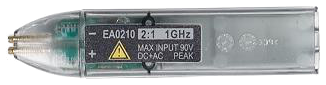

Siglent EA0210 external attenuator for the SAP1000H differential probe: 2X, extends the input range from ±42 V to ±60 V at the full 1 GHz bandwidth.
EA0210 — the SAP1000H probe from ±42 V to ±60 V, still at 1 GHz
The EA0210 is a 2X attenuator that pushes onto the tip of the SAP1000H probe amplifier. Both attenuation settings double, from 10X / 50X to 20X / 100X, and the differential window grows from ±42 V to ±60 V. The bandwidth stays at 1 GHz.
It is the way to take the SAP1000H onto 48 V rails and onto switch nodes that ring past 42 V. The probe then loads the circuit with 400 kΩ and 1.8 pF. One thing to remember: the oscilloscope cannot detect the attenuator, so you select EA0210 in the probe menu.

What it changes
The four input windows of the SAP1000H, without and with the attenuator, against the supply voltages you meet on a power board.
48 V rails
48 V supplies in vehicles, telecom and server power sit outside the ±42 V window of the bare probe. At 100X with the EA0210 they are inside, with room for ripple and transients up to 60 V.
Switch nodes that overshoot
A 24 V or 36 V half-bridge can ring well above its rail. The wider window keeps the whole edge on screen without clipping the probe amplifier.
More room to ground
Either input may now be up to ±90 V from the ground socket (DC + peak AC) instead of ±60 V. That matters for the high-side switch of a stage that floats on the bus.
How to fit it
Where the attenuator sits in the signal path, and the four steps from the SAP1000H user manual.

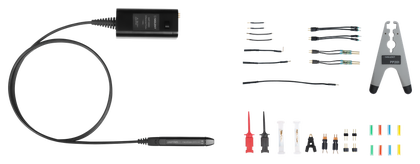
Attenuator and probe amplifier before fitting. The + and − marks of both must face the same way.
Fitted. The label on the attenuator reads 2:1, 1 GHz, maximum input 90 V DC + AC peak.
Clear the probe
Take all tips, leads and clips off the probe amplifier.
Fit the pogo tip
Put a pogo tip in the grounding hole of the probe amplifier.
Push the attenuator on
Slide the EA0210 onto the amplifier, + to + and − to −. The tips and leads now go on the attenuator.
Tell the oscilloscope
Probe information menu › External Attenuator › EA0210. Set it back to NC when you remove the attenuator.
Specifications
| SAP1000H | SAP1000H + EA0210 | |
|---|---|---|
| Bandwidth | 1 GHz | 1 GHz |
| Attenuation | 10X / 50X | 20X / 100X |
| Input dynamic range | ±42 V | ±60 V |
| Vertical displacement (offset) range | 10X: ±8.4 V · 50X: ±42 V | 20X: ±16.8 V · 100X: ±60 V |
| Maximum input voltage to the ground socket | ±60 V | ±90 V |
| Differential input resistance | 200 kΩ | 400 kΩ |
| Differential input capacitance | 1 pF | 1.8 pF |
From the SAP1000H User Manual EN01B, section 5.4. Label on the attenuator: 2:1, 1 GHz, maximum input 90 V DC + AC peak. Siglent part number 0.01.80.10.226. Errors and omissions excepted.
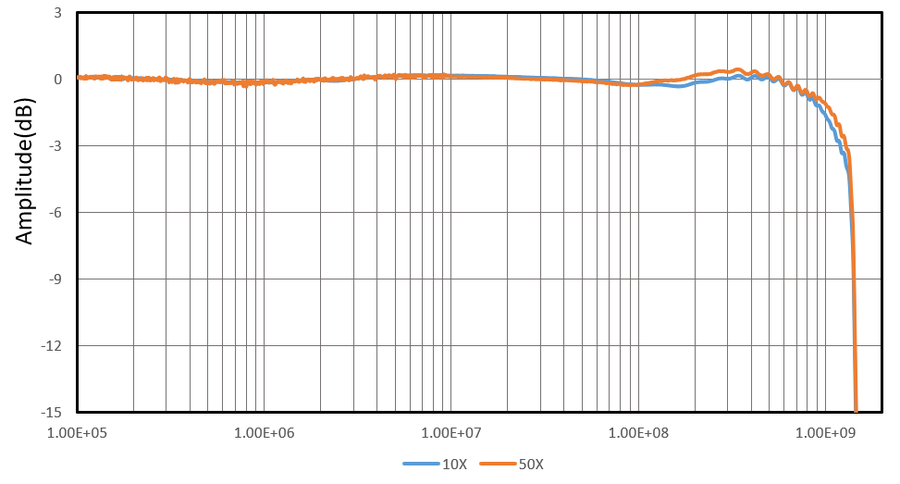
Amplitude response of the SAP1000H with the EA0210 fitted, 100 kHz to 1 GHz, both settings. From the user manual.
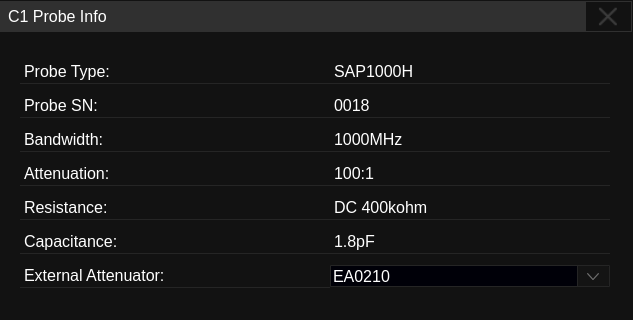
The probe information menu with the attenuator selected: 100:1, 400 kΩ, 1.8 pF.
Who it is for, and what to check first
- SAP1000H users who work on 48 V buses: automotive, telecom, server power
- Gate-drive and switch-node work where overshoot passes 42 V
- Motor-drive and inverter boards up to 48 V
- Labs that want one probe for 12, 24 and 48 V systems
- It fits the SAP1000H. It is not an accessory for the SAP1000, SAP2500 or the SAP2500D and faster differential probes.
- The oscilloscope does not detect it. Select EA0210 in the probe menu, and NC again after removal.
- ±60 V differential and ±90 V to ground are the limits. Mains and high-voltage DC links need a DPB5000-class probe.
- Signals of a few volts are better measured without it: the attenuation doubles.
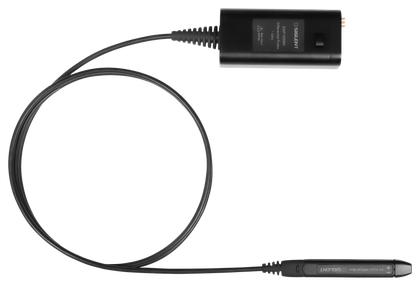
The probe it belongs to
Documents
Questions
Which probes does the EA0210 fit?
The SAP1000H. Its user manual names the EA0210 as the external attenuator that the probe supports, and the oscilloscope’s probe menu offers it by name.
Does the oscilloscope recognise it?
No. The SAP1000H itself is recognised through SAPBus, the attenuator is not. Select EA0210 under External Attenuator in the probe information menu; the menu then shows 100:1 (or 20:1), 400 kΩ and 1.8 pF. After you take the attenuator off, set the entry back to NC, otherwise every reading is a factor of two too high.
Do I lose bandwidth?
The manual specifies 1 GHz with and without the EA0210, and shows the amplitude response with the attenuator fitted at both settings.
Can I measure a 48 V bus with it?
Yes, that is its main use. With the EA0210 the differential window is ±60 V at the 100X setting, and either input may be up to ±90 V from the ground socket (DC + peak AC). Mains and high-voltage DC links are outside that range and need a high-voltage differential probe of the DPB5000 family.
What does it cost in signal?
Attenuation doubles, to 20X and 100X, so small signals sit a factor of two lower above the noise of the system. The load on the circuit becomes lighter in resistance (400 kΩ instead of 200 kΩ) and slightly heavier in capacitance (1.8 pF instead of 1 pF).
±60 V for your SAP1000H
Tell us the bus voltage and the oscilloscope you work with. We confirm that the SAP1000H with the EA0210 covers it, or point you to a DPB5000 probe if it does not.