

Siglent SDS2000HD-PA Power Analysis Licence for SDS2000X HD Oscilloscopes

Siglent SDS2000HD-PA: power analysis key for SDS2000X HD oscilloscopes. Switching loss, harmonics, inrush, ripple, PSRR, efficiency and SOA.
SDS2000HD-PA — power analysis for the SDS2000X HD
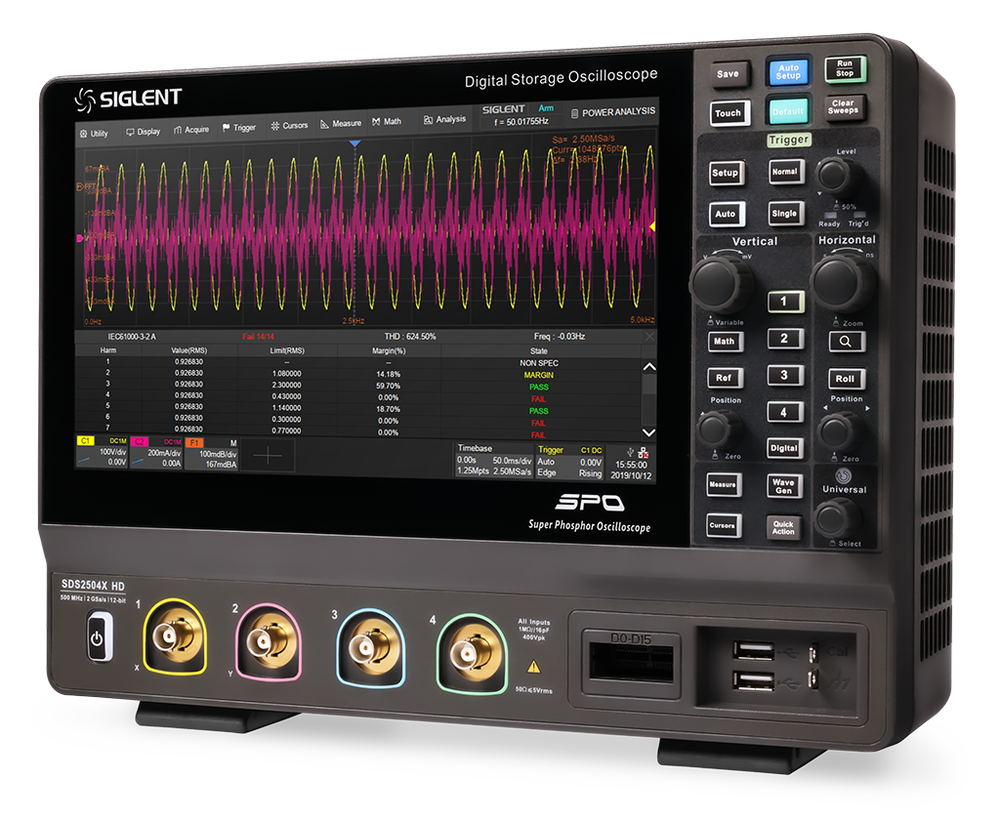
A software key that turns the SDS2000X HD into a power-supply test instrument: twelve guided measurements, from switching loss to current harmonics, calculated from a voltage and a current channel.
Measuring a switching converter by hand means multiplying two waveforms, integrating over the right part of a cycle and keeping track of probe factors and delays. The power analysis application does that bookkeeping: you tell it which channel is voltage and which is current, pick the measurement, and it returns the result as a table next to the waveforms.
The 12-bit acquisition is what makes the results worth having. A MOSFET that blocks several hundred volts conducts with well under a volt across it; on eight bits the on-state disappears into one or two quantisation steps, and with it the conduction loss. Twelve bits and a quiet front end keep both ends of that range on one acquisition.
What the key adds
Input side
Power quality, current harmonics and inrush current — what the supply does to the mains.
The switch
Switching loss, slew rate, modulation and safe operating area (SOA) of the power device.
Output side
Output ripple, turn-on and turn-off behaviour and transient response.
The whole supply
Efficiency from input and output power, and power supply rejection ratio (PSRR).
Which oscilloscope it is for
Both models of the SDS2000X HD series, and an SDS2104X HD you already own. Keys for other Siglent series have their own order codes and are not interchangeable.
Power analysis needs a voltage and a current signal that are aligned in time. That means a high-voltage differential probe for anything connected to the mains, a current probe, and the DF2001A deskew fixture to take out the delay between the two. Without deskewing, a few nanoseconds of offset turn into a large error in every switching-loss figure.
Specification
| Applies to | SDS2204X HD, SDS2354X HD |
| Function | Power analysis application |
| Measurements | Power quality · current harmonics · inrush current · switching loss · slew rate · modulation · output ripple · turn on / turn off · transient response · PSRR · efficiency · SOA |
| Inputs | Voltage and current channels as the measurement requires; efficiency uses input and output voltage and current |
| You also need | A voltage probe suited to the circuit (a high-voltage differential probe for mains-side work), a current probe, and the DF2001A deskew fixture |
| Delivery | Licence key for the instrument’s serial number |
From the SDS2000X HD data sheet EN02B. I²C, SPI, UART, CAN and LIN trigger and decode are standard on the series; all other protocols are listed on the licences page.
How it is delivered
1 · Send us the serial number
A software key is generated for one instrument. Add the serial number to the order, or mail it afterwards.
2 · Receive the key
The licence key is delivered by e-mail — nothing is shipped and nothing leaves your bench.
3 · Enter it on the oscilloscope
Enter the key in the options menu; Power Analysis then opens from the Analysis menu and stays with that unit.
Questions about the SDS2000HD-PA
Is power analysis included with the oscilloscope?
No. Bode plot, Mask Test, FFT and the measurement suite are standard on the SDS2000X HD; power analysis is this key.
Which probes do I need?
A voltage probe that suits the circuit and a current probe. For the primary side of an off-line supply the voltage probe must be a high-voltage differential probe. Tell us the voltages and currents involved and we quote the set.
Why do I need the deskew fixture?
A voltage probe and a current probe have different propagation delays. Switching loss is the product of voltage and current during an edge that lasts tens of nanoseconds, so a few nanoseconds of skew changes the result considerably. The DF2001A gives both probes the same edge to align on.
Does the harmonics test replace a compliance measurement?
It checks the harmonics of the input current against the limits of IEC 61000-3-2 and marks each one pass or fail, which tells you early whether a design is in trouble. A formal compliance report still needs a test set-up with a defined source.
Can I use a current probe from another manufacturer?
Yes, any current probe with a BNC output works on the analogue inputs; enter its conversion factor in the channel menu. Siglent’s own current probes are listed on the series page.
What do you need from me?
The serial number of the oscilloscope. The key is generated for that instrument only.
Setting up a power measurement?
Tell us the topology, the voltages and the currents. We quote the oscilloscope, this key, the probes and the deskew fixture as one set.