

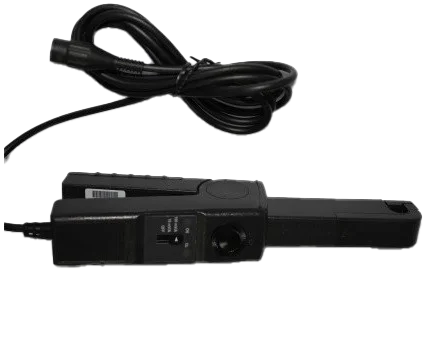
SIGLENT CP4020 AC/DC Current Clamp 60 A, 200 kHz

SIGLENT CP4020 is a compact AC/DC current clamp probe designed for accurate, non-intrusive current measurements up to 60 A peak. With a bandwidth of DC to 200 kHz and dual sensitivity ranges (50 mV/A / 5 mV/A), it is ideal for power electronics, troubleshooting, and general laboratory use. The standard BNC output ensures easy compatibility with most oscilloscopes.
60 A AC/DC current probe, DC–200 kHz
The CP4020 is the entry point to current measurement on an oscilloscope: 60 A peak, DC to 200 kHz, and ±2% DC accuracy for a price that makes it easy to justify. It clamps around the conductor, so nothing is broken into and no burden resistance is added to the circuit you are trying to characterise.
The output is a voltage on a plain BNC at a stated millivolts per amp, so it works with any oscilloscope of any brand — and with a multimeter through a BNC-to-banana adapter. A slide switch picks the range, a knob nulls the residual magnetism in the core before you measure, and the supplied 9 V adapter powers it. Nothing to configure, nothing proprietary.
What it does well
The things that decide whether a current measurement can be trusted.
True AC and DC
A Hall-effect core reads direct current as well as alternating, so a DC bus, a battery discharge or the standing current in a supply rail shows up as a real level — not a signal an AC-only clamp would miss entirely.
Works with any oscilloscope
Plain BNC output at 50 mV/A or 5 mV/A. Set the channel to match and read amps straight off the screen. No proprietary bus, no scope-brand lock-in.
The cheapest way to see amps
If you have never owned a current probe, this is the one that proves why you want one. Everything above it in the range buys more current, more bandwidth or tighter accuracy — not a different capability.
Zero before you measure
Clamping around iron leaves a remanent field that offsets every later DC reading. The zero adjustment nulls it in a second — the step that decides whether a DC current measurement can be trusted.
Rated for mains work
600 V CAT III · 600 V CAT II, with jaws that close over conductors up to 10.3 mm.
Key specifications
- DC–200 kHz (−3 dB), rise time 1.75 µs
- 20 Arms continuous · 60 A peak
- Ranges 50 mV/A and 5 mV/A
- Jaws accept conductors up to 10.3 mm
- Powered by the supplied 9 V adapter
- Plain BNC output — any oscilloscope, any brand
- Also reads on a multimeter with a BNC-banana adapter
- 600 V CAT III · 600 V CAT II
Application examples
Mains-frequency power work
Motor and appliance current at 50/60 Hz and its harmonics, where 200 kHz is ample and 20 Arms covers most single-phase equipment.
Supply and rail current
Follow the current a board actually draws instead of inferring it from a bench supply readout.
Inrush on small equipment
60 A of headroom catches the switch-on surge of a transformer or capacitor-input supply that would clip a 20 A instrument.
Teaching and general bench use
Rugged, self-contained and brand-agnostic — it works with whatever oscilloscope is on the bench.
Specifications
| Bandwidth | DC–200 kHz (−3 dB) |
|---|---|
| Rise time | 1.75 µs |
| Maximum continuous current | 20 Arms |
| Peak current | 60 A |
| Range switch | 50 mV/A and 5 mV/A |
| DC accuracy | ±2% ±0.4 A at 50 mV/A (0.4–10 A p-p) ±2% ±1 A at 5 mV/A (1–60 A p-p) |
| Power supply | DC 9 V adapter (supplied) |
| Maximum rated voltage to earth | 600 V CAT III · 600 V CAT II |
| Maximum conductor size | 10.3 mm |
| Output | BNC |
| Cable length | 200 cm |
| Weight | 310 g |
Taken from the SIGLENT Probe Data Sheet. Errors and omissions excepted; specifications may change without notice.
In the box
- Current probe
- 9 V DC adapter
- Instruction manual
Not sure this is the right probe?
Tell us the current you expect, the frequency it moves at, which oscilloscope you own and whether there is DC in the measurement. We will tell you which probe fits — including when a cheaper one covers it.