

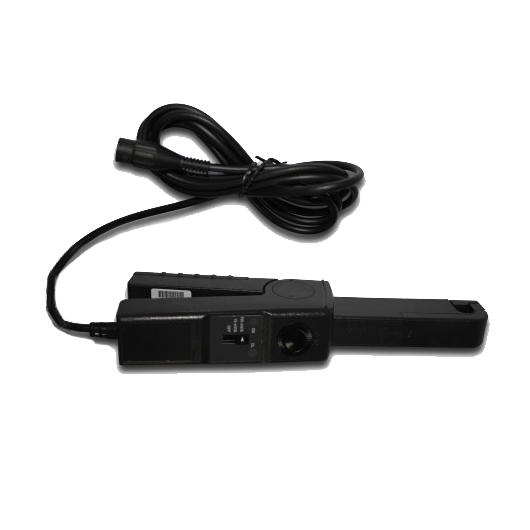
Siglent CP4070A 300 KHz 200 Amp Current Probe

Siglent CP4050 1 MHz 140 Amp Current Probe.
200 A AC/DC current probe, DC–300 kHz, 100 mV/A
The CP4070A matches the CP4070 on current and bandwidth — 200 A peak, DC to 300 kHz — but doubles the output sensitivity to 100 mV/A. That extra factor of two is what lets you resolve small currents on the same probe you use for the big ones, down to 50 mA on the sensitive range.
The output is a voltage on a plain BNC at a stated millivolts per amp, so it works with any oscilloscope of any brand — and with a multimeter through a BNC-to-banana adapter. A slide switch picks the range, a knob nulls the residual magnetism in the core before you measure, and the supplied 9 V adapter powers it. Nothing to configure, nothing proprietary.
What it does well
The things that decide whether a current measurement can be trusted.
True AC and DC
A Hall-effect core reads direct current as well as alternating, so a DC bus, a battery discharge or the standing current in a supply rail shows up as a real level — not a signal an AC-only clamp would miss entirely.
Works with any oscilloscope
Plain BNC output at 100 mV/A or 10 mV/A. Set the channel to match and read amps straight off the screen. No proprietary bus, no scope-brand lock-in.
100 mV/A, so small currents are visible
Twice the output of the CP4070 for the same amps. On a scope at 100 mV/div, one division is one amp on the high range — and 50 mA is still a readable trace on the low one.
11 mm jaw and lighter in the hand
A slightly wider opening than the rest of the CP4000 family, at 260 g rather than 310 g.
Zero before you measure
Clamping around iron leaves a remanent field that offsets every later DC reading. The zero adjustment nulls it in a second — the step that decides whether a DC current measurement can be trusted.
Rated for mains work
600 V CAT III · 600 V CAT II, with jaws that close over conductors up to 11 mm.
Key specifications
- DC–300 kHz (−3 dB), rise time 1.2 µs
- 70 Arms continuous · 200 A peak
- Ranges 100 mV/A and 10 mV/A
- Jaws accept conductors up to 11 mm
- Powered by the supplied 9 V adapter
- Plain BNC output — any oscilloscope, any brand
- Also reads on a multimeter with a BNC-banana adapter
- 600 V CAT III · 600 V CAT II
Application examples
Mixed large and small currents
When the same session needs both the 100 A inrush and the few hundred milliamps of standby draw, this saves swapping probes.
Standby and leakage measurement
The 100 mV/A range starts at 50 mA, so a low-power mode can be verified without breaking the circuit.
Motor drives and inverters
200 A peak with enough sensitivity to see the small ripple currents riding on the big ones.
Battery, PV and DC-bus current
True DC response with the resolution to separate a real trickle current from noise.
Specifications
| Bandwidth | DC–300 kHz (−3 dB) |
|---|---|
| Rise time | 1.2 µs |
| Maximum continuous current | 70 Arms |
| Peak current | 200 A |
| Range switch | 100 mV/A and 10 mV/A |
| DC accuracy | ±3% ±50 mA at 100 mV/A (50 mA–10 A peak) ±4% ±50 mA at 10 mV/A (500 mA–40 A peak) ±15% max at 10 mV/A (40–200 A peak) |
| Power supply | DC 9 V adapter (supplied) |
| Maximum rated voltage to earth | 600 V CAT III · 600 V CAT II |
| Maximum conductor size | 11 mm |
| Output | BNC |
| Cable length | 100 cm |
| Weight | 260 g |
Taken from the SIGLENT Probe Data Sheet. Errors and omissions excepted; specifications may change without notice.
In the box
- Current probe
- 9 V DC adapter
- Instruction manual
Not sure this is the right probe?
Tell us the current you expect, the frequency it moves at, which oscilloscope you own and whether there is DC in the measurement. We will tell you which probe fits — including when a cheaper one covers it.