

Siglent SNA6000-PM pulse measurement option (software)
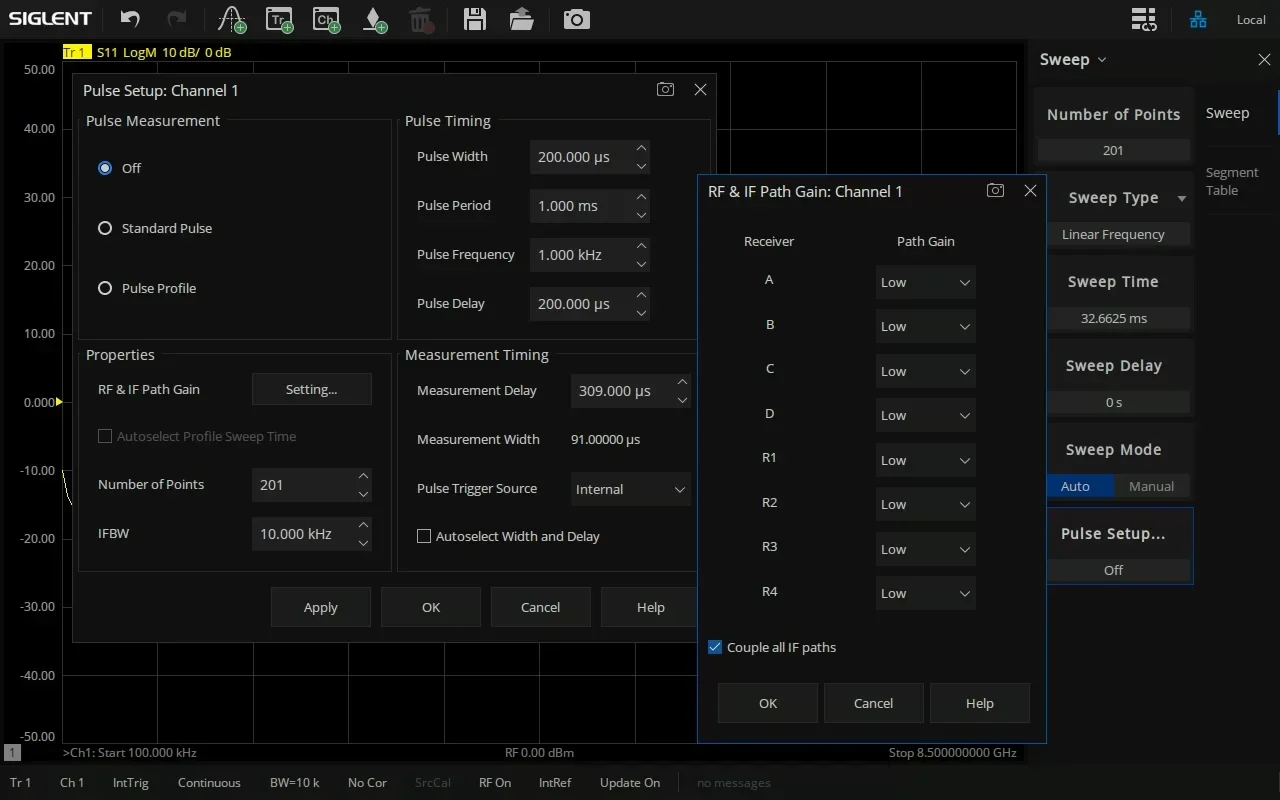
Pulsed S-parameters for the SNA6000A: standard pulse and pulse profile modes, pulse widths from 10 µs, 80 dB on/off ratio to 13.5 GHz. Licence key.
SNA6000-PM — pulse measurement
Pulsed S-parameters for the SNA6000A: standard pulse sweeps in frequency, power and CW time, and pulse profiles of the envelope, using the analyser’s internal pulse modulators.
Some devices cannot be measured with a continuous signal: power amplifiers for TDMA and radar overheat, drift or fail, and on-wafer transistors self-heat. This option pulses the source and the receivers together, so S-parameters are measured only while the pulse is on — at the duty cycle the device is designed for. A pulse-profile mode shows the envelope of the pulse against time at a fixed frequency.
What this option does
What it does
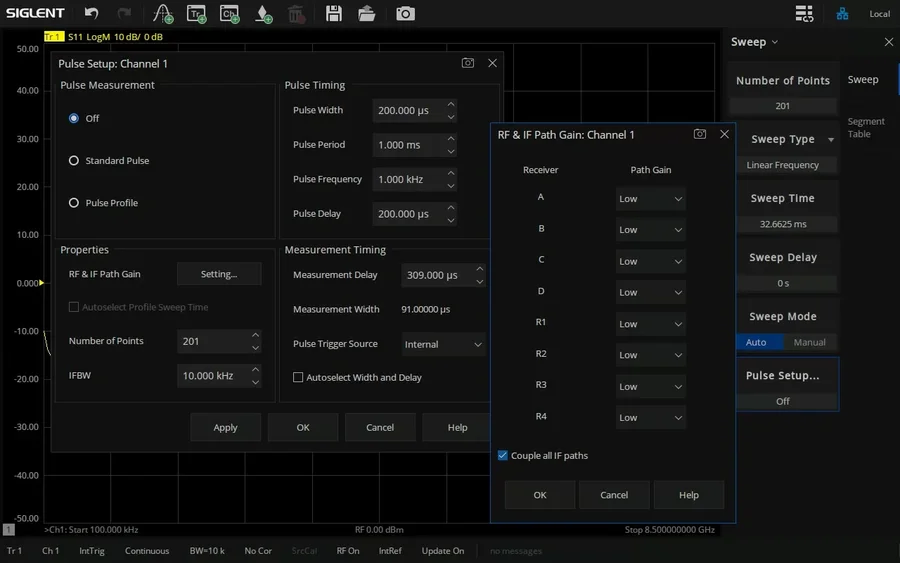
Sets source pulse width, period and delay, receiver delay and width, and the pulse trigger source; measures in standard-pulse mode (frequency, power or CW-time sweep) or pulse-profile mode; sets RF and IF path gain per receiver.
What you use it for
Gain, match and compression of pulsed power amplifiers, and of transistors and modules that must be kept cool or within a duty-cycle limit during test.
In practice
A GSM power amplifier is driven at full output with a 577 µs burst at 12.5 % duty cycle. Its gain matches the CW result at low level, and the pulse profile shows the droop across the burst that a CW sweep cannot show.
This is pulsed S-parameter measurement, not a pulse-parameter analyser: it does not report rise time, fall time or jitter of an external pulse. The internal modulators reach a minimum pulse width of 10 µs and a minimum period of 30 µs (typical) — suited to power amplifiers and TDMA bursts, not to nanosecond radar pulses. The receiver window follows the IF bandwidth: shorter pulses need a wider IFBW.
Pulsed stimulus, gated receivers
Standard pulse
Pulsed S-parameters in linear frequency, power and CW-time sweeps.
Pulse profile
The envelope of the pulse against time at a CW frequency.
Pulse timing
Pulse width, period (or frequency) and delay of the source pulse.
Measurement timing
Receiver delay and width, with the width set by the chosen IF bandwidth.
Autoselect
Width at about 75 % of the period with 20 % delay; in profile mode, a period of twice the width with the pulse centred.
RF & IF path gain
Low, medium or high per receiver, or coupled for all, to fit the pulse level to the receiver.
On/off ratio
80 dB to 13.5 GHz and 70 dB from 13.5 to 26.5 GHz (typical).
Period range
Minimum period 30 µs, maximum 26 s (typical).
Specification
From the SNA6000A data sheet and user manual.
| Measurement modes | Off, standard pulse, pulse profile |
| Sweep types (standard pulse) | Linear frequency, power, CW time |
| Minimum pulse width | 10 µs (typical) |
| Pulse period | 30 µs to 26 s (typical) |
| Pulse modulation on/off ratio | 80 dB, 100 kHz–13.5 GHz · 70 dB, 13.5–26.5 GHz (typical) |
| Source pulse settings | Width, period or frequency, delay |
| Receiver settings | Measurement delay, measurement width (from IFBW), pulse trigger source |
| Autoselect | Width ≈ 75 % of period with 20 % delay (standard) · period = 2 × width (profile) |
| RF & IF path gain | Low, medium, high per receiver; couple all paths |
Compatibility and activation
Works on all eight SNA6000A models; on/off ratio 70 dB above 13.5 GHz on the 26.5 GHz models.
Supplied as a licence key issued against the analyser’s serial number — nothing to fit and nothing to return. Enter it under System → Options → License…, or load the .lic file from a USB stick. Ordered together with a new SNA6000A, Siglent activates it at the factory.
Goes with
Questions about SNA6000-PM
Does it measure rise time, fall time or jitter of a pulse?
No. It measures the S-parameters of a device under pulsed stimulus, and the envelope of the pulse in profile mode. For pulse timing parameters, use an oscilloscope or a spectrum analyser with pulse analysis.
What is the shortest pulse?
Siglent gives a minimum pulse width of 10 µs and a minimum period of 30 µs (typical).
Why does the IF bandwidth matter?
The receiver measures inside the pulse, and its measurement width follows the IF bandwidth. A shorter pulse needs a wider IFBW, which raises the noise floor — the usual trade-off in pulsed measurement.
Do I need an external pulse generator or modulator?
Siglent’s data sheet specifies the pulsed-RF performance of the SNA6000A itself (section 6.6), and the option controls it from the Pulse Setup dialog.
When should I use the profile mode?
When the shape of the burst matters: droop, overshoot or settling of an amplifier across the pulse, at one frequency.
How is the licence delivered?
Supplied as a licence key issued against the analyser’s serial number — nothing to fit and nothing to return. Enter it under System → Options → License…, or load the .lic file from a USB stick. Ordered together with a new SNA6000A, Siglent activates it at the factory. Add the analyser’s serial number to your order, or send it to us afterwards.
Can I return a licence?
Software licences and activation keys are delivered electronically and are excluded from the 14-day EU return right once the key has been issued. If you are unsure, ask us first.
Planning an SNA6000A measurement?
Tell us the device, the frequency range and what you need to measure. We will confirm the model, the options and the calibration you need before you order.