

Siglent SDS800XHD-PA Power Analysis Licence for SDS800X HD

Power Analysis licence for the Siglent SDS800X HD. Twelve analyses: power quality, IEC 61000-3-2 harmonics, inrush, switching loss, SOA, PSRR and more
Turns the oscilloscope into a power-supply instrument
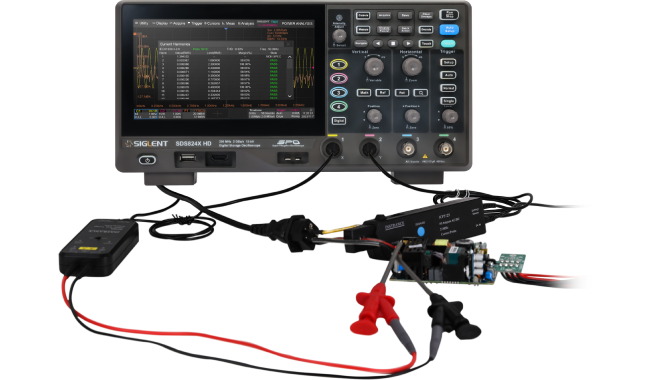
Every measurement in a switching converter is available on an ordinary oscilloscope, in the sense that the waveforms are on the screen. Getting a number out of them is another matter: switching loss means integrating the product of voltage and current over the part of the cycle where the device is transitioning, harmonic compliance means comparing dozens of bins against a limit line, and safe operating area means plotting one channel against another. By hand, each is an afternoon and a spreadsheet, and none of it is repeatable between two engineers.
The SDS800XHD-PA licence adds the application that does all of it on the instrument. Twelve analyses, each with a defined method, a configuration page and a results table — so the measurement can be repeated identically on the next unit off the line, and the numbers mean the same thing to whoever reads them.
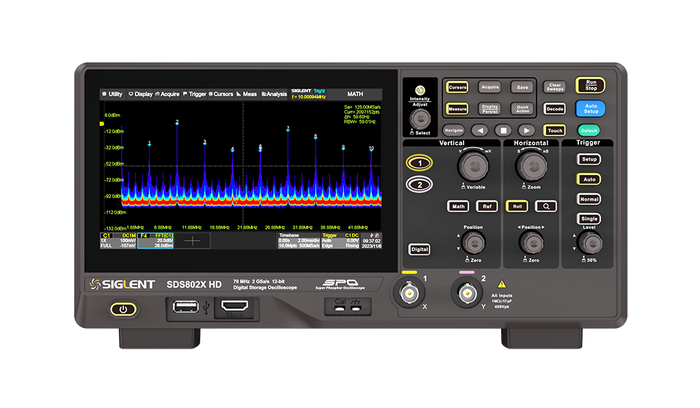
It is a software key. Nothing is returned to the factory, nothing is recalibrated, and it can be added at any point in the instrument's life. On the SDS800X HD it is also the only paid software option — serial trigger and decode for I²C, SPI, UART, CAN and LIN is standard on this series, as are Bode plot and mask test.
Twelve analyses
The full set from the SDS800X HD data sheet. Each one is a guided measurement with its own setup page, not a preset on a cursor.
Power quality
Real, apparent and reactive power, power factor, crest factor and displacement, taken together rather than one cursor at a time.
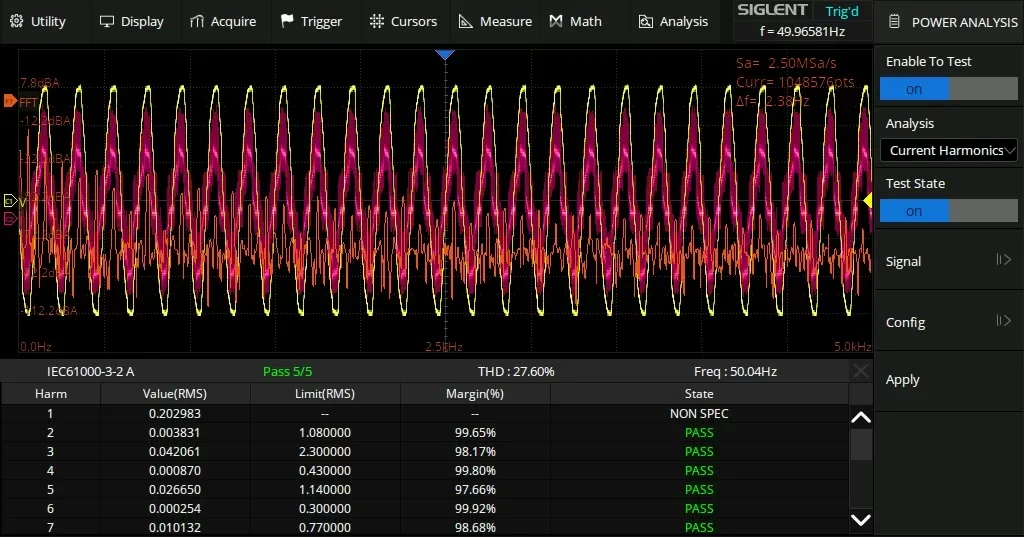
Current harmonics
Harmonic content measured against the IEC 61000-3-2 limit lines, with a per-harmonic pass/fail table and total harmonic distortion.
Inrush current
The peak the supply draws at switch-on — the number that decides fuse and NTC ratings, and that is easy to miss with a manual single capture.
Switching loss
Turn-on, turn-off and conduction loss per cycle, computed from the synchronised voltage and current channels instead of by hand with cursors and a spreadsheet.
Slew rate
dv/dt and di/dt on the switching edges, where device stress and radiated emissions both come from.
Modulation
How the duty cycle, pulse width and period of the switching waveform move as the converter regulates.
Output ripple
The residual AC on the rail, measured to a defined method so one board can be compared with the next.
Turn on / turn off
How long the rail takes to come up and to collapse — sequencing behaviour that matters as soon as more than one rail is involved.
Transient response
Sag, overshoot and recovery time when the load steps, measured against the tolerance band the specification allows.
PSRR
Power-supply rejection ratio — how much of a disturbance on the input survives to the output across frequency.
Safe operating area
Voltage plotted against current for the switching device, with the manufacturer's SOA boundary overlaid so excursions are visible rather than inferred.
Efficiency
Input against output power, with loss accounted for. Four-channel models only — it needs two voltage and two current channels at once.
What you need alongside it
The licence enables the software. Power is a voltage multiplied by a current, so two probes and a way to align them are what make the measurement real. We would rather say so before you order than after.
A differential voltage probe
The switching node is not at earth potential, so an earthed passive probe cannot go there. Siglent specify the DPB5000 series.
A current probe
Clamped round the conductor so current is measured without breaking the circuit or inserting a shunt. Siglent specify the CP6000 series.
A way to deskew them
A current probe typically lags a voltage probe by several nanoseconds — exactly where switching loss is calculated. The DF2001A fixture measures that offset so it can be corrected.
Which oscilloscopes it fits
All six SDS800X HD models. One caveat worth knowing before you order: efficiency needs four channels — input voltage, input current, output voltage and output current at the same time — so on a two-channel instrument you get eleven of the twelve analyses.
| Model | Bandwidth | Channels | Analyses available |
|---|---|---|---|
| SDS802X HD | 70 MHz | 2 | 11 — no efficiency |
| SDS812X HD | 100 MHz | 2 | 11 — no efficiency |
| SDS822X HD | 200 MHz | 2 | 11 — no efficiency |
| SDS804X HD | 70 MHz | 4 | All 12 |
| SDS814X HD | 100 MHz | 4 | All 12 |
| SDS824X HD | 200 MHz | 4 | All 12 |
Questions we are asked
Which oscilloscopes does this licence fit?
Every model in the SDS800X HD series — SDS802X HD, SDS804X HD, SDS812X HD, SDS814X HD, SDS822X HD and SDS824X HD. It is keyed to the series, so quote your instrument's serial number when ordering.
Do I get all twelve measurements on a two-channel model?
Eleven of them. Efficiency is four-channel only, because measuring it means watching input voltage, input current, output voltage and output current at the same time. Everything else — power quality, harmonics, inrush, switching loss, slew rate, modulation, ripple, turn on/off, transient response, PSRR and SOA — works on two channels.
What else do I need to buy?
Probes. Power analysis multiplies a voltage by a current, so you need a differential voltage probe and a current probe — Siglent specify the DPB5000 and CP6000 series. You also need to deskew them, which is what the DF2001A fixture is for. The licence on its own will not measure anything.
Why does deskew matter so much?
Because switching loss is calculated exactly where the two waveforms cross. A current probe commonly lags a passive voltage probe by several nanoseconds, and on a 100 kHz converter that offset sits squarely in the switching edge where nearly all the loss occurs. Uncorrected, the loss figures can be wrong by tens of percent while both probes are working perfectly.
Is this the only software option for the SDS800X HD?
Yes. Serial trigger and decode for I²C, SPI, UART, CAN and LIN is standard on this series, as are Bode plot, mask test and the 2 Mpts FFT; there are no further protocol keys for the SDS800X HD. Power Analysis is the one paid software option.
Can I add it after buying the oscilloscope?
Yes. It is a software key: no hardware changes, no return to the factory and no recalibration. Send us the serial number and the key is issued against that instrument.
Does the harmonics test give me a compliance certificate?
No — and nothing on a bench can. The test measures against the IEC 61000-3-2 limit lines and reports pass or fail per harmonic, which is what you want for pre-compliance: finding and fixing problems before you book chamber time. Formal compliance is measured in an accredited laboratory.
Goes with
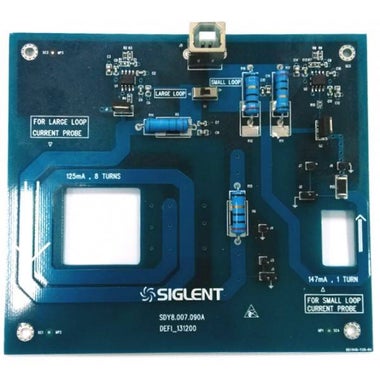
Deskew fixture — corrects the timing offset between the voltage and current probe.
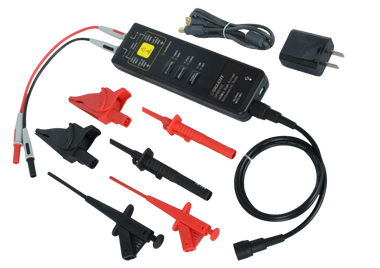
DPB5000 series high-voltage differential probes for the switching node.
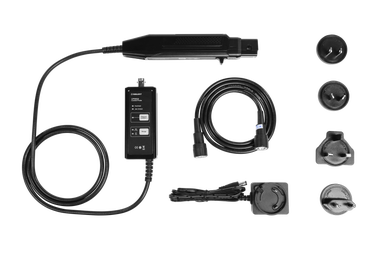
CP6000 series current probes — clamp round the conductor, no shunt.
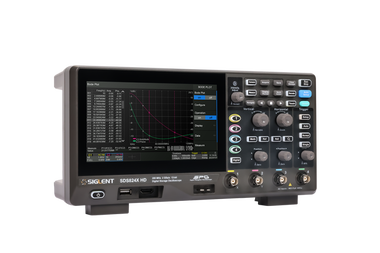
The oscilloscopes this licence runs on — six 12-bit models, 70 to 200 MHz.
Send us the serial number
The key is issued against your instrument. Tell us the model and serial number and what you are measuring, and we will confirm the licence and whether you have the probes to go with it. We are the official Siglent distributor for the European Union.
Software licences and activation keys are delivered electronically and are excluded from the 14-day EU return right once the key has been issued.