

Siglent SDS1104X-E 100 MHz Four-Channel Oscilloscope — second-hand unit
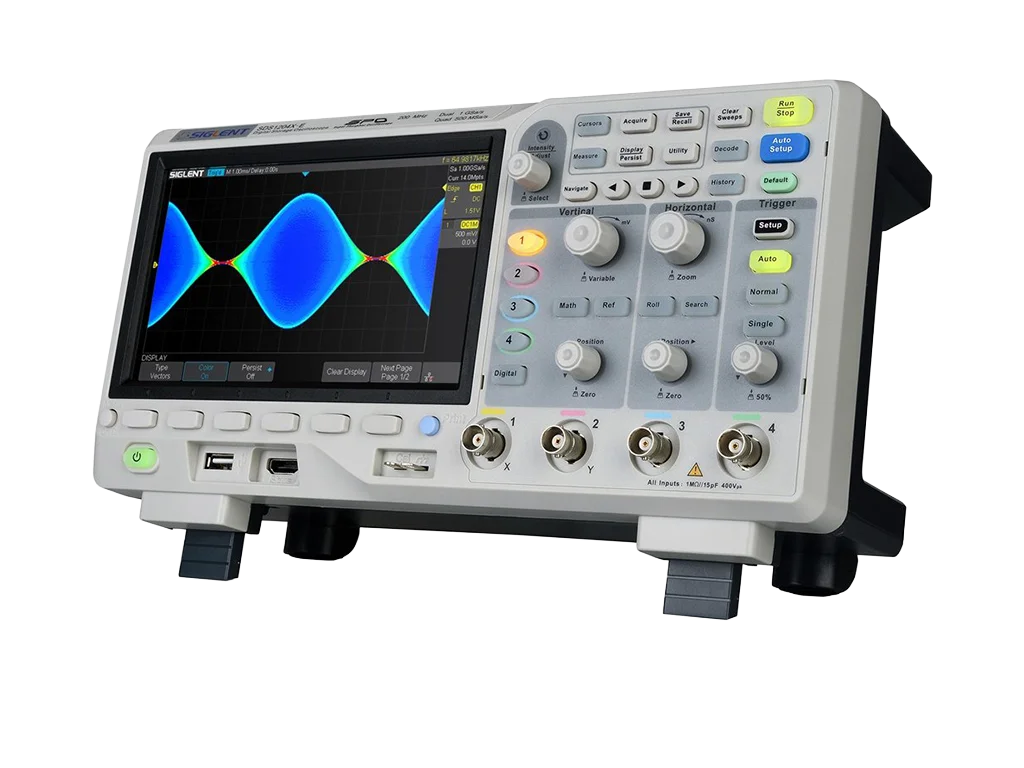
Second-hand Siglent SDS1104X-E: 100 MHz, 4 channels, free serial decode, Bode plot, web control, 4 probes included, 2-year warrant
Four channels is a different instrument, not two more BNCs
The SDS1104X-E is 100 MHz across four channels at 1 GSa/s, with 14 Mpts of memory and a 400,000 wfm/s capture rate in sequence mode. Serial triggering and decoding for I²C, SPI, UART, RS232, CAN and LIN are included, with nothing to license.
What is easy to miss is that on this family the four-channel models are not simply the two-channel ones with more inputs. Roughly a dozen functions exist only on them — the MSO option, the AWG module, Bode plot, control from a web browser, search and navigate, channel labels, a hardware counter, the data logger, FFT peaks and markers, NTP. None of those can be added to a two-channel model at any price. There is a full comparison further down.
This particular one was traded in against another instrument. It is in as-new condition in its original carton, complete with all four 100 MHz probes, and it is €84 below the price of the same scope new. There is one of it.
- As new, original carton, complete
- Four 100 MHz probes included
- Serial decode free, nothing to license
- Two-year warranty · still a current model
- Ships from the Netherlands
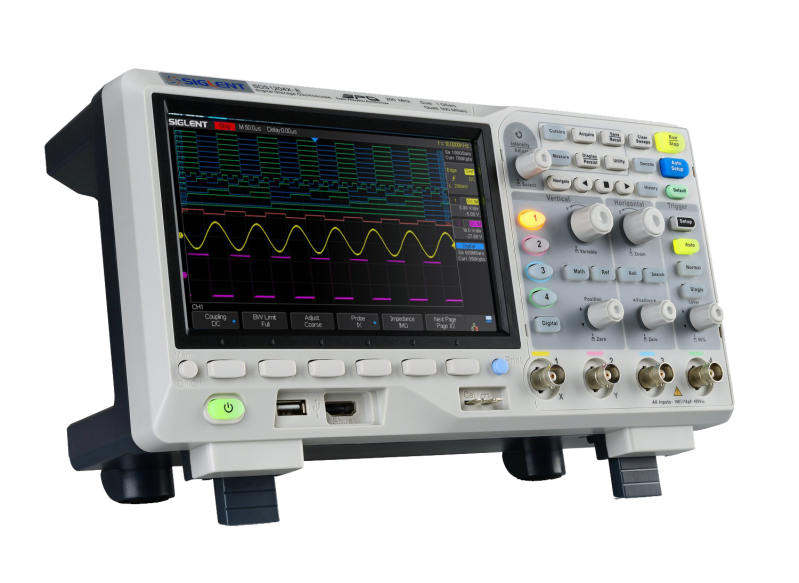
This particular unit
What you are actually buying, before the specification.
Why it is discounted
It was traded in. A customer moved up to another instrument and this one came back to us against the new one. It is second-hand rather than ex-demo — the difference is who used it, not what state it is in.
The condition
As new, in its original carton, with nothing missing. Ask us for photographs of the actual instrument before you order and we will send them — including anything a photograph would show that a description would not.
What comes with it
The four PP510 100 MHz probes, power cord, USB cable and quick start guide — the complete standard set. Four probes is a meaningful part of what you are buying at this price.
Warranty and support
Two years, against three on a new one — the single difference between this and buying it new. Firmware, the software tools and our technical support are identical.
It is a plain four-channel oscilloscope, and that is worth knowing before you order rather than after. The built-in generator needs the SAG1021I module and its separate activation licence — the module alone does nothing and neither does the licence alone. Bode plot needs the SAG1021I as its source. MSO needs the SLA1016. All three fit this instrument and all three are priced further down this page.
Two channels against four, on this family
Straight from the data sheet’s own “four channel series only” markings. It is a longer list than most people expect, and it is the reason a 100 MHz four-channel model is often the better buy than a 200 MHz two-channel one at a similar price.
| Two-channel models | Four-channel — including this SDS1104X-E | |
|---|---|---|
| Analogue channels | 2, plus an external trigger input | 4 |
| ADCs / memory modules | One 1 GSa/s ADC, one 14 Mpts module | Two 1 GSa/s ADCs, two 14 Mpts modules (CH1+CH2 share one, CH3+CH4 the other) |
| 1 GSa/s and 14 Mpts at the same time on | One channel | Two channels — one per pair, e.g. CH1 and CH3 |
| 16 digital channels (MSO) | — | Option: SLA1016 |
| Built-in AWG | — | Option: SAG1021I module + activation licence |
| Bode plot / control-loop response | — | Yes, including Vari-level for PSRR |
| Control from a web browser | — | Yes, embedded web server |
| Search and navigate | — | Yes |
| Channel labels | — | Yes |
| Hardware 6-digit counter | — | Yes |
| Data logger (sample + measurement) | — | Yes |
| FFT peaks and markers | — | Yes |
| NTP time synchronisation | — | Yes |
| USB host ports | 1 | 2 |
| Power / net weight | 25 W max · 2.5 kg | 50 W max · 2.6 kg |
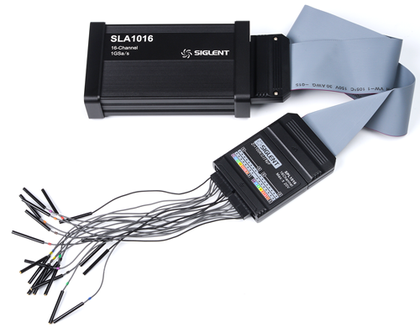
Sixteen digital channels at 1 GSa/s with 14 Mpts each, plugged into the Sbus connector on the back. Four analogue channels and sixteen digital ones is a different class of debugging tool, and the two-channel models cannot take it at all.
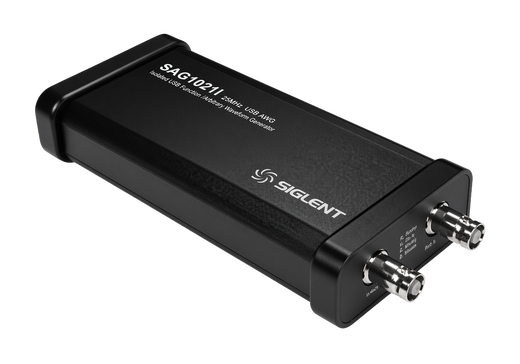
A 25 MHz isolated arbitrary generator driven from the scope’s own front panel, and the source the Bode plot function sweeps. Measuring a power supply’s control loop, gain margin and phase margin needs both halves — and the module needs its activation licence alongside it.
What 14 Mpts is actually for
Deep memory is easy to quote and hard to picture. These two screenshots are the same instrument and the same 11 MHz signal — the difference is how much memory was behind the acquisition. On this model you get that depth on two channels at once, one from each converter pair, which the two-channel models cannot do.
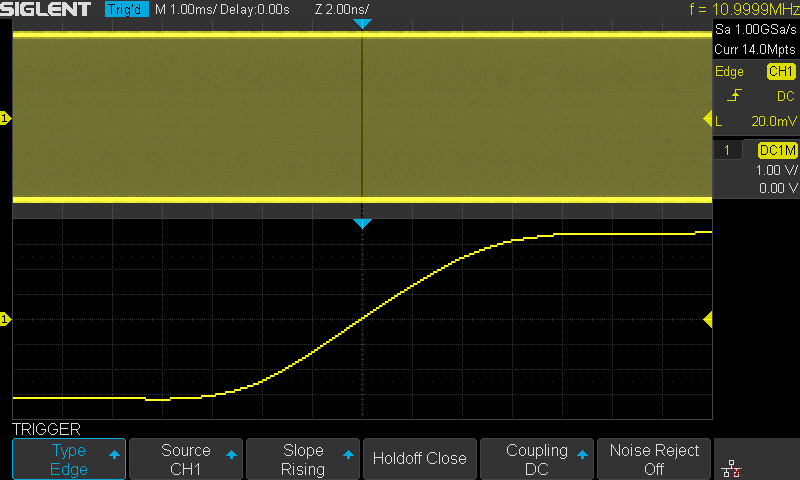
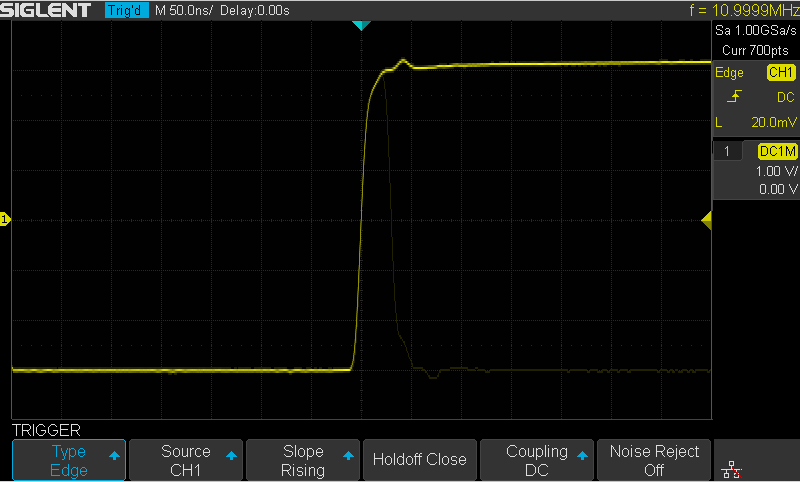
400,000 wfm/s in sequence
Sequence mode splits the memory into up to 80,000 segments with very little dead time between them, so an event that happens once an hour is still there when you come back to look for it.
80,000 history frames
Every acquisition is kept. Scroll back through what already happened rather than trying to provoke it again, with measurements and decoding running on the recalled frames.
256-level intensity grading
Colour-temperature mode maps how often each point is hit onto a colour scale, which turns jitter and modulation into something you can see at a glance instead of something you have to hunt for.
Triggering and decoding, all included
Nothing here is a licence. On most instruments at any price, serial decode is the option you discover you need after you have bought it — and with four channels you can watch a bus and the two signals that are upsetting it at the same time.
Trigger and decode, standard.
Beyond edge, which is where the useful ones start.
Search, navigate and label
Two more four-channel-only conveniences that do not sound like much until you use them. Search and navigate finds every occurrence of an event inside a long acquisition and steps you between them, instead of leaving you to drag the horizontal position and hope. Channel labels let you name the traces, which is the difference between a screenshot that means something in a report and one that does not.
The hardware 6-digit frequency counter runs alongside, and the data logger records either raw samples at 1 Sa/s to 25 kSa/s or up to four measured parameters at intervals from 0.1 s to 10 minutes — a scope left to watch something overnight.
- Web control. An embedded web server — the whole front panel in a browser, over LAN, with no software to install.
- Bode plot. Control-loop gain and phase from 10 Hz, scan bandwidth 500 Hz to 120 MHz, up to 500 points, with Vari-level mode for PSRR.
- FFT peaks and markers. The 1 Mpts FFT with automatic peak finding instead of cursor work.
- NTP. The instrument clock synchronised over the network, so timestamps on saved files are actually right.
Specification
From the SDS1000X-E data sheet, four-channel model. Being second-hand changes the price, not the instrument.
| Bandwidth | 100 MHz (−3 dB) |
| Channels | 4 analogue |
| Sample rate | 1 GSa/s with one channel per ADC pair active · 500 MSa/s with both |
| Record length | 14 Mpts with one channel per ADC pair active · 7 Mpts/ch with both |
| Vertical resolution | 8-bit |
| Vertical scale | 500 µV/div to 10 V/div in 1-2-5 steps (probe 1×) |
| Input | 1 MΩ ±2% in parallel with 17 pF ±3 pF · max. 400 Vpk |
| DC gain accuracy | ±3.0% from 5 mV/div to 10 V/div · ±4.0% at 2 mV/div |
| Rise time (typical) | 3.5 ns |
| Timebase | 1 ns/div to 100 s/div · accuracy ±25 ppm · roll mode from 50 ms/div |
| Waveform capture rate | 100,000 wfm/s normal · 400,000 wfm/s in sequence mode |
| Sequence and history | Up to 80,000 segments · up to 80,000 history frames |
| Trigger types | Edge, slope, pulse width, window, runt, interval, dropout, pattern, video (NTSC, PAL, 720p, 1080i, 1080p, custom) |
| Serial trigger & decode | I²C, SPI, UART/RS-232, CAN, LIN — standard, nothing to license |
| Maths | +, −, ×, ÷, FFT (1 Mpts), d/dt, ∫dt, √ · FFT windows: rectangular, Blackman, Hanning, Hamming, flat-top · peaks and markers |
| Measurements | 38 parameters with statistics, gating, zoom, history and reference — computed over all sampled points, up to 14 Mpts |
| Counter | Hardware 6-digit frequency counter |
| Data logger | Sample logger 1 Sa/s to 25 kSa/s · measurement logger, up to 4 values, interval 0.1 s to 10 minutes |
| Bode plot | From 10 Hz · scan bandwidth 500 Hz to 120 MHz · up to 500 points · Vari-level mode — requires the SAG1021I module |
| Pass/fail | Hardware-based, up to 40,000 decisions per second, 3.3 V TTL output |
| Display | 7-inch TFT-LCD, 800 × 480, 24-bit colour, 500:1, 300 nits · 256-level intensity grading and colour-temperature mode |
| I/O | 2 × USB host · USB device (USB-TMC) · LAN · pass/fail · trigger out · Sbus for the SLA1016 |
| Remote control | SCPI over VXI-11, Telnet (port 5024) and raw socket (port 5025) · browser-based web control |
| Languages | English, German, French, Italian, Portuguese, Russian, Japanese, Korean, simplified and traditional Chinese |
| Power | 100–240 V 50/60 Hz or 100–120 V 400 Hz · 50 W max |
| Dimensions and weight | 312 × 132.6 × 151 mm · 2.6 kg net |
| Environment | 0 to +40 °C operating · 85% RH · to 3,000 m |
Channels are paired across two converters and two memory modules: CH1 with CH2, CH3 with CH4. One channel from each pair gets the full 1 GSa/s and 14 Mpts; with both channels of a pair on, each gets 500 MSa/s and 7 Mpts.
In the box
The full standard set, in the original carton and complete. Note the four probes — a set of four 100 MHz passive probes is a real part of what this costs.
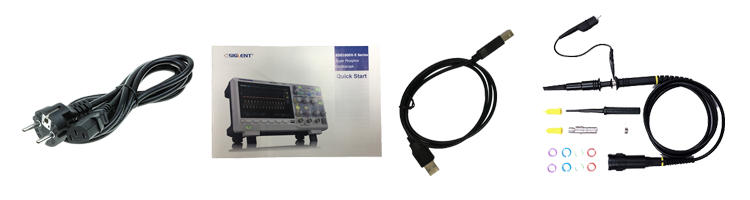
- 4 × PP510 100 MHz passive probes, 1×/10×, each with tips, ground clips, colour rings and a trimmer
- Power cord (EU)
- USB cable for the USB-TMC device port
- Quick start guide — the full manual and data sheet are below
- The original carton, which is worth having if it ever needs to travel
Worth adding
None of these are fitted to this unit. The first three are the four-channel-only options, so this is the instrument they belong on.
| Accessory | What it is | Price |
|---|---|---|
| SLA1016 | 16-channel logic probe module — the MSO hardware. 1 GSa/s, 14 Mpts/ch, 4 ns minimum detectable pulse, supplied with interface cable, flying leads and grabbers. Four-channel models only, so it fits this one. | €328 |
| SAG1021I | 25 MHz isolated USB arbitrary waveform generator module, ±42 Vpk output. Four-channel models only, and the source the Bode-plot function drives. | €239 |
| SDS1000X-E AWG licence | The activation licence that unlocks generator control inside the oscilloscope. Required in addition to the SAG1021I hardware — the module on its own will not do anything. | €95 |
| SDS1000X-E Wi-Fi module | Wireless module with its activation licence, for benches where an Ethernet run is impractical. | €102 |
| SDS1X-E-RMK | 19-inch 4U rack shelf with front panel and handles. | €125 |
| BAG-S1 | Soft carry case sized for the whole SDS1000X-E family. | €59 |
| PP510 | Spare or extra 100 MHz 1×/10× passive probe, 150 V / 300 V RMS CAT II. | €16 |
| STB-3 | Demonstration and training board — square, sine, AM, fast edge, PWM, I²C, CAN and LIN sources for teaching and for checking an instrument. | €189 |
Accessory prices ex VAT, as listed on the shop.
Manuals and data sheet
The same documentation as a new unit.
The complete specification, including every function marked four-channel-only.
Acquisition, triggering, serial decode, maths, measurement, history, sequence, pass/fail and the four-channel-only functions.
The full SCPI command set — everything needed to automate the instrument over LAN or USB-TMC.
Block diagrams, disassembly and the performance verification procedure.
Measuring power-supply control-loop response with the Bode plot function and the SAG1021I.
How the sample logger and the measurement logger work in practice on this model.
Unpacking, first power-up, front and rear panel layout and the safety notes.
Specifications for the whole Siglent probe range, including the supplied PP510.
Questions we are asked
What is wrong with it?
Nothing. It came back to us as a trade-in when its owner moved to another instrument, and it is in as-new condition in its original carton with everything present. It is discounted because it is second-hand, not because anything is the matter with it. If there were a fault, this listing would say what it was — that is the rule on every unit we sell this way.
Why the four-channel 100 MHz rather than the two-channel 200 MHz?
Because on this family the channel count decides what the instrument can do, not just how many probes you can hang on it. MSO, the AWG module, Bode plot, browser control, search and navigate, channel labels, the hardware counter, the data logger, FFT peaks and NTP are all four-channel-only. The two-channel model has none of them at any price. If your work is embedded, power or control-loop, that list matters more than the difference between 100 and 200 MHz. If you are chasing fast edges, it does not — buy bandwidth instead.
Does it really do 1 GSa/s and 14 Mpts?
On one channel per converter, yes, and that is where the four-channel model quietly wins. It has two 1 GSa/s converters and two 14 Mpts memory modules: CH1 and CH2 share one, CH3 and CH4 the other. So you can run two channels at the full 1 GSa/s and 14 Mpts at once — one from each pair, CH1 and CH3 for instance. Turn on all four and each gets 500 MSa/s and 7 Mpts. The two-channel model has one converter and one memory module, so it can never do this.
Are any options or licences activated on it?
No. It comes as a plain four-channel oscilloscope. That is worth reading carefully if you are planning on the built-in generator: the AWG needs the SAG1021I module and the separate activation licence — the module on its own does nothing, and neither does the licence. The Bode plot function needs the SAG1021I too. MSO needs the SLA1016. All three are listed with their prices further up this page, and all three fit this instrument.
Is serial decoding an extra?
No. I²C, SPI, UART, RS232, CAN and LIN triggering and decoding are all included, with nothing to license. At this price that is unusual and it is the main reason the family has stayed popular.
Can I control it from a browser, and do Bode plots?
Yes to the browser — the embedded web server is a four-channel-only function and this is a four-channel model. Bode plot is there in the firmware as well, but it needs an external source to sweep, which is the SAG1021I module. Without it the function is present and cannot run.
Is the photograph this actual instrument?
No, and we would rather say so. Siglent publish one photograph of the four-channel chassis and the front panel in it is silkscreened SDS1204X-E, the 200 MHz model. The instrument on offer is the SDS1104X-E, 100 MHz — physically the same box, a different name printed on it. Ask us and we will send photographs of the actual unit before you order.
What warranty does it have?
Two years, where a new one carries three. That is the only thing you give up, and it is worth setting against the €84 you save. It is handled by us in the Netherlands, the same as any other instrument you buy from us.
Is it still a current model?
Yes. The SDS1104X-E is still in the catalogue and still sold new at €419, which is what the saving here is measured against. This is not old stock being cleared.
What if it has already gone?
There is one. If you are too late, tell us what you were after — we usually know what is coming back before it is listed.
There is one of these
Ask for photographs of the actual instrument, or for anything the listing does not answer, before you order. JRSE B.V. is the official Siglent distributor for the European Union.
More about the range this belongs to: the SDS1000X-E series, where all three models are compared side by side.