

Siglent SNA6000-AFR automatic fixture removal option (software)
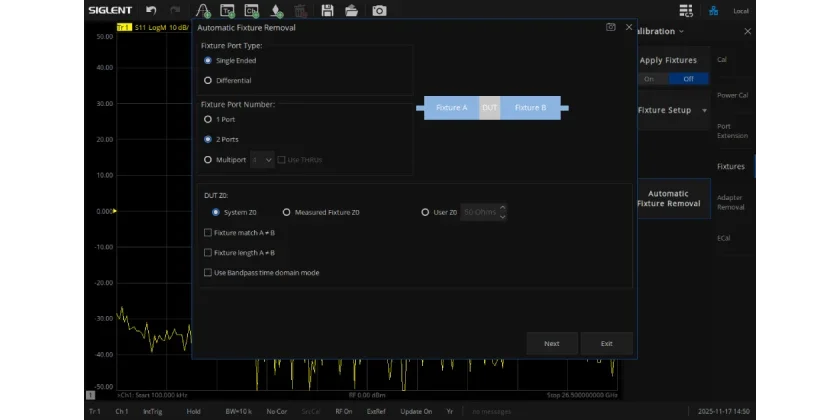
Automatic fixture removal for the SNA6000A VNA: 2X-Thru and 1X-Reflect methods, single-ended or differential fixtures, fixture files saved as s2p.
SNA6000-AFR — automatic fixture removal
Characterises a test fixture from a 2X-Thru or 1X-Reflect standard and de-embeds it mathematically, so PCB launches, connectors and surface-mount parts are measured as themselves, not with the board around them.
A part on a PCB coupon, a board-mounted connector or a chip component cannot be reached with a coaxial calibration kit; the fixture between the analyser and the device adds loss, reflection and phase. AFR measures a standard built in the same fixture technology — a 2X-Thru, a 1X-Reflect, or both — transforms that measurement to the time domain, splits it into the two fixture halves and stores them as S-parameter files. Applied as de-embedding, the fixture disappears from the trace. Siglent positions it as simpler than TRL calibration with comparable precision.
What this option does
What it does
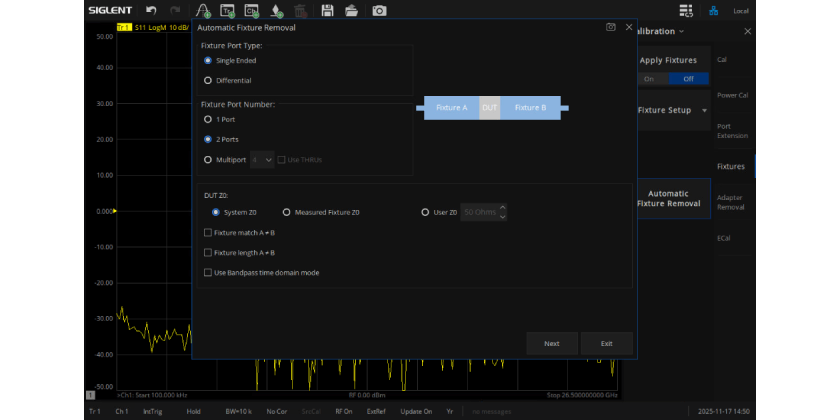
Extracts the S-parameters of each fixture half from a 2X-Thru (two halves back to back) or from a 1X-Reflect (the fixture itself, open or short at the device plane), saves them as .s2p files and de-embeds them from the measurement. A wizard walks through port type, port count, DUT impedance and the measurements.
What you use it for
S-parameters of PCB traces, launches, board-mounted connectors, surface-mount filters and other non-coaxial devices — anywhere the coaxial calibration plane cannot reach the device.
In practice
A balun on a test coupon has a 2X-Thru coupon beside it on the same panel. Measure the 2X-Thru once, run the wizard, and every later measurement of the balun shows the balun alone — launch and trace removed, reference plane at the pads.
You need a standard in the fixture technology: a 2X-Thru (both fixture halves back to back) and/or a 1X-Reflect (the fixture with an open or short at the device plane, so the device must be removable). The 2X-Thru method assumes the standard has the same impedance, delay and loss as the fixture and that its halves are symmetrical; when they are not, a second 2X-Thru and a 1X-Reflect correction are available. Differential fixtures need a 4-port model. Calibrate at the coaxial plane first; AFR builds on that calibration.
What is in the fixture-removal toolkit
2X-Thru method
Two fixture halves measured back to back; the fixture model is split at half the standard’s delay.
1X-Reflect method
Uses the fixture itself with an open or short at the device plane; no separate thru structure needed.
Combined
2X-Thru plus 1X-Reflect for higher accuracy, and a second 2X-Thru when the halves are not symmetrical.
Single-ended or differential
Port type selected in the wizard; differential fixtures on the 4-port models.
One or two fixture ports
Choose the fixture port count and port numbers; multiport is listed in the wizard.
DUT impedance
System Z0, the measured fixture Z0, or a user value, with fixture match and length A = B options.
Fixture files
Each half is saved as <name>_1.s2p and <name>_2.s2p, and the raw measurements can be stored too.
Band-pass time-domain mode
Selectable for band-limited fixtures where the low-pass transform is not valid.
Specification
From the SNA6000A data sheet and user manual.
| Extraction methods | 2X-Thru · 1X-Reflect (open or short) · both combined · second 2X-Thru correction |
| Fixture types | Single-ended or differential · 1 or 2 fixture ports (multiport selectable) |
| DUT impedance | System Z0 · measured fixture Z0 · user value |
| Output | Fixture S-parameters per half (.s2p), applied as de-embedding; raw measurements saveable |
| Needs | A 2X-Thru and/or 1X-Reflect standard in the fixture technology; coaxial calibration at the test-port plane |
| Differential fixtures | 4-port models (SNA6024A, SNA6124A, SNA6034A, SNA6134A) |
| Models | All eight SNA6000A models |
Compatibility and activation
Works on all eight models; differential fixtures need a 4-port analyser.
Supplied as a licence key issued against the analyser’s serial number — nothing to fit and nothing to return. Enter it under System → Options → License…, or load the .lic file from a USB stick. Ordered together with a new SNA6000A, Siglent activates it at the factory.
Goes with
Questions about SNA6000-AFR
How is AFR different from time-domain gating?
TDA gating removes a stretch of the time response you can separate from the device. AFR builds a full S-parameter model of the fixture from a standard and de-embeds it, including its loss and phase, which gating cannot do.
How is it different from TRL calibration?
TRL needs a set of in-fixture standards and a careful line design. AFR needs one 2X-Thru or a reflect in the fixture and a wizard; Siglent describes it as simpler to operate with comparable precision.
Do I need both a 2X-Thru and a 1X-Reflect?
One is enough. Use both when the 2X-Thru halves are not symmetrical or when you want the extra accuracy.
What do I get out of it?
Two Touchstone files, one per fixture half, that the analyser applies as de-embedding and that you can reuse or load into a simulator.
Can I use it on a differential pair?
Yes, on the 4-port models: choose the differential fixture type in the wizard.
How is the licence delivered?
Supplied as a licence key issued against the analyser’s serial number — nothing to fit and nothing to return. Enter it under System → Options → License…, or load the .lic file from a USB stick. Ordered together with a new SNA6000A, Siglent activates it at the factory. Add the analyser’s serial number to your order, or send it to us afterwards.
Can I return a licence?
Software licences and activation keys are delivered electronically and are excluded from the 14-day EU return right once the key has been issued. If you are unsure, ask us first.
Planning an SNA6000A measurement?
Tell us the device, the frequency range and what you need to measure. We will confirm the model, the options and the calibration you need before you order.