

Siglent SDS1052DL+ 50MHz Dual channel oscilloscope


The SIGLENT SDS1052DL+ series is a dual-channel 50 MHz model. It includes a 30 kpts memory depth that helps to ensure accurate waveform resolution and to capture long signal lengths. With its 7-inch TFT-LCD (800*480) screen.
A complete two-channel oscilloscope at the lowest price Siglent offer
The SDS1052DL+ is the entry point of the whole Siglent oscilloscope range: two channels at 50 MHz, 500 MSa/s of real-time sampling and 32 kpts of record length, in a conventional, well-proven instrument that has been in the catalogue for years.
What it does not do is feel like a budget instrument to use. The display is a full 7-inch 800 × 480 colour panel, not the small one an entry price usually buys. There are 32 automatic measurements with five on screen at once, manual, track and auto cursors, a 6-digit hardware frequency counter, a zoom window that keeps the whole record in view, maths including an FFT with four window functions, a software digital filter, a continuous waveform recorder, and a hardware pass/fail comparator that drives a TTL line on the rear panel.
It also has a LAN port with VXI-11 and USB-TMC, and answers the standard SCPI command set — so it can sit in an automated test setup rather than only on a bench. It ships with two PB470 probes, one per channel, each with its accessory kit.
Two things to know before you order, and both are set out fully below: the specification figures published for this instrument are often the wrong ones, and there are no options of any kind — no memory, bandwidth or decoding upgrade exists for it.
- Two PB470 probes in the box, one per channel
- LAN with VXI-11, USB-TMC and full SCPI
- Three-year manufacturer warranty
- EU stock, ships from the Netherlands
- ISO or DKD/DAkkS calibration available
What it does
All standard. There are no licences or options for this model — not because they are bundled, but because none exist.
A full 7-inch 800 × 480 screen
Not the small, low-resolution display an entry price usually buys. 24-bit colour, 300 nit and 8 × 16 divisions — the same panel fitted to the rest of the family, which matters when two people have to read it at once.
32 automatic measurements
Voltage, timing and channel-to-channel delay parameters, with five on screen beside the trace or all of them together, plus manual, track and auto cursors and a 6-digit hardware frequency counter.
Zoom against the whole record
The upper window keeps the entire acquisition with the selected part highlighted while the lower one expands it. You never lose your place in the waveform.
LAN and USB-TMC as standard
A LAN port with VXI-11, a USB device port with USB-TMC and the standard SCPI command set, so it scripts like a laboratory instrument rather than being a bench-only scope.
Hardware pass/fail with a TTL output
Compare the live trace against a mask you define and drive a 3.3 V TTL line on the rear panel from the verdict — enough for a repeatable go/no-go check.
Recorder, digital filter and FFT
A continuous waveform recorder with 7 M of recorder memory, a software digital filter, and maths including an FFT with four window functions in full-screen or split display.
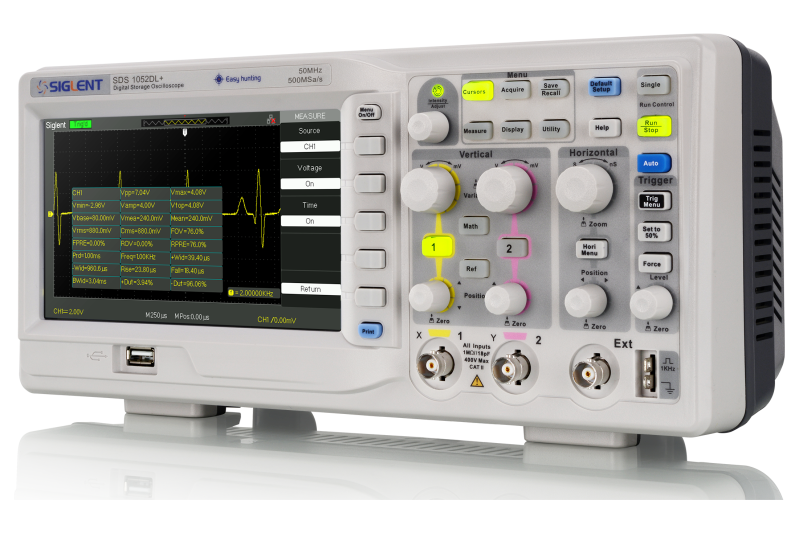
Thirty-two measurements, read rather than counted
Voltage parameters — maximum, minimum, peak-to-peak, amplitude, top, base, mean, cycle mean, RMS, cycle RMS and the four overshoot figures. Timing parameters — period, frequency, positive and negative width, rise and fall time, burst width and both duty cycles. And ten channel-to-channel delay measurements, from simple phase to first-rising-to-last-falling edge.
Five can sit permanently beside the waveform, or the whole table can be called up at once as in the photograph. Cursors work in manual, track and auto modes, and a 6-digit hardware frequency counter runs independently with 1 Hz resolution.
In a teaching laboratory this is the feature that matters most: a student reads a number and compares it with a calculation, rather than counting divisions and making arithmetic errors that have nothing to do with the exercise.
Zoom, without losing your place
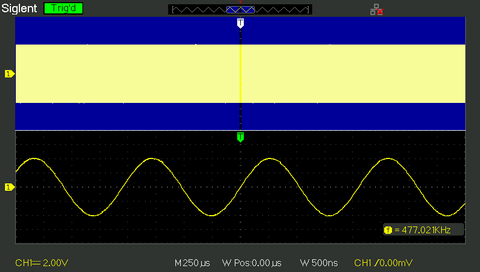
The upper window keeps the entire acquisition with the selected portion highlighted; the lower one expands just that portion. In the capture beside this text the main timebase is 250 µs per division and the zoom window is showing a 500 ns slice of it — and the relationship between the two stays visible the whole time.
This matters more on an instrument with 32 kpts than on one with megapoints of memory. The record here is short, so the way you work is to trigger reliably on a repetitive signal and then expand the part that interests you — rather than capturing a long window and hunting through it afterwards. Within that way of working, zoom does the job well.
If your signals are not repetitive, or you need to capture a long stretch and find a short event inside it, that is the honest limit of this model and the reason the alternatives table further down exists.
Full specifications
From the SDS1000DL+/CML+ data sheet, DS0101A-E03A. Every figure below is the SDS1052DL+ column.
Why you will see “1 GSa/s” and “2 Mpts” quoted for this instrument. Siglent publish one data sheet for the SDS1000DL+ and SDS1000CML+ together, and its front page leads with the best figures in the document. Those belong to the CML+ models. This instrument samples at 500 MSa/s with 32 kpts of record, and has no long-memory mode. Where you see 30 kpts quoted, that is also wrong — the data sheet says 32.
| Model | SDS1052DL+ — the only SDS1000DL+ model in the European price list |
| Bandwidth (−3 dB) | 50 MHz |
| Channels | 2, plus an external trigger input |
| Real-time sample rate | 500 MSa/s |
| Equivalent-time sample rate | Up to 50 GSa/s, on repetitive signals only |
| Record length | 32 kpts — there is no long-memory mode on this model |
| Vertical resolution | 8-bit |
| Vertical scale | 2 mV/div to 10 V/div in 1-2-5 steps (probe 1×) |
| Offset range | ±1.6 V from 2 mV/div to 200 mV/div · ±40 V from 206 mV/div to 10 V/div |
| Input | 1 MΩ ±2% in parallel with 18 pF ±3 pF · DC, AC and GND coupling · max. 400 V · channel isolation >100:1 |
| Probe attenuation | 1×, 10×, 50×, 100×, 500×, 1000× |
| DC gain accuracy | ±3.0% from 5 mV/div to 10 V/div · ±4.0% at 2 mV/div |
| Rise time (typical) | 7.0 ns |
| Bandwidth limit | 20 MHz |
| Acquisition modes | Normal, peak detect, average (4 to 256) · Sin(x)/x interpolation · software digital filter |
| Timebase | 5 ns/div to 50 s/div · accuracy ±50 ppm · scan mode 100 ms/div to 50 s/div · channel skew <500 ps |
| Display formats | Y-T, X-Y and scan |
| Trigger types | Edge, pulse, video (NTSC, PAL/SECAM), slope, alternate |
| Trigger sources | CH1, CH2, EXT, EXT÷5, AC line · coupling AC, DC, LF reject, HF reject · holdoff 100 ns to 1.5 s |
| Trigger sensitivity | 1 division from DC to 10 MHz · 1.5 divisions from 10 MHz to full bandwidth |
| Measurements | 32 parameters — voltage, timing and channel-to-channel delay · five displayed at once, or all together |
| Cursors | Manual, track and auto |
| Counter | 6-digit hardware frequency counter, 1 Hz resolution |
| Maths | +, −, ×, ÷, FFT · FFT windows: rectangular, Blackman, Hanning, Hamming · full-screen or split display |
| Recorder | Continuous waveform recorder with 7 M of recorder memory, to internal storage or a USB stick |
| Pass/fail | Mask comparison against a user-defined template, 3.3 V TTL output |
| Save / recall | 2 reference traces, 20 setups and 10 waveforms internally · setups, waveforms, BMP and CSV to a USB stick |
| Display | 7-inch TFT-LCD, 800 × 480, 24-bit colour, 500:1, 300 nit · 8 × 16 divisions · persistence off, 1 s, 2 s, 5 s or infinite |
| I/O | USB host (front) · USB device, USB-TMC (rear) · LAN with VXI-11 · pass/fail output |
| Remote control | Standard SCPI command set over LAN and USB-TMC |
| Languages | Twelve, including English, German, French, Italian, Spanish, Portuguese, Russian, Arabic, Japanese, Korean and Chinese · embedded on-screen help |
| Power | 100–240 V 50/60 Hz or 100–120 V 400 Hz · 50 W max per the data sheet; the instrument’s own rating plate reads 30 W max |
| Dimensions | 323.1 × 135.6 × 157 mm (L × W × H) |
| Weight | 2.5 kg net · 3.5 kg packed |
| Environment | 10 to +40 °C operating, −20 to +60 °C storage · 85% RH · to 3,000 m |
Software, PC tools and automation
A LAN port with VXI-11 and a USB device port with USB-TMC are standard, and the instrument answers the standard SCPI command set — so it drops into an existing test framework rather than having to be driven by hand. That is not a given at this price.
EasyScopeX provides a remote front panel, screen capture and waveform and setup transfer from a PC, and a LabVIEW driver is published for the family. Both are in the downloads below, together with the note on reading the instrument’s binary waveform files if you post-process captures yourself.
The pass/fail output is a 3.3 V TTL line driven by the hardware mask comparator, which is what makes a simple automated go/no-go check possible on an instrument in this class.
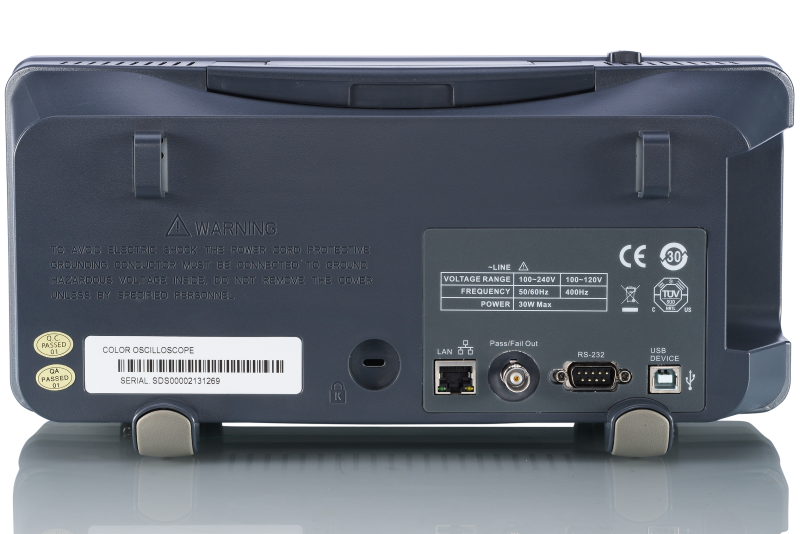
About the 9-pin connector in the photograph. Some units carry a DB9 on the rear panel, but neither the data sheet nor the user manual lists RS-232 as a supported interface for this model — both document only USB host, USB device, LAN and the pass/fail output. If you need serial control, ask us first rather than planning around it.
What is in the box
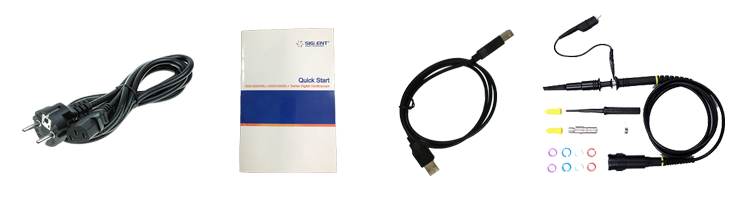
Two probes, one per channel, each with its accessory kit — ready to work out of the carton.
| Item | Qty |
|---|---|
| SDS1052DL+ oscilloscope | 1 |
| PB470 passive probes — 70 MHz, 1×/10×, 150 V / 300 V RMS CAT II, each with its accessory kit | 2 |
| Power cord | 1 |
| USB cable, type A to type B | 1 |
| Quick start guide, printed | 1 |
| Certificate of conformance | 1 |
Accessories
There are no options for this model
No serial decoding licence, no logic module, no signal generator, no bandwidth or memory upgrade. Nothing can be unlocked or fitted after purchase — what is in the box is what the instrument will always be. That is simply what an oscilloscope at this price is, but it should be a conscious decision rather than a surprise.
There is also no rack kit for this chassis. The SDS1X-E-RMK is specified for the SDS1000X-E, SDS1000X-U, SDS2000X-E and SDS800X HD, and this instrument is a physically different size at 323 × 136 × 157 mm.
These are the physical accessories that do fit it. Prices exclude VAT.
| Code | What it is | Price |
|---|---|---|
| BAG-S1 | Soft carry case. Siglent’s price list names the SDS1000DL+/CML+ series for this case explicitly. | €59 |
| PB470 | Spare or extra 70 MHz 1×/10× passive probe — the one supplied with this instrument. | €16 |
| PAK1 | Probe accessory kit — tips, sprung hooks, ground leads and colour rings for the PB470 and the other Siglent passive probes. | €8 |
| STB-3 | Demonstration and training board — square, sine, AM, fast edge, PWM, I²C, CAN and LIN sources. The natural companion in a teaching laboratory. | €189 |
| ISFEOUT OF STOCK | Isolated front end — two isolated channels, ±600 Vpk, floating to 1000 Vrms from earth and 2000 Vrms between the two, USB powered. ⚠ 1 MHz bandwidth: it buys isolation, not speed. | €121 |
| DPB5150 | 70 MHz differential high-voltage probe, 1500 V, 50×/500× — for the floating measurements the scope inputs cannot make on their own. | €825 |
| CP4020 | AC/DC current clamp, 60 A peak, 200 kHz — read current without breaking the circuit. | €409 |
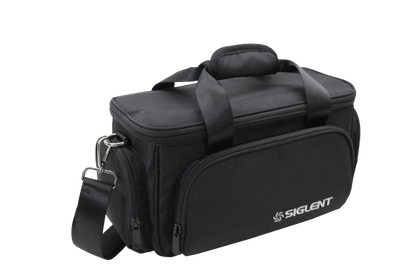
BAG-S1 carry case
Padded soft case for the instrument, its two probes and its leads. Named by Siglent for this series.
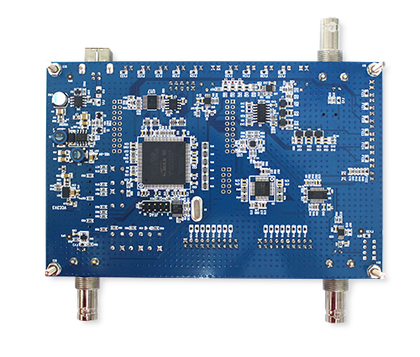
STB-3 demo and training board
Known-good square, sine, AM, fast-edge, PWM, I²C, CAN and LIN signals — for teaching, and for proving an instrument is behaving.
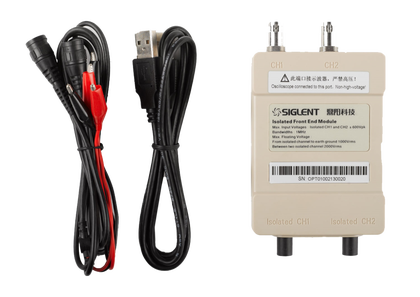
ISFE isolated front end
Two isolated channels, ±600 Vpk, floating to 1000 Vrms — but only 1 MHz of bandwidth. Currently out of stock; ask us for the lead time.
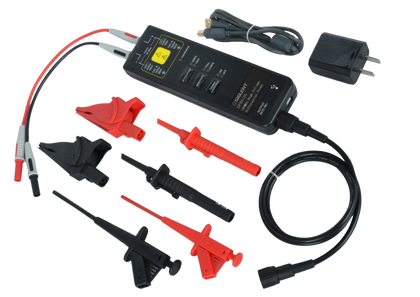
Differential high-voltage probes
For gate drives, DC buses and mains-referenced circuits — measurements the 400 V inputs cannot make on their own.
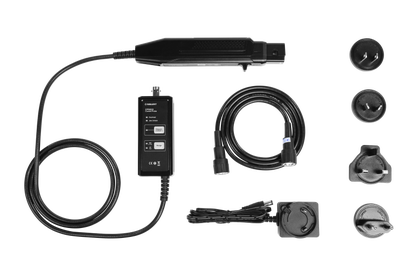
Current probes
Clamp round a conductor and read amps without breaking the circuit. CP4000 and CP5000 series, 60 A to 500 A.
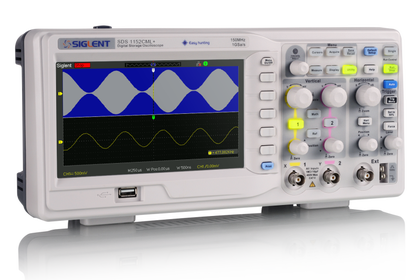
SDS1000CML+ series
Same chassis, same menus, same manual. The SDS1102CML+ is €13 more than this instrument, with 100 MHz, 1 GSa/s and 2 Mpts. In stock.
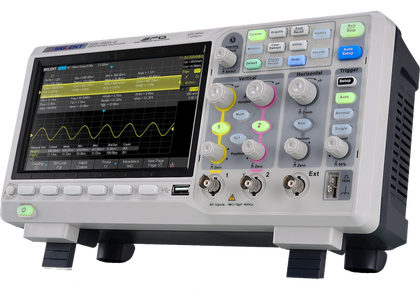
SDS1202X-E
A generation newer: 200 MHz, 14 Mpts, 400,000 wfm/s and I²C, SPI, UART, CAN and LIN decoding included.
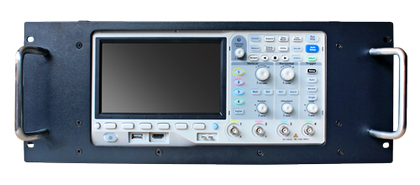
Probes and accessories
The full range of passive, differential, current and high-voltage probes for Siglent oscilloscopes.
Related and alternative models
The next two rungs cost very little more, so they are worth a moment before you order. Prices exclude VAT; all three are in stock.
| Model | BW | Sample rate | Record | What it adds | Price |
|---|---|---|---|---|---|
| SDS1052DL+THIS PAGE | 50 MHz | 500 MSa/s | 32 kpts | The lowest entry price Siglent offer. No decoding, and no options exist. | €277 |
| SDS1102CML+ | 100 MHz | 1 GSa/s | 2 Mpts | Same chassis and menus. Double the bandwidth and sample rate, 64× the record length, for €13. | €290 |
| SDS1202X-E | 200 MHz | 1 GSa/s | 14 Mpts | A generation newer. 400,000 wfm/s, 38 measurements, 1 Mpts FFT, and I²C, SPI, UART, CAN and LIN decoding included. | €339 |
The honest summary: €13 moves you to the SDS1102CML+ — the same chassis and menus, with double the bandwidth and sample rate and sixty-four times the record length. For most buyers that is the better instrument. Choose the SDS1052DL+ when the budget line genuinely will not stretch, when you are matching an existing fleet, or when your work is audio, mains-frequency or power electronics where 50 MHz was never going to be the limit. And if you will ever look at a serial bus, go straight to the SDS1202X-E.
Manuals and downloads
Everything Siglent publish for this model. These links go to the factory download service, which always serves the current revision, so a bookmark here does not go stale when a document is reissued. The data sheet, user manual and quick start guide are shared with the SDS1000CML+ — that is correct, not a mislabelled file. The firmware is not shared.
Covers the SDS1000DL+ and SDS1000CML+ together. ⚠ Its headline “1 GSa/s” and “2 Mpts” are the CML+ figures — read the SDS1052DL+ column.
Also shared with the SDS1000CML+. Every function menu by menu, including the recorder, the pass/fail mask and the digital filter.
Unpacking, first power-up, the front and rear panel layout and the safety notes.
The SCPI command set for the SDS1000, SDS2000X and SDS2000X-E families.
The SDS1000CML+ / DL+ Schnellstart, in German.
The binary waveform file format, for post-processing captures on a computer.
Specifications for the whole Siglent probe range, including the supplied PB470.
Which probe ships with which oscilloscope, as published by the factory.
Licences for the open-source components used in the instrument firmware.
Firmware and software
⚠ DL+ firmware only. The SDS1000CML+ image (V6.01.01.xx) is a different build and must not be installed here, even though the two share their manual.
The PC application: remote front panel, screen capture, waveform and setup transfer.
Instrument driver for the SDS1000, SDS2000X and SDS2000X-E families.
Older revisions and documents for every other Siglent instrument are on our downloads page, searchable by model number.
All downloadsQuestions we are asked
What does it really sample at, and how much memory has it?
500 MSa/s in real time, with 32 kpts of record. This is worth saying plainly because the data sheet is shared with the SDS1000CML+ models and its front page leads with “up to 1 GSa/s” and “up to 2 Mpts” — both of which are CML+ figures. Read the SDS1052DL+ column of the model table. On repetitive signals the equivalent-time mode reaches 50 GSa/s, but that only works on a signal that genuinely repeats.
Should I spend €13 more on the SDS1102CML+?
For most people, yes, and we would rather say so than sell the wrong instrument. It is the same chassis with the same menus, the same manual and the same case, and it gives 100 MHz instead of 50, 1 GSa/s instead of 500 MSa/s and 2 Mpts instead of 32 kpts. Buy this one when the budget line genuinely will not stretch, when you are matching an existing fleet of them, or when your signals are audio, mains-frequency or power work where 50 MHz was never the limit.
Does it decode serial buses?
No, and no option adds it. If you work on I²C, SPI, UART, CAN or LIN, the instrument to buy is the SDS1202X-E, where all five are standard.
Can I add memory, bandwidth or software options later?
No. There are no licences, no upgrades and no expansion modules for this model. What is in the box is what it will always be. That is not a criticism — it is simply what a €277 oscilloscope is — but it should be a conscious decision when you order.
Is 32 kpts enough?
It depends on how long a window you need. 32 kpts at 500 MSa/s is about 65 µs of record at full rate, so it suits repetitive signals you can trigger on reliably. It is the first thing you will run out of if you need to capture a long stretch and then zoom into a short event inside it — and that is exactly what the step up to the SDS1102CML+, with sixty-four times the record, is for.
Can I control it from a script?
Yes. It has a LAN port with VXI-11 and a USB device port with USB-TMC, and it answers the standard SCPI command set, so it drops into a test framework like any other instrument. EasyScopeX and a LabVIEW driver are in the downloads below.
There is a 9-pin connector on the back — is that a serial port?
Ask us before you rely on it. Some units carry a DB9 on the rear panel, but neither the data sheet nor the user manual lists RS-232 as a supported interface for this model — both document only USB host, USB device, LAN and the pass/fail output. We would rather tell you that than let you plan a serial installation around a connector we cannot confirm.
Is there a rack kit for it?
No. The SDS1X-E-RMK is specified for the SDS1000X-E, SDS1000X-U, SDS2000X-E and SDS800X HD, and this is a physically different chassis at 323 × 136 × 157 mm. If the instrument has to live in a rack, start from a model the kit actually fits.
How high a voltage can I measure?
The inputs are rated 400 V and the supplied PB470 probes are 150 V / 300 V RMS CAT II. Beyond that you need a differential probe such as the DPB5150. Never put a mains-referenced circuit directly on a scope input — both probe grounds are joined inside the instrument, so the earth lead becomes a short circuit.
Is it still supported, and what warranty does it carry?
It is in the current Siglent European price list, we hold stock, and firmware is still published — the most recent SDS1000DL+ build is V6.02.01.13. It carries three years of manufacturer warranty, handled by us in the Netherlands as the official Siglent distributor for the European Union, and we can supply it with an ISO or DKD/DAkkS calibration certificate — often worth doing on a teaching instrument that has to be demonstrably traceable.
Calibration, warranty and support
Three years of manufacturer warranty, handled by JRSE B.V. in Helmond, the Netherlands — the official Siglent distributor for the European Union. We hold EU stock and can supply this instrument with an ISO or DKD/DAkkS calibration certificate, which is often worth having on teaching equipment that must be demonstrably traceable. Buying several for a laboratory? Ask us for a quotation and we will tell you honestly which model in the range fits what your students will measure.
Specifications on this page are taken from Siglent’s official SDS1000DL+/CML+ data sheet (DS0101A-E03A) and the shared user manual (UM0101A-E01B), and are published for guidance only. They are subject to change without notice, and errors and omissions are excepted. The manufacturer’s current data sheet is the definitive reference.