

Siglent SNA6000-MT material measurement option (software)
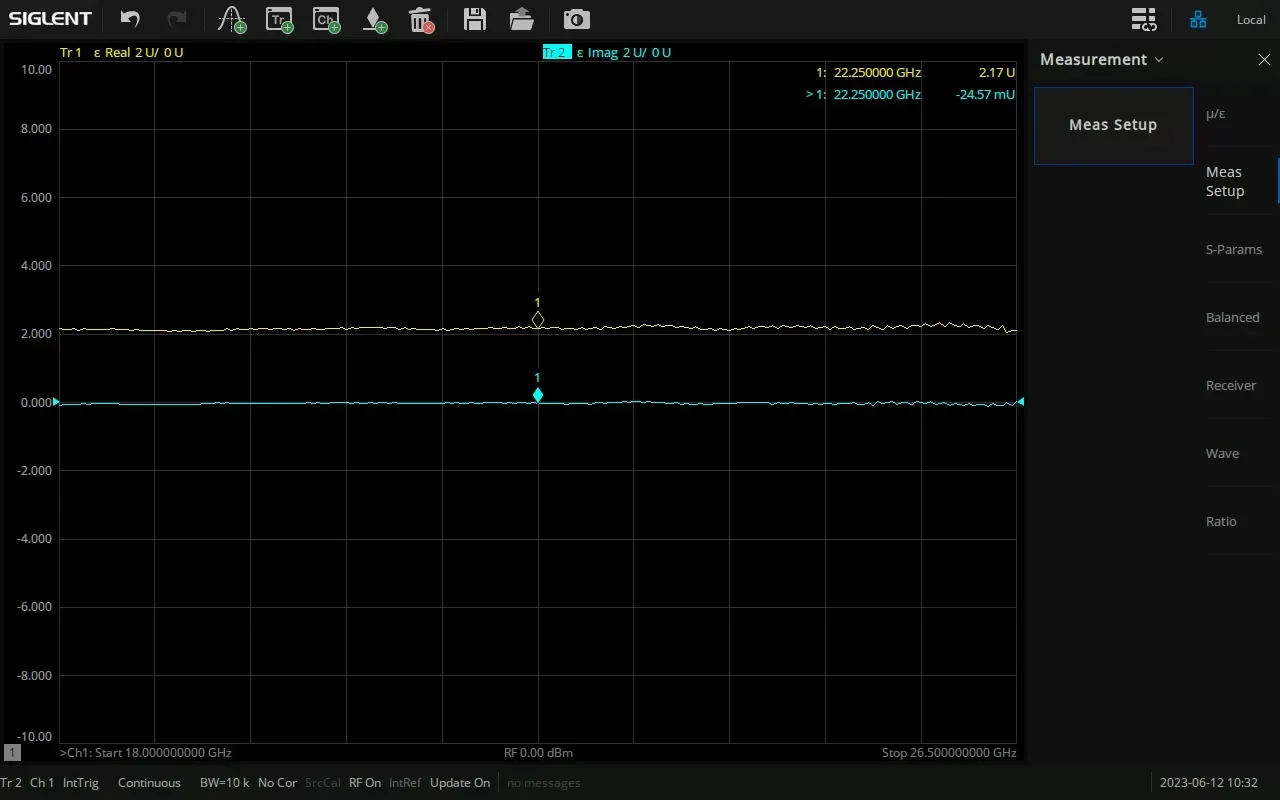
Permittivity and permeability measurement for the SNA6000A: NRW, NIST precision and fast models, waveguide TRL calibration, K-band with KWR42A.
SNA6000-MT — material measurement
Material measurement for the SNA6000A: complex permittivity and permeability of samples in a K-band waveguide holder, with waveguide TRL calibration. Requires the KWR42A kit.
Substrates, radomes, absorbers and plastics behave differently at 24 GHz than their data sheet says at 1 or 10 GHz. This option places a machined sample in a waveguide holder between two waveguide-to-coax adapters, measures all four S-parameters, and calculates complex relative permittivity and permeability across the band — with a choice of algorithm for magnetic, non-magnetic and fast measurements.
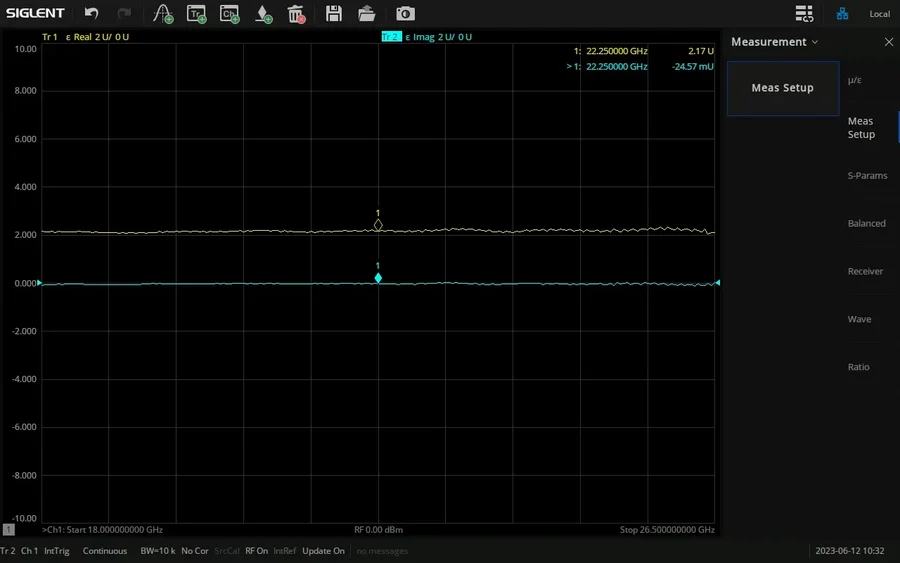
What this option does
What it does
Sets up the waveguide from a lookup table, calibrates with waveguide TRL, and calculates ε and μ with the NRW, NIST precision or fast model, forward, reverse or averaged, with sample-holder and air-gap corrections.
What you use it for
Characterising PCB laminates, radome and housing plastics, absorbers and ferrite-loaded materials at the frequencies they are used at, for design data and incoming inspection.
In practice
A radome supplier changes resin. A sample cut to the waveguide shows the permittivity has risen at 24 GHz — enough to detune the antenna behind it — before a single radome is moulded.
⚠ Requires the KWR42A K-band waveguide calibration kit (18–26.5 GHz), so in practice a 26.5 GHz model: SNA6032A, SNA6034A, SNA6132A or SNA6134A. The sample must be machined to fit the waveguide, with one face flush with the reference plane; an air-gap correction handles a sample thinner than the guide height.
From waveguide set-up to ε and μ
NRW model
Complex permittivity and permeability together — for magnetic materials; affected by half-wavelength resonance in the sample.
NIST precision model
Permittivity of non-magnetic materials, starting from your estimate.
Fast model
Non-iterative permittivity of non-magnetic materials for quick checks.
Calculation
Forward, reverse, or the average of both directions.
Waveguide lookup
Band, width, cut-off and operating range set in one step.
Sample holder
Holder length, distance to sample, sample thickness, waveguide width and cut-off.
Air-gap correction
Corrects for a sample smaller than the waveguide height.
Waveguide TRL
Thru, reflect (short) on each port and a quarter-wave line — no standard definitions needed.
Specification
From the SNA6000A data sheet and user manual.
| Results | Complex relative permittivity ε and permeability μ (real and imaginary) |
| Measurement models | Ref/Tran μ&ε (NRW) · Ref/Tran ε precision (NIST, non-magnetic) · Tran ε fast (non-iterative, non-magnetic) |
| Calculation | Average, forward only, reverse only |
| Sweep | Linear or log frequency; start, stop, points, IFBW, power |
| Sample holder | Holder length, distance to sample, sample thickness, waveguide, width, cut-off |
| Gap correction | Waveguide and sample height |
| Calibration | Waveguide TRL: thru, reflect (short) per port, quarter-wave line |
| Required kit | KWR42A K-band (WR-42) waveguide calibration kit, 18–26.5 GHz |
| Ports | Any two ports as forward and reverse |
Compatibility and activation
The KWR42A covers 18–26.5 GHz, so the option is for the four 26.5 GHz models. The 13.5 GHz models do not reach the band.
Supplied as a licence key issued against the analyser’s serial number — nothing to fit and nothing to return. Enter it under System → Options → License…, or load the .lic file from a USB stick. Ordered together with a new SNA6000A, Siglent activates it at the factory.
Questions about SNA6000-MT
Which SNA6000A models can use it?
In practice the 26.5 GHz models — SNA6032A, SNA6034A, SNA6132A and SNA6134A — because the required KWR42A kit covers 18 to 26.5 GHz.
Which model should I choose for my material?
Use NRW (μ&ε) for magnetic materials. For non-magnetic materials, NIST precision avoids the errors NRW shows near half-wavelength resonance in the sample; the fast model gives a quick non-iterative result.
Why TRL calibration?
The measurement plane is inside waveguide adapters, where coaxial standards do not fit. TRL needs only a thru, a reflect and a line, and does not depend on precisely defined standards.
How must the sample be prepared?
Cut to fill the waveguide cross-section, with one face flush with the reference plane. If it is thinner than the guide height, enter both heights and switch on gap correction.
Can I measure in other waveguide bands?
The software has a waveguide lookup table, but Siglent lists only the KWR42A kit for this option. For other bands, ask us.
How is the licence delivered?
Supplied as a licence key issued against the analyser’s serial number — nothing to fit and nothing to return. Enter it under System → Options → License…, or load the .lic file from a USB stick. Ordered together with a new SNA6000A, Siglent activates it at the factory. Add the analyser’s serial number to your order, or send it to us afterwards.
Can I return a licence?
Software licences and activation keys are delivered electronically and are excluded from the 14-day EU return right once the key has been issued. If you are unsure, ask us first.
Planning an SNA6000A measurement?
Tell us the device, the frequency range and what you need to measure. We will confirm the model, the options and the calibration you need before you order.