

Siglent SSA3000XR-AMK Advanced Measurement Kit (software)

Siglent SSA3000XR-AMK Measurement license option adds channel power, ACPR, occupied bandwidth, T-Power, C/N, harmonics with THD, TOI and spectrum monitor. Activated by licence key.
SSA3000XR-AMK — Advanced Measurement Kit
Eight guided transmitter measurements for the SSA3000X-R: channel power, ACPR, occupied bandwidth, time-domain power, carrier-to-noise, harmonics, TOI and a spectrum monitor.
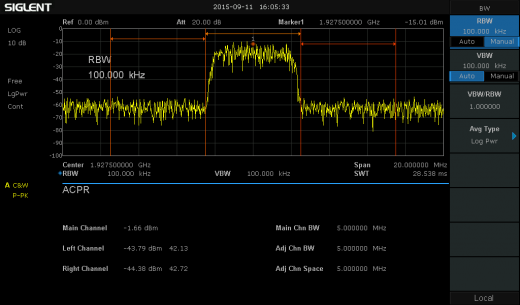
Without this kit, a channel-power or adjacent-channel result is something you build from markers and arithmetic — and two engineers build it two different ways. With it, each measurement has its own set-up: you enter the channel bandwidth, the spacing or the carrier and noise bandwidths once, and the analyser integrates the power and prints the result below the trace. The same set-up gives the same number on the tenth unit as on the first.
What this option does
What it does
Adds eight measurements to spectrum analyser mode. Each integrates power over bandwidths you define and reads out the answer: channel power and density, adjacent-channel ratios in dBc, occupied bandwidth and frequency error, zero-span power, C/N, up to ten harmonics with THD, the third-order intercept, and a waterfall of successive sweeps.
What you use it for
Transmitter and amplifier verification: does the radio stay inside its channel, how much leaks next door, is the carrier where it should be, how clean is the output, and how linear is the amplifier. These are the numbers that go into a test report.
In practice
An 868 MHz ISM module must not spill into the neighbouring channel. Set the main and adjacent channel bandwidth and spacing once, save the state, and ACPR returns the lower and upper ratio in dBc for every board on the line — measured the same way each time, not by where somebody put a marker.
The kit measures what reaches the input, so two measurements need the right set-up. TOI needs two tones at the input — two signal generators and a combiner. Harmonics needs a fundamental above −50 dBm, otherwise Siglent marks the result invalid. The measurements run in spectrum analyser mode; for wideband or bursty signals, see real-time mode and SSA3000XR-RT40.
The eight measurements
What each one returns and what you set, from the SSA3000X-R user manual.
Channel power
Channel power, and power spectral density in dBm/Hz
Integration bandwidth 100 Hz to span; “span power” integrates the whole span
ACPR — adjacent channel power
Main channel power; lower and upper channel power, each also in dBc
Main channel bandwidth, adjacent channel bandwidth, channel spacing
OBW — occupied bandwidth
Occupied bandwidth and transmit frequency error
Power ratio of the signal to be contained
T-Power — time-domain power
Peak, average or RMS power in zero span
Start and stop line in time
CNR — carrier-to-noise
C/N ratio, carrier power, noise power
Carrier bandwidth, noise bandwidth, frequency offset
Harmonics
Amplitude of each harmonic up to the 10th, and total harmonic distortion
Fundamental found automatically or entered; 2 to 10 harmonics; zero-span view per harmonic
TOI — third-order intercept
Third-order products of two tones and the intercept point
Fully automatic, no parameters
Spectrum monitor
Successive sweeps as a colour waterfall
Start, pause and restart
Compatibility and activation
Supplied as a licence key issued against the instrument’s serial number. There is no hardware to fit and nothing to return: the key is entered under System → System Info → Load Option, and the measurements appear under the Meas key.
The SSA3000X and SSA3000X Plus use their own kits: AMK-SSA3000X and SSA3000X Plus-AMK.
Goes with
Questions about SSA3000XR-AMK
What does the kit add that markers cannot do?
Repeatability and integration. Channel power, ACPR and C/N integrate power over a defined bandwidth rather than reading one trace point, and the set-up is stored, so every unit is measured the same way. Harmonics and TOI find the products and do the arithmetic for you.
Is “T-Power” the total power in the span?
No. T-Power switches the analyser to zero span and measures power over time, between a start and a stop line — as peak, average or RMS. For the power in a band, use channel power with “span power”.
Are there presets for LTE, Wi-Fi or other standards?
The user manual describes the measurements with bandwidths and spacing that you set yourself, so you enter the values your standard specifies and save the instrument state for next time.
What do I need for a TOI measurement?
Two closely spaced tones of equal level at the input of the device under test, usually from two signal generators through a combiner. The analyser then finds the third-order products and calculates the intercept automatically.
Can I automate it?
Yes. The programming guide lists SCPI commands to select each measurement (ACPR, channel power, OBW, T-Power, spectrum monitor, TOI, harmonics and CNR), set it up and read the results.
Does it work on every SSA3000X-R?
Yes — the SSA3032X-R, SSA3050X-R and SSA3075X-R. The key is tied to one instrument’s serial number.
I have an SSA3000X or SSA3000X Plus.
Those series have their own measurement kits: AMK-SSA3000X and SSA3000X Plus-AMK. This key is for the SSA3000X-R only.
How is the licence delivered?
Supplied as a licence key issued against the instrument’s serial number. There is no hardware to fit and nothing to return: the key is entered under System → System Info → Load Option, and the measurements appear under the Meas key. Add the instrument’s serial number to your order, or send it to us afterwards — the key is issued against it.
Can I return a licence?
Software licences and activation keys are delivered electronically and are excluded from the 14-day EU return right once the key has been issued. If you are unsure, ask us first.
Setting up a transmitter test?
Tell us the signal and the standard it has to meet. We will tell you which measurements cover it and how to set them up on the SSA3000X-R.