

Siglent SSA3000XR-EMI EMI pre-compliance measurement option (software)

Siglent SSA3000XR-EMI EMI pre-compliance for the SSA3000X-R series: CISPR 16-1-1 filters 200 Hz to 1 MHz, quasi-peak and average detectors, scan-search-measure and EN55/FCC limits.
SSA3000XR-EMI — EMI measurement mode
EMI pre-compliance mode for the SSA3000X-R: CISPR 16-1-1 filters, peak, average and quasi-peak detectors, and a scan – search – measure sequence against standard limits.
Adds a dedicated EMI measurement mode to the SSA3000X-R real-time spectrum analysers. It follows the test flow recommended by CISPR 16-2-3: scan the band with up to three detectors at once, search the result for peaks, then re-measure each suspect frequency in zero span with the quasi-peak and average dwell that a compliance measurement uses — and compare everything against the limit lines of the standard you are designing to.
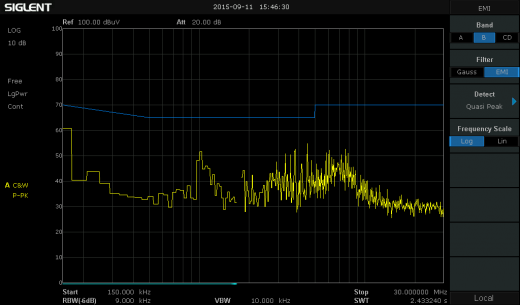
What this option does
What it does
Brings the four CISPR 16-1-1 EMI filters (200 Hz, 9 kHz, 120 kHz and 1 MHz at −6 dB), peak, voltage-average and quasi-peak detection, and a measurement view with a frequency scan, three meters and a signal list. Scan, peak search and final measurement run as one sequence or step by step, and each signal in the list is updated with its detector readings and distance to the limit.
What you use it for
Finding and fixing conducted and radiated emission problems on your own bench before a product goes to an accredited EMC laboratory. A failed formal test costs the retest fee and the schedule; a pre-compliance scan that shows the problem early costs neither.
In practice
A switch-mode supply fails conducted emissions around 150 kHz at the test house. On the bench, a CISPR Band B scan with a limit line and margin shows the same peaks in minutes; the final measurement confirms the quasi-peak level at each one. A changed filter capacitor, one more scan, and the margin is visible before the laboratory is booked again.
This is pre-compliance, not certification. For conducted emissions you also need a line impedance stabilisation network (LISN) — and a transient limiter in front of the analyser input is standard practice. For radiated work you need an antenna, or near-field probes such as the SRF5030T to locate the source on the board.
How a pre-compliance run works
The sequence follows the EMI test flow recommended by CISPR 16-2-3. Run it in one go, or only the step you need.
1 · Scan
The analyser sweeps the band you set, or a CISPR preset, with up to three traces running different detectors. Limit lines and a margin are drawn over the result.
2 · Search
Peaks above the threshold and excursion you choose are marked and collected into the signal list — the suspects worth a closer look.
3 · Measure
For each signal in the list the analyser tunes to its frequency in zero span, dwells with the final detectors and records the level and its distance to the limit.
Alongside the sequence, up to three meters show the live level at one frequency with their own detectors and dwell times — the quickest way to watch an emission move while you change the circuit.
Specification
From the SSA3000X-R data sheet and user manual.
| Measurement views | Frequency scan, meters, signal list |
| Pre-compliance sequence | Scan, search, measure — together or one step at a time |
| EMI filters (−6 dB) | 200 Hz, 9 kHz, 120 kHz, 1 MHz, following CISPR 16-1-1 · RBW uncertainty < 5 % |
| Detectors | Peak, voltage average, quasi-peak (following CISPR 16-1-1) |
| Traces and limits | 3 traces with independent detectors · 3 limit lines with pass/fail and a margin of 0 to −40 dB |
| Limit standards | EN 550xx, GB 9254, FCC Part 15, and user-defined |
| CISPR band presets | A 9–150 kHz · B 150 kHz–30 MHz · C 30–300 MHz · B&C 150 kHz–300 MHz · D 300 MHz–1 GHz |
| Dwell time | 0 µs to 10 s |
| Sweep resolution | RBW/step 0.1, 0.3, 0.5, 1, 2 or 3 |
| Corrections | 4 amplitude correction tables, for gains or losses of antennas, cables and other external devices |
| Units | dBm, dBmV, dBµV, dBµA, V, W |
| Attenuator | 0–50 dB |
| Frequency scale | Linear or logarithmic |
| Report | Signal list with detector values and limit deltas |
| Remote control | Full SCPI command set for scan, sequence, meters, signal list and limit test |
| PC software | EMI receiver mode in EasySpectrum: pre-scan, peak search, final scan and report |
Compatibility and activation
Supplied as a licence key issued against the instrument’s serial number. There is no hardware to fit and nothing to return: the key is entered under System → System Info → Load Option and EMI mode appears in the Mode menu straight away.
The SSA3000X and SSA3000X Plus use their own EMI keys: EMI-SSA3000X and SSA3000XP-EMI.
Questions about SSA3000XR-EMI
Does this replace a test at an accredited EMC laboratory?
No. It is pre-compliance: the CISPR 16-1-1 filters and detectors make your bench results comparable with a formal measurement, so you arrive at the laboratory knowing where you stand. Certification still needs an accredited test set-up.
What else do I need for conducted emissions?
A line impedance stabilisation network (LISN) between the supply and the device under test, and — as standard practice — a transient limiter in front of the analyser input to protect it from switching spikes. Losses of the LISN and cables can be compensated with the amplitude correction tables.
And for radiated emissions?
An antenna with its antenna factor entered as a correction table, or near-field probes to find where on the board an emission comes from. The SRF5030T set is the one Siglent lists alongside this option.
Which limit lines are built in?
EN 550xx, GB 9254 and FCC Part 15, plus user-defined limits. Up to three limit lines can be active, each with its own margin, and the result is shown as pass, fail or fail margin.
Does it work on every SSA3000X-R?
Yes — the SSA3032X-R, SSA3050X-R and SSA3075X-R. The key is tied to one instrument’s serial number.
I have an SSA3000X or SSA3000X Plus, not an -R.
Those series have their own EMI keys: EMI-SSA3000X for the SSA3000X and SSA3000XP-EMI for the SSA3000X Plus. This key is for the SSA3000X-R only.
Can I automate the measurement or create a report?
Yes. The programming guide documents SCPI commands for the whole EMI mode — frequency range, sequence, meters, signal list and limit test. The free EasySpectrum PC software adds an EMI receiver mode with pre-scan, peak search, final scan and report generation.
How is the licence delivered?
Supplied as a licence key issued against the instrument’s serial number. There is no hardware to fit and nothing to return: the key is entered under System → System Info → Load Option and EMI mode appears in the Mode menu straight away. Add the instrument’s serial number to your order, or send it to us afterwards — the key is issued against it.
Can I return a licence?
Software licences and activation keys are delivered electronically and are excluded from the 14-day EU return right once the key has been issued. If you are unsure, ask us first.
Setting up EMI pre-compliance?
Tell us what you are testing and to which standard. We will confirm the option, the accessories and the set-up before you order.