

Siglent SSA3000XR-WDMA wideband digital modulation analysis option (software)
Siglent SSA3000XR-WDMA Measurement license option for digital modulation analysis for the SSA3000X-R: ASK, FSK, MSK, PSK and QAM to 256QAM with EVM, constellation and eye views, up to 40 MHz wide.
SSA3000XR-WDMA — digital modulation analysis
Vector analysis of digitally modulated signals on the SSA3000X-R: ASK, FSK, MSK, PSK, DPSK and QAM up to 256QAM, with EVM, constellation, eye diagrams and a decoded symbol table.
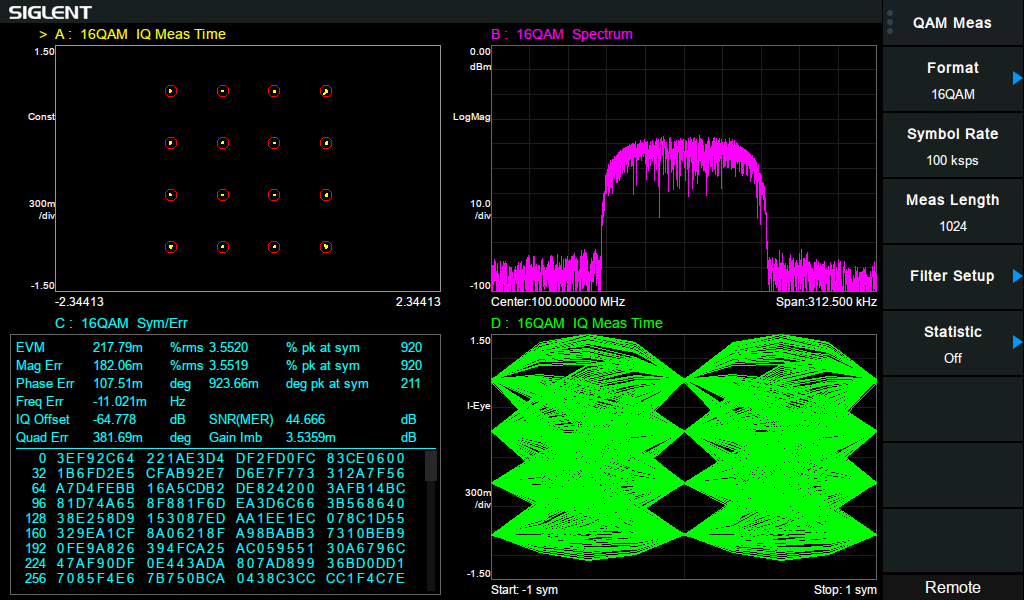
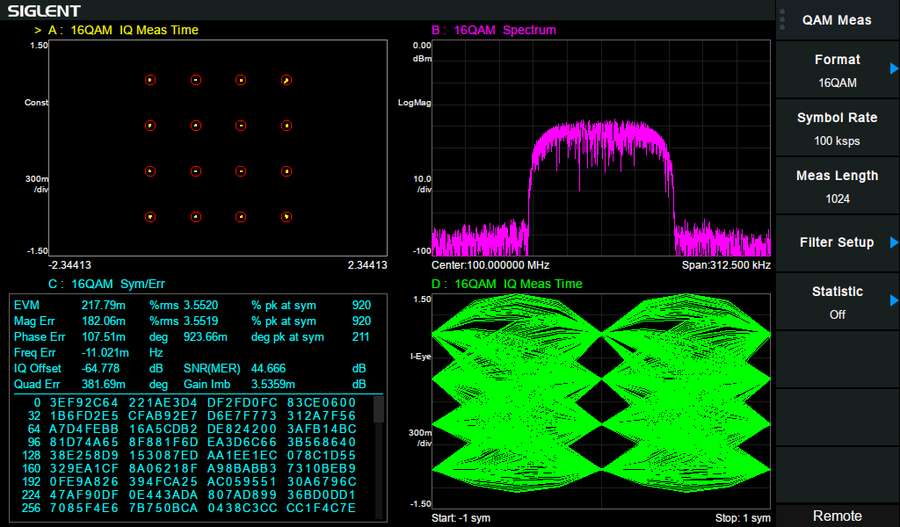
A spectrum view tells you a transmitter is on frequency and at the right power. It cannot tell you whether a receiver will decode it. This key adds the digital half of the modulation analyser: set the format, symbol rate and filter to match the transmitter, and the SSA3000X-R demodulates the signal and measures how far each symbol lands from where it should — EVM, magnitude and phase error, frequency error, I/Q offset and SNR. The analysis bandwidth follows the real-time bandwidth: 25 MHz as standard, 40 MHz with SSA3000XR-RT40.
What this option does
What it does
Demodulates ASK, 2/4/8/16FSK, GMSK, BPSK, QPSK, OQPSK, 8PSK, five DPSK variants and 16 to 256QAM. Up to four views at once — constellation, I/Q or eye diagrams, spectrum, error-vector traces and a symbol table — with averaging and max/min statistics on the results.
What you use it for
Finding why a digital link underperforms when its power and frequency look right: filter and modulator faults, I/Q imbalance, crystal and deviation errors in IoT and telemetry radios, and checking signal generators and modems against their specification.
In practice
A 2-FSK sensor at 868 MHz has poor range although its output power is correct. The FSK result shows the carrier offset well off channel and the deviation low — a crystal loading error on the latest board revision. A spectrum sweep shows a healthy-looking carrier and hides both.
Single-carrier formats only. Wi-Fi, LTE and 5G use OFDM, which is not among the formats — this option cannot demodulate them. Analysis starts at 2 MHz and the carrier must be between −30 and +20 dBm. For AM and FM, use SSA3000XR-AMA.
Formats and results
What each modulation family reports — the same values the programming guide returns over SCPI.
| Family | Variants | Results |
|---|---|---|
| ASK | 2ASK | ASK error rms and peak, ASK depth, carrier power, carrier offset |
| FSK | 2, 4, 8 and 16-level FSK | FSK error rms and peak, FSK deviation, carrier power, carrier offset |
| MSK | GMSK | EVM rms and peak, magnitude and phase error, frequency error, I/Q offset, SNR (MER), quadrature error |
| PSK | BPSK, QPSK, OQPSK, 8PSK | EVM rms and peak, magnitude and phase error, frequency error, I/Q offset, SNR (MER), quadrature error, gain imbalance |
| DPSK | DBPSK, DQPSK, D8PSK, π/4-DQPSK, π/8-D8PSK | As PSK |
| QAM | 16, 32, 64, 128 and 256QAM | As PSK |
Specification
From the SSA3000X-R data sheet, user manual and programming guide.
| Frequency range | 2 MHz to 3.2, 5.0 or 7.5 GHz, depending on the model |
| Analysis bandwidth | Equal to the real-time bandwidth: 25 MHz, or 40 MHz with SSA3000XR-RT40 |
| Carrier power | −30 to +20 dBm (nominal) · accuracy ±2 dB (nominal) |
| Symbol rate | 1 ksps to 25 Msps, with symbol rate × points per symbol ≤ 150 Msps (data sheet) |
| Points per symbol | 4, 6, 8, 10, 12, 14 or 16 |
| Measurement length | 16 to 4096 symbols |
| Measure / reference filter | Nyquist, root Nyquist, Gaussian, half sine, rectangular · length 2 to 128 · alpha 0.01 to 1, BT 0.01 to 10 |
| Presets | PDC, GSM, TETRA, DECT, PHS, NADC |
| Trace data | I/Q measured and reference (time and spectrum), time, spectrum, symbol error table, error vector (time and spectrum), I/Q magnitude and phase error |
| Trace formats | Log and linear magnitude, real, imaginary, I-Q, constellation, I-eye, Q-eye, wrapped and unwrapped phase, trellis eye |
| Layout | Up to 4 traces: single, stacked 2, grid 1+2, grid 2×2 |
| Statistics | Averaging over 1 to 1000 measurements; max and min |
| Recording | I/Q to PC, 60 MB (7.5 M sample pairs), for analysis and playback in EasyVSA, EasyIQ or an SSG5000X signal generator |
| Remote control | SCPI — :DDEMod:MODulation selects the format, :READ:DDEMod? returns the results |
Compatibility and activation
Supplied as a licence key issued against the instrument’s serial number. There is no hardware to fit and nothing to return: the key is entered under System → System Info → Load Option, and the digital formats appear in the modulation analyser’s Meas menu.
The SSA3000X Plus and SVA1000X use their own keys: SSA3000X Plus-DMA and SVA1000X-DMA.
Goes with
Questions about SSA3000XR-WDMA
Can it demodulate Wi-Fi, LTE or 5G?
No. Those standards use OFDM, which is not one of the supported formats. The option covers single-carrier ASK, FSK, MSK, PSK, DPSK and QAM.
What does “wideband” mean here?
The analysis bandwidth equals the real-time bandwidth of the SSA3000X-R: 25 MHz as standard, 40 MHz with SSA3000XR-RT40. Wider signals fit in one capture.
How high can the symbol rate go?
Siglent’s data sheet gives 1 ksps to 25 Msps, provided symbol rate times points per symbol stays at or below 150 Msps. The user manual quotes 2.5 Msps; if your signal is above that, ask us and we will confirm it before you order.
Are there presets for common standards?
Yes: PDC, GSM, TETRA, DECT, PHS and NADC set the format, symbol rate, filters and alpha or BT in one step. For anything else you enter those parameters to match the transmitter.
Why must the filter settings match the transmitter?
The analyser rebuilds the ideal signal from the demodulated symbols using the reference filter. If filter type, alpha or BT differ from the transmitter’s, the mismatch shows up as error that is not really there. Siglent’s rule: a root-Nyquist transmitter needs a root-Nyquist measure filter and a Nyquist reference filter.
Can I record a signal and analyse it later?
Yes. The modulation analyser records I/Q data to a PC for analysis and playback in Siglent’s EasyVSA software, or for replay from EasyIQ or an SSG5000X signal generator.
Does it work on every SSA3000X-R?
Yes — the SSA3032X-R, SSA3050X-R and SSA3075X-R. The key is tied to one instrument’s serial number.
I have an SSA3000X Plus or SVA1000X.
Those have their own keys: SSA3000X Plus-DMA and SVA1000X-DMA. This key is for the SSA3000X-R only.
How is the licence delivered?
Supplied as a licence key issued against the instrument’s serial number. There is no hardware to fit and nothing to return: the key is entered under System → System Info → Load Option, and the digital formats appear in the modulation analyser’s Meas menu. Add the instrument’s serial number to your order, or send it to us afterwards — the key is issued against it.
Can I return a licence?
Software licences and activation keys are delivered electronically and are excluded from the 14-day EU return right once the key has been issued. If you are unsure, ask us first.
Analysing a digital link?
Tell us the format, symbol rate and bandwidth of your signal. We will confirm it fits, and whether you also need the 40 MHz real-time key.