

Siglent SSA5000-EMI EMI measurement (software license)
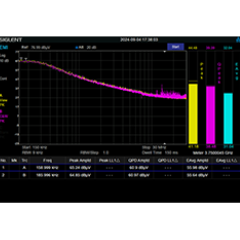
EMI pre-compliance for the Siglent SSA5000A: CISPR 16-1-1 bandwidths, quasi-peak detector, EN 550xx and FCC limit lines, scan-search-measure. Licence key.
SSA5000-EMI — EMI measurement
EMI pre-compliance mode for the SSA5000A: CISPR 16-1-1 bandwidths and quasi-peak detector, limit lines for EN 550xx and FCC Part 15, and a scan, search and measure sequence with a signal list.
A failed emission test at the test house costs the retest fee and weeks of schedule. Pre-compliance moves the first look to your own bench. This option adds the receiver functions an emission measurement is defined with — the −6 dB bandwidths and the quasi-peak and average detectors of CISPR 16-1-1 — and the workflow around them: scan the band, collect the peaks, re-measure each with the final detectors and compare with the limit.

What this option does
What it does
Adds an EMI receiver mode with frequency scan, three detector meters and a signal list; peak, quasi-peak and voltage-average detectors; EMI bandwidths of 200 Hz, 9 kHz, 120 kHz and 1 MHz; limit lines and correction tables for antennas, probes and cables.
What you use it for
Checking conducted and radiated emissions during development, finding the source of a failing frequency with near-field probes, and verifying a fix before the product goes back to the test laboratory.
In practice
A switching supply fails at 32 MHz at the test house. On the bench, the scan finds the same line; the quasi-peak meter stays on that frequency while a snubber is tried, and the margin to the limit line is read directly.
Pre-compliance, not a certified test. The bandwidths and detectors follow CISPR 16-1-1, but an accredited measurement also depends on the test site, the antennas or LISN, and a receiver with the dynamic range the standard requires. Use this option to arrive at the laboratory with margin. Transducers are not included: for locating sources, see the SRF5030T near-field probe set (300 kHz to 3 GHz).
Scan, search, measure
Scan
Sweep a CISPR band or your own range, with up to three traces and detectors at once, on a linear or logarithmic frequency axis.
Search
Peaks above a threshold and excursion go into the signal list.
Measure
Each listed signal is re-measured in zero span with the final detectors and dwell time, and compared with the limit.
Three meters
Peak, quasi-peak and average side by side at one frequency, each with its own dwell time and limit.
EMI bandwidths
200 Hz, 9 kHz, 120 kHz and 1 MHz at −6 dB, per CISPR 16-1-1.
Limit lines
EN 550xx, GB 9254 and FCC Part 15 built in, or your own, with a margin.
Corrections
Four correction tables for antenna factors, probes, cables and amplifiers.
Signal list
Sort by frequency, detector value or margin; mark, delete and re-measure single signals; the list is the report.
Specification
From the SSA5000A data sheet (EN02A) and user manual.
| Measurement views | Frequency scan, meter, signal list |
| Pre-compliance sequence | Scan, search, measure — together or one at a time |
| EMI filter bandwidth (−6 dB) | 200 Hz, 9 kHz, 120 kHz, 1 MHz (following CISPR 16-1-1) |
| RBW uncertainty | < 5 % (nominal) |
| Detectors | Peak, voltage average, quasi-peak (following CISPR 16-1-1) |
| Dwell time | 0 µs to 10 s |
| Scan step, as a fraction of RBW | 0.1, 0.3, 0.5, 1, 2, 3 |
| Corrections | 4 |
| Limits and traces | 3 |
| Limit standards | EN 550xx, GB 9254, FCC Part 15, user defined |
| Attenuator | 0 to 50 dB |
| Report | Signal list |
| Frequency scale | Linear, logarithmic |
Compatibility and activation
Listed for both models.
Supplied as a licence key issued against the analyser’s serial number — nothing to fit and nothing to return. Enter it under System → System → Load Option, or load the licence file from internal memory or a USB stick; the option is active after a restart.
Goes with
Questions about SSA5000-EMI
Does this make the analyser a compliant EMI receiver?
No. It gives you the CISPR bandwidths, detectors and limit lines for pre-compliance work. A compliance measurement is made by an accredited laboratory with a full-compliance receiver and a qualified test site.
Why does quasi-peak matter?
Most limits for emissions are quasi-peak and average limits. A peak scan is fast and always reads highest, so it finds the candidates; the quasi-peak and average readings decide whether they pass.
What else do I need?
A transducer: a LISN for conducted emissions, an antenna for radiated ones, or near-field probes for locating sources on a board. Their factors go into the correction tables.
Which frequency range does it cover?
The analyser’s own, from 9 kHz. The scan can follow the CISPR bands or a range you set.
Can I keep a record of the result?
Yes. The signal list holds frequency, the reading of each detector and the margin to the limit for every signal found.
How is the licence delivered?
Supplied as a licence key issued against the analyser’s serial number — nothing to fit and nothing to return. Enter it under System → System → Load Option, or load the licence file from internal memory or a USB stick; the option is active after a restart. Add the analyser’s serial number to your order, or send it to us afterwards.
Can I return a licence?
Software licences and activation keys are delivered electronically and are excluded from the 14-day EU return right once the key has been issued. If you are unsure, ask us first.
Planning an SSA5000A measurement?
Tell us the signal, the frequency range and what you need to measure. We will confirm the model and the options you need before you order.